


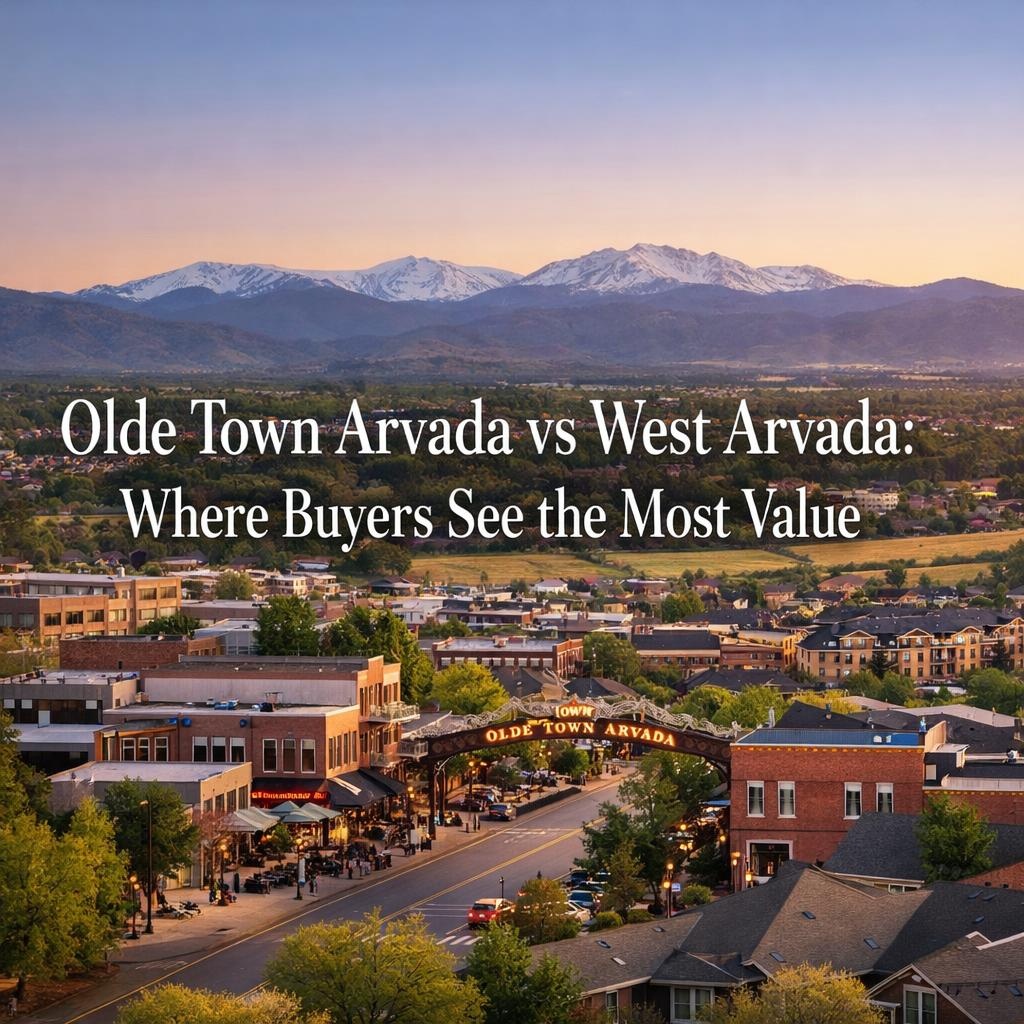
This guide is part of our Arvada Real Estate Guide→ [Arvada Real Estate Guide]
If you’ve worked with buyers across Arvada long enough, you start to see a consistent pattern: this decision is almost never about price—it’s about how value actually shows up after you’ve lived there for a year.
On paper, Olde Town and West Arvada can look comparable. Similar price bands. Same city. Same general access to Denver and the foothills. But in reality, they behave like completely different assets—both in how they live and how they perform over time.
And that gap becomes obvious once buyers move past the emotional phase and into real ownership.
This is where most people get it wrong. They evaluate:
→ charm vs space
But they should be evaluating:
→ liquidity, livability, and long-term flexibility
Because that’s ultimately what determines whether a home holds value—or becomes harder to exit later.
Olde Town Arvada: High Lifestyle Value, Narrower Buyer Pool
Olde Town is the emotional winner for most buyers.
It’s the historic core of Arvada, anchored by walkable streets, restaurants, and a strong sense of place.
There’s a reason it draws attention—it’s designed for experience.
And in the right scenario, it absolutely delivers.
Where Olde Town Wins
- Walkability to dining, shops, and commuter rail access
- Strong identity and neighborhood character
- Consistent demand from relocators and lifestyle buyers
- Smaller, more approachable price points in certain pockets
Homes here often sell steadily, supported by demand for proximity and lifestyle appeal .
Where Buyers Start to Hesitate (Year 2 Reality)
This is where I see the shift happen with clients:
- Parking becomes a daily friction point
- Lot sizes feel limiting over time
- Older homes require more ongoing maintenance
- Noise and density shift from “energy” to “constant”
None of these are dealbreakers—but they narrow the buyer pool on resale.
That’s exactly why what living in Denver is really like after the first year becomes a more accurate predictor of satisfaction than anything you feel during a showing.
Olde Town is a great fit for the right buyer. But it’s not a universally easy asset.
West Arvada: Lower Emotion, Stronger Long-Term Flexibility
West Arvada is the opposite dynamic.
It doesn’t win emotionally on day one—but it consistently wins over time.
You’re typically looking at:
- Larger homes (2,200–3,500+ sq ft)
- Attached garages
- Basements
- Usable yard space
That creates flexibility—not just for how you live, but for how future buyers evaluate the home.
Where West Arvada Wins
- More functional layouts for long-term living
- Better adaptability for families, remote work, and storage
- Easier parking and lower day-to-day friction
- Broader buyer appeal at resale
This is what I call a “calm asset”—and it ties directly into why calm feeling assets retain liquidity longer.
West Arvada homes don’t require explanation.
They just make sense.
Where It Falls Short
- Less walkability and immediate lifestyle access
- Longer drive times depending on location
- Less “charm factor” during showings
- Some areas with older systems and deferred maintenance
But here’s the key:
These aren’t emotional negatives—they’re positioning differences.
And positioning matters less than functionality when it comes to resale.
The Real Difference: Buyer Pool Size
This is where the decision becomes clear.
Olde Town:
→ Higher emotional appeal
→ Narrower buyer pool
West Arvada:
→ Lower initial emotion
→ Much broader buyer pool
And in real estate, broader buyer pool = stronger liquidity.
That’s not theory—that’s what shows up in how homes move, how long they sit, and how much negotiation happens.
It’s the same dynamic behind how days on market and inventory levels impact deal outcomes in Denver.
Commute, Daily Life, and Long-Term Satisfaction
One of the most underrated differences between these areas is how they impact daily life.
Olde Town:
- Easier access to transit (G-Line to Union Station)
- Better for hybrid or city-connected lifestyles
West Arvada:
- More driving-dependent
- Easier in-and-out logistics
- Less congestion and friction
And this is where decisions quietly change over time.
Because buyers don’t move because they hate their house—they move because daily life starts wearing on them.
That’s the exact pattern behind how commute and geography shape your daily life in Denver.
Investment Perspective: Which One Actually Holds Value Better?
If you’re looking purely at long-term performance, here’s how I break it down with clients:
Olde Town
- Strong during high-demand cycles
- Premium for lifestyle buyers
- More sensitive to market slowdowns
West Arvada
- More stable across cycles
- Broader resale demand
- Less dependent on perfect timing
Arvada overall continues to attract buyers due to relative affordability and access compared to other west-side markets .
But within Arvada, the performance difference comes down to:
→ how many buyers your home works for
That’s why understanding how long-term appreciation actually plays out in Denver real estate matters more than trying to time the market.
The Biggest Mistake Buyers Make Here
Most buyers choose based on:
- What feels exciting
- What looks best during showings
- What aligns with their current lifestyle
Very few choose based on:
- Future buyer behavior
- Liquidity under pressure
- Adaptability over time
That’s the gap.
And it’s exactly why how to identify opportunity vs risk in Denver listings becomes such a critical skill.
Because what feels like a “win” on day one doesn’t always translate into a win when you sell.
So Where Is the “Best Value”?
The honest answer:
👉 It depends on what you mean by value.
If value = lifestyle + walkability:
→ Olde Town wins
If value = flexibility + long-term liquidity:
→ West Arvada wins
But if you define value the way experienced buyers do:
→ “How easy will this be to sell in any market?”
Then West Arvada tends to come out ahead more consistently.
Final Take: This Is a Strategy Decision, Not a Preference Decision
Olde Town and West Arvada are both strong options—but they serve very different strategies.
Olde Town is a lifestyle-driven asset.
West Arvada is a stability-driven asset.
The mistake is thinking they’re interchangeable.
The buyers who make the best decisions here aren’t choosing what looks best.
They’re choosing what:
- Fits their actual daily life
- Holds up over time
- And stays easy to exit when needed
Because in Denver real estate, that’s where real value is created.


Littleton’s Ken Caryl for Lockheed Relocations
This is part of Lockheed Martin Relocation → [Lockheed Martin Relocation Hub] & the larger Denver Relocation Hub → [Denver Relocation Hub] Written by: Chad Cabalka Ken Caryl is one of the best-kept “family first” relocation options for Lockheed Martin employees who want foothills scenery, strong neighborhood appeal, and a real suburban lifestyle that still feels connected…

Centennial & Parker for Lockheed Relocations
This is part of Lockheed Martin Relocation → [Lockheed Martin Relocation Hub] & the larger Denver Relocation Hub → [Denver Relocation Hub] Written by: Chad Cabalka Centennial and Parker are two of the smartest suburban choices for Lockheed Martin employees relocating with families because they give you a strong balance of commute flexibility, good neighborhood variety, and…

Highlands Ranch for Family-Friendly Lockheed Relocations
This is part of Lockheed Martin Relocation → [Lockheed Martin Relocation Hub] & the larger Denver Relocation Hub → [Denver Relocation Hub] Written by: Chad Cabalka Highlands Ranch is one of the strongest choices for Lockheed Martin employees relocating with families because it delivers exactly what most parents want after a big move: stable neighborhoods, strong community…