


Centennial Lifestyle Guide — How Life in Centennial Actually Works
The Centennial Lifestyle Guide is a practical, real‑world resource designed to help residents, buyers, and long‑term planners understand what daily life in Centennial, Colorado actually looks like — across neighborhoods, routines, schools, amenities, movement patterns, and long‑term livability. This hub focuses on how people live in Centennial, not how they relocate to it.
Centennial is often described with simple labels — “great schools,” “near DTC,” “close to the Tech Center,” or “easy to get anywhere on E‑470” — but those descriptions flatten a city that functions very differently depending on where you live, how you commute, and how much of life stays local. Two households less than ten minutes apart can experience completely different versions of Centennial — shaped by school boundaries, proximity to DTC or Park Meadows, trail access along the High Line Canal or Cherry Creek State Park, commute direction, and whether daily life orbits the Tech Center, downtown Denver, DIA, or mostly stays within a few miles of home.
This hub exists to replace assumptions with clarity.
Compare Centennial to Other Denver-Metro Lifestyle Guides
If you’re exploring Centennial, it often helps to compare how other Denver-area communities function day to day. These guides break down lifestyle differences across the metro — including commute patterns, neighborhood character, recreation access, and long-term livability.
Daily Rhythm – Functional Living – Long‑Term Fit
Rather than promotional narratives or surface‑level overviews, this hub examines the lived experience of Centennial — how neighborhoods function Monday through Friday, how weekends are actually spent, how seasons shape routines, and how lifestyle choices intersect with housing, schools, commuting, recreation, and social life.
This is not a tourism guide.
It is an on‑the‑ground look at how Centennial actually operates day to day.
Explore This Guide
Last updated: January 2026
Why Life in Centennial Feels Different by Neighborhood

Centennial is not a single lifestyle environment — and treating it as one often leads to mismatched expectations.
Lifestyle variation in Centennial is driven by:
- Different school district boundaries and feeder patterns (Cherry Creek, Littleton, plus charters and choice)
- Proximity to major job centers like DTC, Inverness, and the southeast business corridor
- Access to I‑25, I‑225, and E‑470 versus more interior, neighborhood‑street living
- How closely homes connect to the High Line Canal, Cherry Creek State Park, and other greenway systems
- Commute direction toward downtown Denver, DTC, DIA, or the Anschutz medical campus
- Light‑rail station access versus fully car‑first living
- Street layouts, lot sizes, and mid‑century versus newer subdivision construction
- Weekend activity near Park Meadows, big‑box clusters, and busy east–west arterials
In Centennial, price and finishes reveal very little about how daily life will feel. Lifestyle differences show up in subtler ways — school‑hour congestion, noise levels along key corridors, evening quiet in interior pockets, weekend parking pressure near major shopping, and how often residents leave Centennial at all.
This hub is built to surface those realities clearly.
School Districts & Family‑Driven Lifestyles in Centennial

In Centennial, schools influence daily life far beyond academics.
School structure affects:
- Morning and afternoon traffic flow around elementary, middle, and high schools
- Bus routes, drop‑off queues, and the timing of neighborhood congestion
- After‑school sports and activity logistics, including which fields and gyms families live at in the evenings
- Weekend calendars, as tournaments, performances, and school events anchor many Saturdays
- Long‑term neighborhood stability, as families stay through multiple school stages when feeders work well
Deep Dives:
- Centennial School Zones & Feeder Patterns by Micro‑Area
- Charter, Choice & Open Enrollment Dynamics in Centennial
- How School Boundaries Influence Home Search Behavior in Centennial
- How School Calendars Shape Daily Routines in Centennial
- Public vs Private School Considerations in Centennial
This section focuses less on rankings and more on how school systems affect lifestyle — predictability, commute time, family scheduling, and community involvement. Even households without children often feel the ripple effects of school‑driven activity patterns in Centennial.
DTC, Park Meadows & Local Dining Culture

Centennial’s social life is distributed across several hubs, with the Denver Tech Center, Park Meadows/County Line corridor, and neighborhood centers playing larger roles than a single historic downtown. Instead of one concentrated entertainment district, residents move between work‑adjacent dining in DTC, mall‑and‑big‑box options near Park Meadows, and smaller, quieter centers embedded in their own neighborhoods.
Where you live in relation to these hubs strongly shapes daily habits. Residents within a short drive or light‑rail ride of DTC often treat lunch spots, coffee shops, and happy‑hour locations as extensions of their workday. Households near Park Meadows and surrounding plazas tend to use chain restaurants, quick‑serve options, and anchor stores as the default for weekend meals and errands. Those farther from major commercial corridors — especially in more interior or eastern neighborhoods — often treat dining as a planned outing, bundling food, errands, and kid activities into fewer, more intentional trips.
Community culture in Centennial prioritizes convenience and repeat visits over “scene.” Restaurants, cafés, and breweries function as regular gathering places for teams, neighbors, and extended families rather than one‑off destinations. Seasonal events, neighborhood get‑togethers, and casual meetups at local spots don’t just provide entertainment — they set the rhythm for social life, quietly influencing when people go out, how often they stay local, and how connected specific pockets of Centennial feel over time.
Deep Dives:
- Everyday Restaurants & Cafés Centennial Residents Actually Use
- DTC‑Adjacent Dining vs Neighborhood Spots in Centennial
- Date‑Night Options in and Around Centennial
- Coffee Shops & Morning Routine Culture in Centennial
- Breweries, Taprooms & Low‑Key Evening Hangouts in Centennial
Centennial’s culture leans into familiarity and function — fewer “destination” spots than downtown Denver, but enough variety that most people find a regular circuit that fits their week.
Parks, Trails & Corridor‑Oriented Living

Outdoor access in Centennial is not something residents only “plan for” on weekends — it shows up in short, repeatable moments during the day. The city’s greenways, drainage corridors, and proximity to Cherry Creek State Park and the High Line Canal mean that many households get outside without driving far or making a big production out of it.
Centennial’s trail and park system creates a distinction between recreational access and functional access. Some parks and paths are used occasionally for bigger outings — laps at Cherry Creek State Park, long weekend rides on the canal — while others become part of weekly or even daily patterns for walking, biking, or running local errands. Neighborhoods with direct or easy connections to major trail corridors tend to integrate outdoor movement naturally into routines; areas buffered by busy roads or patchy sidewalks often rely more on intentional park visits and short drives to get to the same experiences.
Proximity to major open‑space anchors introduces another layer of lifestyle difference. Homes near Cherry Creek State Park and the canal experience easier access to long walks, rides, and lakefront views, but also more traffic and activity on nice days. Interior neighborhoods trade that immediate access for quieter streets, more predictable parking, and a stronger reliance on small parks, school fields, and greenbelts. Neither pattern is better — but each produces a different rhythm of outdoor life.
In Centennial, usability matters more than sheer proximity. A path you feel comfortable using three times a week before or after work matters more than a park you only drive to once a month.
Deep Dives:
- High Line Canal & Daily Use in Centennial
- Cherry Creek State Park & East‑Side Lifestyle Patterns
- Neighborhood Parks vs Regional Corridors in Centennial
- How Trail Connections Change Daily Routines in Centennial
Commutes, Traffic & Southeast‑Metro Movement Patterns

In Centennial, the commute experience is shaped by a mix of strong regional access and a few persistent chokepoints. Most residents live within a short drive of I‑25, I‑225, or E‑470, but those same corridors define the daily rhythm, especially for jobs in DTC, downtown Denver, Anschutz, and DIA‑adjacent employment. Average one‑way commutes fall around the Denver‑metro norm, but comfort levels vary a lot based on which direction you travel and when.
The main spikes are morning and evening rush on I‑25 near DTC, on Arapahoe and Dry Creek around major interchanges, and on Smoky Hill and Parker corridors heading toward I‑225 or E‑470. For families, that means school start and dismissal times often get synchronized with the least painful commute windows, and a home a few minutes closer to a key on‑ramp or arterial can feel like a bigger win than an extra bedroom.
Movement patterns across the southeast metro feel like a web rather than simple spokes. Many Centennial residents work in DTC, Greenwood Village, or downtown Denver, but plenty also head to tech, healthcare, and logistics jobs east and north. That creates a more complex, multi‑directional flow than a single “everyone downtown” pattern. Light rail helps for certain office‑centric jobs, but for most households juggling school, sports, and errands, driving remains the default.
Weekends add another layer: routes toward downtown, the airport, and the mountains can all back up on Friday afternoons and Sunday evenings, especially during peak travel and ski seasons. For anyone evaluating Centennial, it’s worth mapping not just the weekday commute, but typical weekend patterns — games, airport runs, mountain trips, and visits into Denver — because that mix of everyday and occasional drives is what really defines how a location will feel.
Deep Dives:
- DTC‑Bound vs Downtown‑Bound Commutes from Centennial
- Arterials vs Freeways: How Centennial Residents Actually Get Around
- School‑Hour Congestion Patterns in Centennial
- Remote‑Work Compatibility by Centennial Neighborhood
- Why Some “Short” Commutes Feel Long — and Vice Versa — in Centennial
Centennial rewards strategic positioning. Two similar homes can produce very different stress levels depending on route, timing, and how many major corridors you depend on.
Light Rail, E‑470 & Regional Access

Access in Centennial is best understood as flexible suburban connectivity, not car‑free urban living. Light rail, E‑470, and a network of major arterials shape that reality clearly.
The southeast light‑rail lines and stations near I‑25 offer a meaningful alternative for some DTC and downtown commuters, but they rarely eliminate the car outright; they supplement it. Most households still rely heavily on personal vehicles for school runs, groceries, kids’ activities, and off‑peak trips. In a place like Centennial, where employment and daily needs are spread across the southeast quadrant, the rhythm is suburban but the connectivity is strong.
The real advantage is having choices:
- Rail for downtown or certain DTC jobs when schedules and locations line up
- E‑470 for direct, toll‑based access to DIA and far‑flung job centers
- A well‑developed grid of arterials (Arapahoe, Dry Creek, Orchard, Smoky Hill, Parker, Quebec, University) to reach most of the metro in a predictable window
For families, this means Centennial feels like a true southeast‑metro base — close enough to job centers, the airport, and major entertainment to be convenient, far enough from the urban core to avoid the most intense downtown congestion, and planned around the kind of multi‑car, multi‑stop days that define many modern households.
This section focuses on:
- When Light Rail Actually Works for Daily Life in Centennial
- Park‑and‑Ride vs Short‑Drive Station Lifestyles
- Airport Access Realities from Different Parts of Centennial
- Mountain & Foothill Access Patterns from the Southeast Metro
Function matters more than a simple map radius.
Community Events, Entertainment & Nightlife
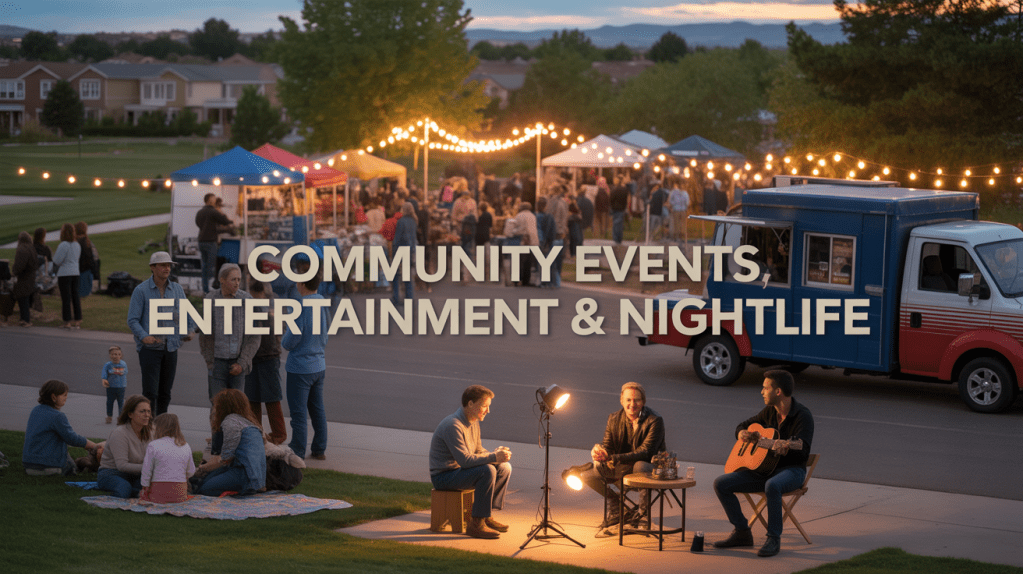
Entertainment in Centennial is built around community anchors, nearby regional venues, and low‑key local spots more than a single, dense nightlife strip. That shapes how evenings and weekends feel once day jobs and school are done.
Residents are more likely to:
- Attend concerts, plays, and games in neighboring cities, then return to quieter streets
- Join city‑sponsored events in local parks, seasonal festivals, or neighborhood block parties
- Meet friends at a brewery, sports bar, or restaurant near a familiar intersection rather than drive to a central “downtown” area
“A night out” in Centennial often looks like dinner and a show nearby, trivia at a taproom, a family festival in a park, or a quick trip into Denver with a defined start and end, rather than a late bar crawl. For many households, that’s a feature: it keeps the evening vibe calmer, more predictable, and more tightly connected to home, school, and neighborhood life.
This section covers:
- City & Neighborhood Events Centennial Residents Actually Attend
- Farmers Markets and Local Gathering Spots in and Around Centennial
- Live Music, Breweries & Outdoor Evenings in the Southeast Metro
- Family‑Friendly Evening Options in and Near Centennial
- Why Centennial Feels Active Without Feeling Overwhelming
Centennial offers energy in measured doses — enough going on that you don’t feel stuck, but not so much that you feel like you live in the middle of a party.
Seasonal Living in Centennial

Seasonal living in Centennial is a big part of what makes the city feel grounded and predictable over the long run, because the rhythm of the year quietly structures how families actually live day to day.
Winter brings snow, cold snaps, and shorter days, which slows the pace, shifts more activity indoors, and puts rec centers, home gyms, and school events at the center of many weeks. Commute planning and route choice matter more, especially around storms and freeze‑thaw cycles, and trails may see more use in midday windows when sunshine and temperatures cooperate.
Spring and summer open up the parks, trails, and event calendar. Centennial becomes much more outdoor‑oriented and bike‑and‑walk‑friendly, with families spending evenings on patios, in neighborhood parks, along greenways, and at nearby concerts and festivals. Backyards, cul‑de‑sacs, and sports fields become de facto social spaces, and longer daylight hours let people stretch out work, errands, and recreation.
Fall often feels like the sweet spot — cooler temperatures, stable weather, full school and sports schedules, and plenty of good days for walks and rides without the extremes of summer heat or winter storms. That predictable seasonal shift — from an indoor‑heavy winter to an outdoor‑heavy warm season — is a big reason why long‑time residents feel so settled and comfortable structuring their routines around the local climate.
This section examines:
- Snow & Ice Exposure Differences by Corridor and Micro‑Area in Centennial
- Winter Sun Patterns and Street Orientation in Centennial Neighborhoods
- Spring and Summer Event Density in Centennial & Nearby Hubs
- Trail and Park Usage Throughout the Year in Centennial
- How Seasonality Affects Routines, Not Just Weather, in Centennial
In Centennial, seasonal rhythm plays a bigger role in livability than most people expect when they only look at average temperatures on a chart.
Experience, Authority & How This Hub Is Built
This Centennial Lifestyle Hub is written and maintained by a Colorado‑based real estate professional who works in and around Centennial regularly — not by scraping generic summaries.
Every section reflects:
- First‑hand local experience
- Direct feedback from residents and buyers
- Ongoing observation of neighborhood and traffic patterns
- Continuous updates as infrastructure, schools, and community dynamics evolve
This is a living resource — built with accountability to how the city actually behaves.
Who This Hub Is For
This hub is built for people who want to understand how Centennial actually feels to live in, including:
- Long‑time residents reassessing priorities or neighborhoods
- Buyers focused on daily function over just finishes and photos
- Families balancing schools, schedules, and space
- Professionals managing commute and lifestyle alignment (or shifting to remote work)
- Anyone evaluating Centennial for long‑term fit rather than a short stop
This is not a relocation pitch.
It is Centennial lifestyle intelligence.
Frequently Asked Questions About Living in Centennial

Is Centennial more “suburban” or “urban” in daily life?
Centennial is firmly suburban in form, with strong links to major job centers and amenities. Daily life feels like neighborhoods, schools, parks, and shopping nodes tied together by arterials and freeways, with fairly quick access to Denver when you want it — but most routines stay local.
How much do school boundaries matter in Centennial?
School boundaries shape traffic patterns, social circles, and long‑term neighborhood stability. They influence where you drive each morning, which parks and fields you frequent, and how many times you move as kids advance through grades. For many families, getting into the right feeder path is as important as the house itself.
Does light rail meaningfully reduce car dependence?
For some Centennial households with predictable downtown or DTC routines, light rail can take a car off the road during the workweek. For most families juggling multiple jobs, schools, and activities, it’s a useful option rather than a full replacement — the car still does the heavy lifting for everyday life.
Are major shopping and job hubs disruptive to nearby homes?
Living close to DTC, Park Meadows, or big‑box clusters means more traffic, lights, and activity at peak times. For many residents, that’s offset by convenience — short drives to work, errands, and meals. A few turns into interior streets usually quiets things down while keeping the benefits within easy reach.
How different does Centennial feel across seasons?
Centennial feels noticeably different across the year. Winter is more car‑focused and home‑centered, with schedules shaped by weather and daylight. Spring, summer, and fall activate trails, parks, patios, and sports fields, turning the city into a more outward‑facing, socially connected place until cold and dark pull people back inside.
Talk With a Centennial Lifestyle Expert
If you’re evaluating neighborhoods, reassessing how your current area fits your life, or aligning long‑term priorities with daily living realities, a direct conversation often brings clarity faster than more reading.
You can contact me directly to talk through how Centennial neighborhoods actually function day to day — without pressure, scripts, or generic advice. If you are seriously considering Centennial, I’m happy to walk through how schools, commutes, parks, and amenities line up with your specific goals so you can decide not just where you can live, but where your life will actually work.