


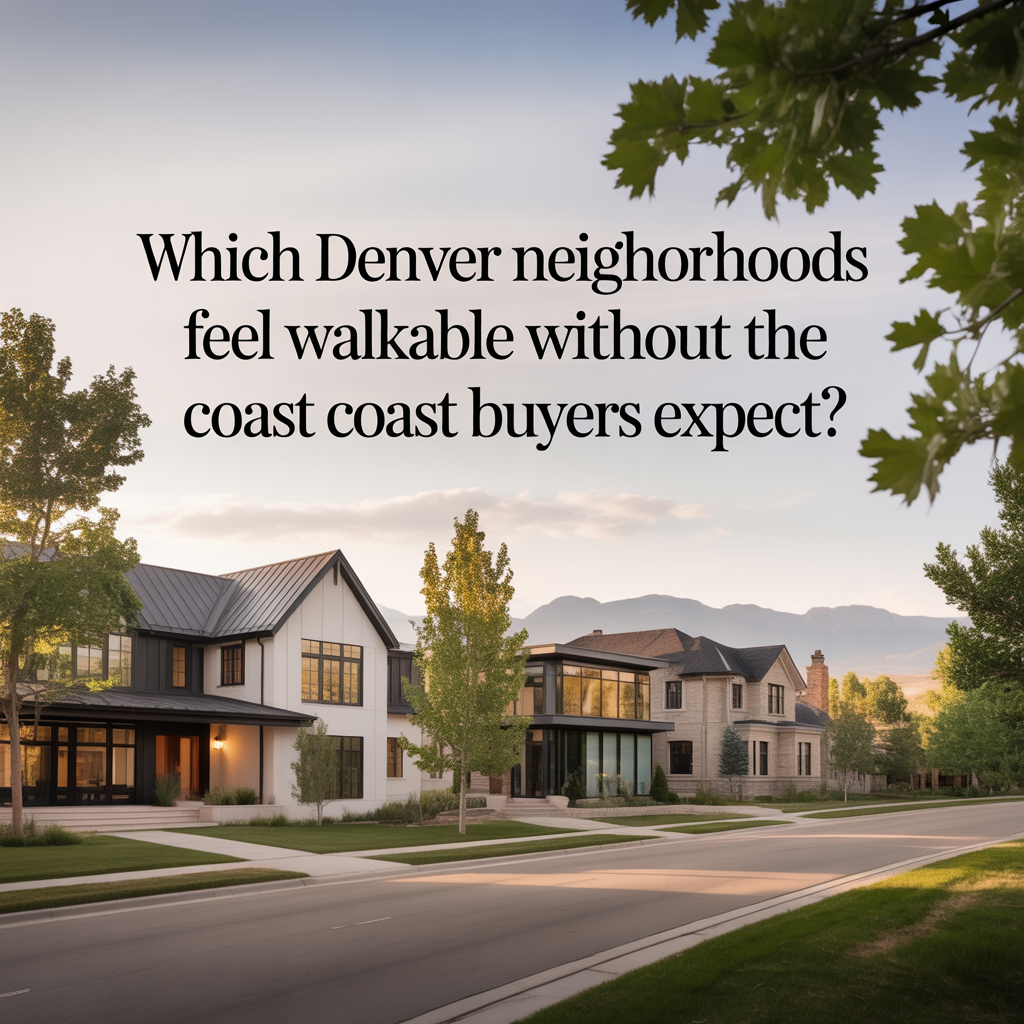
This is part of the Denver Metro Relocation Guide → [Relo Guide]
For many East Coast buyers relocating to Colorado, “walkability” means more than a good Walk Score. It’s about having access to local amenities—coffee shops, parks, markets, and restaurants—while avoiding the constant congestion, density, and parking stress that define many urban centers back east.
In Denver, walkability takes on a different texture. Here, neighborhoods can feel connected and vibrant without feeling crowded, and pedestrian-friendly streets are often framed by mountain views and tree canopies rather than high-rises. Understanding which areas strike that balance helps buyers make more informed and enduring choices in a market where lifestyle and property values are closely intertwined.
The Colorado Version of Walkability
Walkability in Denver doesn’t look like Manhattan, Boston’s Back Bay, or Washington D.C.’s Georgetown. Sidewalk access, transit proximity, and local retail matter, but so do quality of life and manageable density. Many homebuyers relocating from the East Coast discover that what they truly seek is “livable walkability”—a neighborhood that supports daily convenience without the crowded, high-stress backdrop.
Several factors shape how that plays out in Denver:
- Zoning and density: Denver’s residential zoning tends to protect single-family blocks even near commercial corridors, allowing residents to walk to shops without living above them.
- Transit access: Light rail, bus networks, and major roadway connections shape how neighborhoods function for pedestrians.
- Climate and layout: With roughly 300 days of sunshine, outdoor spaces are well-used but still designed with car considerations in mind. Walkability often means proximity, not complete car independence.
- Community character: Local businesses often serve as neighborhood anchors—breweries, independent coffee shops, or small markets that encourage foot traffic and interaction.
For buyers accustomed to East Coast urban density, understanding this difference helps recalibrate expectations and align neighborhood choices with long-term satisfaction.
Neighborhoods That Deliver Walkability Without the Overcrowding
Denver’s best walkable neighborhoods have a common thread: they blend accessibility with space, and community energy with calm. Below are several areas that consistently appeal to incoming buyers seeking that balance.
Washington Park: Classic, Green, and Steady
Washington Park—often simply “Wash Park”—remains a gold standard for Denver walkability with an established, residential feel. The park itself spans over 150 acres, featuring trails, lakes, gardens, and a loop favored by joggers and cyclists. The surrounding streets include century-old homes mixed with tasteful remodels and duplexes.
Residents can walk to South Gaylord Street’s shops or Old South Pearl’s restaurants without encountering true urban congestion. On weekends, the park fills with locals but rarely feels unmanageable. Importantly, parking and traffic remain more predictable than in Denver’s denser neighborhoods.
From a buyer’s standpoint, Washington Park’s lasting appeal lies in its liquidity—the property market stays balanced even during slower cycles. Homes here tend to hold long-term value because the area’s character cannot be replicated elsewhere in Denver.
South Pearl Street and Platt Park: Small-Town Feel Near the Core
Just south of Wash Park, Platt Park offers a more approachable housing stock—bungalows, 1920s cottages, and newly built condos—and a central retail corridor that feels distinctly community-driven. South Pearl Street serves as the hub, lined with restaurants, coffee shops, boutiques, and a popular Sunday farmer’s market from spring through fall.
What makes this area stand out for East Coast transplants is how walkability and personality align. You can stroll to dinner, meet neighbors, and still find quiet side streets within minutes. The RTD light rail station on Louisiana–Pearl connects directly to downtown and the Tech Center, keeping commutes manageable.
While prices have appreciated sharply over the past decade, Platt Park continues to be one of the few walkable areas where you can still find townhomes or smaller-lot single-family options under the highest price brackets of central Denver.
Highlands and LoHi: Urban Energy with Manageable Scale
For buyers accustomed to city neighborhoods like Brooklyn’s Fort Greene or D.C.’s Logan Circle, Denver’s Highlands and Lower Highlands (“LoHi”) offer familiar rhythms at lower intensity. These neighborhoods balance older residential character with new infill development that brought restaurants, rooftop patios, and boutique retail.
What differentiates these areas from East Coast equivalents is the sense of scale—buildings rarely exceed five stories, streets remain wide, and mountain views open the horizon. Walkability means access to some of Denver’s most acclaimed dining, yet daily living feels more relaxed than frenetic.
Still, these areas do see weekend influxes and evening activity around major restaurants. Buyers who prioritize quieter streets can focus west of Lowell Boulevard or north toward Highland Park, where zoning transitions back to traditional lots and shaded sidewalks.
Congress Park and Cheesman Park: Classic Urban Form Without Chaos
Just east of central Denver, these two adjoining neighborhoods appeal to those seeking historic architecture, mature trees, and proximity to cultural amenities. The area around 12th Avenue offers walkable access to small grocers, bakeries, and cafes, while the Denver Botanic Gardens and Cheesman Park create open green anchors.
These neighborhoods maintain excellent access to downtown and Cherry Creek while feeling distinctly residential. For East Coast buyers used to brick rowhouses, the brick Denver Squares, bungalows, and mid-century apartments in Congress Park may feel comfortably familiar.
Importantly, this part of Denver remains more balanced than built out. Redevelopment pressure exists, but design standards and conservation overlays help preserve character. That stability supports both livability and long-term property values.
Baker and South Broadway: Historic Texture and Emerging Stability
Baker, southwest of downtown, offers one of Denver’s most walkable historic districts. Its grid of early-1900s Victorian homes and alley cottages sits adjacent to South Broadway’s corridor of shops, restaurants, and music venues.
For buyers wanting walkability with authenticity, Baker delivers a neighborhood identity that feels organic rather than master-planned. It’s less polished than Wash Park or Highlands but more approachable in price. Light rail access at Alameda Station also improves mobility for daily commuting.
From an investment perspective, Baker has matured from its former “up-and-coming” status into a stable, established alternative with limited inventory and enduring buyer interest—especially among remote workers seeking a mix of walkable lifestyle and architectural character.
Suburban Pockets Balancing Accessibility and Space
Several close-in suburbs now offer versions of walkability that suit Colorado living better than some central Denver locations. They combine updated retail environments with calm residential pockets and strong transit connections.
Olde Town Arvada
A restored historic core centered on a light rail stop gives Olde Town Arvada the feel of a small downtown without Denver’s pricing or intensity. The area features locally owned restaurants, breweries, and merchants, and most homes within a mile radius are older ranches or updated mid-century models.
Its true daily convenience—grocery stores, coffee shops, and parks within walking distance—makes it a compelling alternative for remote professionals or families who want to live outside Denver proper.
Downtown Littleton
Downtown Littleton offers a traditional main street, local transit access, and proximity to the South Platte River Trail. Unlike newer suburban town centers, Littleton’s walkability developed organically over decades, giving it a genuine sense of place.
The surrounding residential blocks retain mid-century ranches and cottage-style homes with yards—something you rarely find near downtown Denver. For East Coast buyers seeking quieter urbanism, this mix of space, transit, and authenticity ranks highly.
Why Walkable but Calm Areas Hold Long-Term Value
The desire for walkability is not new, but the pandemic era and the shift to hybrid work have reshaped how buyers define it. In Denver’s market, three underlying forces sustain demand for these quieter yet connected neighborhoods:
- Lifestyle durability. Areas with true pedestrian infrastructure and local commerce hold appeal across market cycles—not just during hot years.
- Diverse buyer profiles. Walkable but calm areas attract families, professionals, and downsizers alike, spreading risk across demographics.
- Limited redevelopment potential. Established zoning and mature trees limit drastic changes, which supports consistent property values.
Over time, these factors reinforce demand resilience. Even as broader market cycles fluctuate, areas like Wash Park, Platt Park, Congress Park, and Olde Town Arvada maintain a consistent depth of interest from thoughtful buyers who value both proximity and peace.
Setting Expectations for Relocating Buyers
Relocating buyers from the East Coast often arrive expecting either full car dependence or high urban density; Denver offers something in between. The key is adjusting criteria away from traditional “downtown or suburb” thinking and toward micro-location nuance—how far you walk for coffee, where your nearest park sits, and how traffic behaves at rush hour.
- Buyers focused on quality of life per square foot often value detached homes in walkable corners of central Denver more than condos near high-traffic corridors.
- For those commuting part-time, light rail access or proximity to I‑25 matters more than absolute distance from downtown.
- Seasonal patterns also play a role: pleasant weather extends walking viability well into fall and early spring, supporting outdoor activity more than in many East Coast cities.
Understanding these subtleties helps new residents feel grounded faster and leads to decisions aligned with how they actually live, not just how they imagine “urban living” to look.
Making a Thoughtful Purchase in a Walkable Denver Neighborhood
Whether you’re drawn to Wash Park’s timeless charm or Platt Park’s village-like energy, the key is recognizing that Denver’s walkability functions differently—more decentralized, more residential, and often more sustainable long term.
Buyers should evaluate each candidate neighborhood not only by its Walk Score but also by what lies within a 10‑minute stroll: the grocery options, the evening ambiance, the street lighting, and the rhythm of pedestrian activity. Similarly, sellers in these areas benefit from highlighting how convenience intersects with calm—something increasingly rare in fast-growing metro regions.
Conclusion: Walkable, Calm, and Built for Long-Term Value
For East Coast transplants seeking the best of both worlds, Denver’s most balanced neighborhoods prove that walkability and tranquility can coexist. The city’s pattern of compact retail corridors surrounded by stable, tree-lined housing offers everyday convenience without the intensity of older coastal metros.
From Washington Park’s enduring appeal to Olde Town Arvada’s low-key vibrancy, each area delivers a livable rhythm distinct to Colorado—where footsteps connect you to local life, but open skies and manageable pace remind you why you chose to relocate in the first place.
If you’re exploring which walkable Denver neighborhoods best fit your lifestyle and long-term goals, reach out to me for tailored advice and current market insights. Understanding not just where, but why, a neighborhood fits your priorities is the difference between buying a home and building your foundation in Colorado.
Get the full Denver Market Insights → [Market Insights]


Littleton’s Ken Caryl for Lockheed Relocations
This is part of Lockheed Martin Relocation → [Lockheed Martin Relocation Hub] & the larger Denver Relocation Hub → [Denver Relocation Hub] Written by: Chad Cabalka Ken Caryl is one of the best-kept “family first” relocation options for Lockheed Martin employees who want foothills scenery, strong neighborhood appeal, and a real suburban lifestyle that still feels connected…

Centennial & Parker for Lockheed Relocations
This is part of Lockheed Martin Relocation → [Lockheed Martin Relocation Hub] & the larger Denver Relocation Hub → [Denver Relocation Hub] Written by: Chad Cabalka Centennial and Parker are two of the smartest suburban choices for Lockheed Martin employees relocating with families because they give you a strong balance of commute flexibility, good neighborhood variety, and…

Highlands Ranch for Family-Friendly Lockheed Relocations
This is part of Lockheed Martin Relocation → [Lockheed Martin Relocation Hub] & the larger Denver Relocation Hub → [Denver Relocation Hub] Written by: Chad Cabalka Highlands Ranch is one of the strongest choices for Lockheed Martin employees relocating with families because it delivers exactly what most parents want after a big move: stable neighborhoods, strong community…