


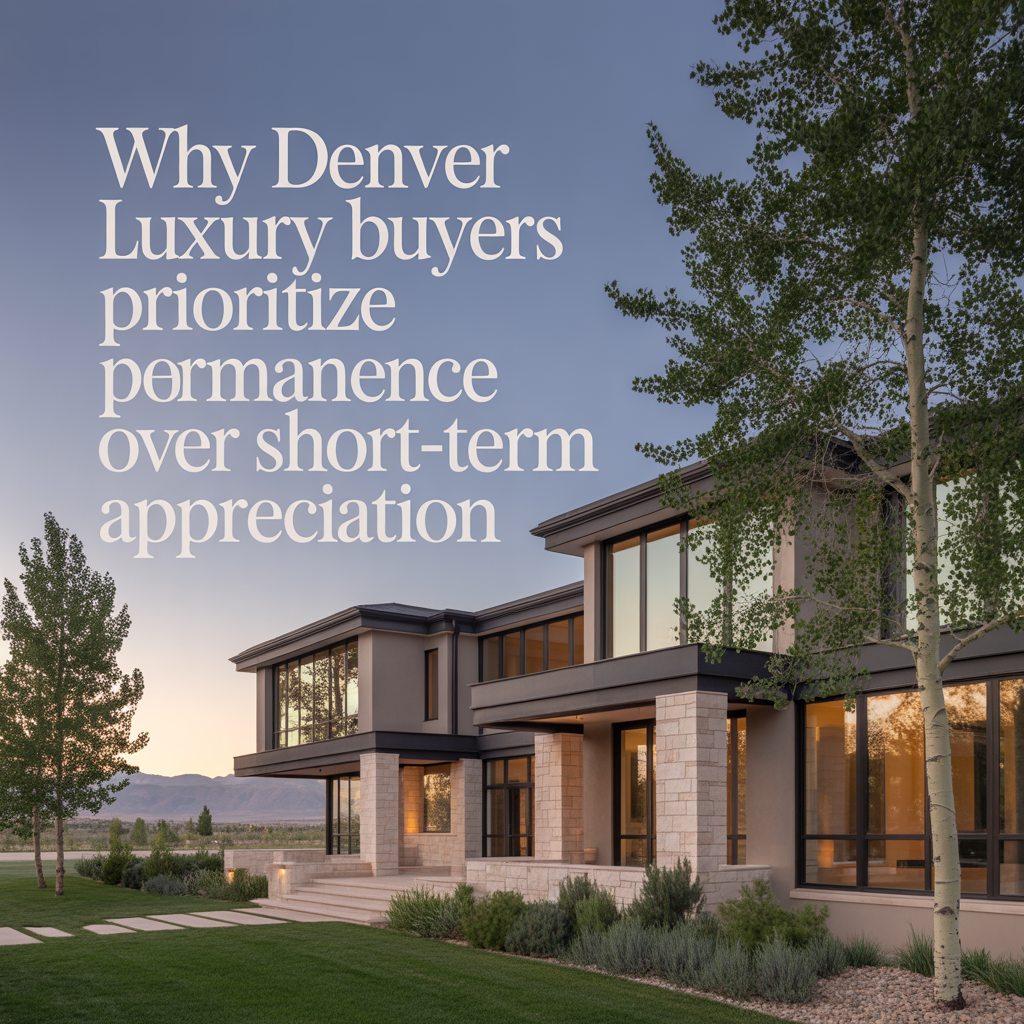
This is part of the Denver Metro Luxury Market Guide → [Luxury Guide]
Luxury homebuyers in the Denver metro market have quietly shifted their priorities. In previous cycles, investment return and appreciation potential drove most high-end purchases. Today, permanence—measured in lifestyle stability, quality of life, and the enduring value of a home’s setting—has become the central consideration. This change reflects broader social and economic shifts: remote work realities, constrained housing inventory, and a redefined sense of what “home” truly means.
As prices and interest rates have normalized, affluent buyers aren’t simply chasing the next appreciating neighborhood. They’re asking deeper questions about lasting suitability: Will this home truly work for my long-term life? and Does this community fit the way I actually live? Understanding why that shift matters helps both buyers and sellers navigate a maturing, more deliberate market.
The Evolving Mindset of Denver’s Luxury Homebuyer
From Speculators to Settlers
Over the last decade, Denver’s upper-tier market attracted a mix of transplants, investors, and professionals riding the wave of rapid metro growth. Buying in areas like Cherry Creek, Washington Park, and Sloan’s Lake often felt as much like an investment strategy as a lifestyle decision. But as rapid appreciation slows and price volatility occasionally surfaces, luxury buyers now behave less like speculators and more like settlers.
Affluent households increasingly see their Colorado residence as a primary or generational home, not a stepping stone. Many have already built wealth elsewhere; they’re not relying on short-term price gains to justify the purchase. Instead, permanence—proximity to family, quality of schools, private outdoor space, and stable neighborhood identity—drives decision-making.
Stability in a More Mature Market
Denver is no longer the “up-and-coming” city it once was in the early 2010s. The metro has matured economically and demographically, and its most desirable neighborhoods are largely built out. That leaves fewer opportunities to “get in early” on an appreciating pocket. Buyers now focus on intrinsic value—the enduring appeal of architecture, location, and community fabric—rather than speculative upside.
This mindset stabilizes the luxury segment. Sellers encounter fewer buyers chasing quick gains but more who appreciate the neighborhood for what it already is. That shift supports long-term pricing confidence even in slower sales environments.
Lifestyle Permanence: Redefining What “Luxury” Means
Space and Function Over Status
Luxury buyers once equated value with brand names—custom builders, imported finishes, or mountain-style extravagance. In today’s Colorado market, function and adaptability carry more weight. A well-constructed home with timeless materials and a logical layout often outperforms flashier but less practical designs.
Properties that blend architectural integrity with daily livability—dedicated offices, transitional indoor-outdoor spaces, low-maintenance landscaping, and flexible floor plans—command stronger loyalty from buyers. Permanence grows out of usability, not novelty.
The Role of Location Beyond the Obvious
Traditional prestige ZIP codes still perform well, but permanence depends less on exclusivity and more on long-term liveability. Suburbs like Greenwood Village and Bow Mar appeal for their privacy and lot size. Closer to downtown, Hilltop and Observatory Park retain demand thanks to school quality and neighborhood coherence. Even newly popular areas such as Castle Pines and Lone Tree attract buyers willing to trade proximity for open space and predictability.
Denver’s commuting culture also influences this permanence-based mindset. As hybrid work compresses weekly travel, buyers weigh the convenience of major corridors like I‑25 or the accessibility of DIA less heavily than they once did. Instead, they look toward balanced access—close enough to cultural amenities, yet far enough from the stress of constant movement.
Economic Factors Reinforcing the Desire for Permanence
Rate Environment and Holding Periods
Higher interest rates since 2022 have had an unintended stabilizing effect on luxury ownership patterns. With fewer low-rate mortgages available, buyers evaluate purchases more seriously, and once they close, they’re inclined to stay longer. Locking in a property that meets long-range needs reduces the uncertainty of future refinancing or relocation costs.
Similarly, wealth preservation strategies have changed. Many affluent Coloradans treat real estate as a stable asset class that offers lifestyle returns—comfort, security, and optionality—alongside financial ones. When equities feel volatile and alternative investments appear speculative, a high-quality residence in a steady market feels sensible.
Limited Land and Zoning Constraints
Permanence also reflects physical realities. Buildable land in desirable parts of the Front Range is scarce, and local zoning limits create natural boundaries. Boulder’s tight growth controls, Centennial’s single-family emphasis, and Denver’s historical preservation overlays all restrict new supply. Buyers recognize that scarcity enhances the long-term character of these areas. A house that fits well within its established neighborhood becomes inherently more stable in value.
This scarcity shifts attention from short-term resale predictions to the enduring advantage of owning something irreplaceable. In practical terms, buyers are purchasing location quality and architectural longevity, not just square footage.
Psychological Dimensions of Long-Term Ownership
The Desire for Anchoring
After years of mobility and market flux, many people crave permanence simply as a form of psychological anchoring. For Denver’s luxury demographic—professionals, entrepreneurs, retirees relocating from coastal states—the home represents a base of operations in an unpredictable world.
That motivation subtly changes buying behavior. Instead of aiming for the “best deal,” these buyers prioritize properties that offer emotional continuity: walkable neighborhoods, consistent architectural character, and access to familiar routines year-round. That mindset reduces turnover and reinforces the strength of Colorado’s luxury segment.
Generational Planning and Legacy
Another emerging driver is multi-generational intent. Parents purchasing in neighborhoods like Columbine Valley or Cherry Hills Village increasingly view their homes as intergenerational assets—places where family can gather or expendable wealth can be stabilized. Buying for legacy rather than leverage reflects financial maturity and a longer timeline.
In this context, permanence translates to stewardship. Homeowners invest in quality maintenance, sustainable materials, and enduring design choices not just for aesthetics, but to preserve value across decades.
What This Means for Buyers and Sellers
For Buyers: Focus on Longevity Metrics
Those entering the Denver luxury market should evaluate properties as long-term holdings. Key questions include:
- How adaptable is the floor plan to future life stages?
- Does the neighborhood have a stable identity and zoning protection?
- Are maintenance and utility systems efficient enough for long-term cost predictability?
- Will this property’s design still feel relevant 10–15 years from now?
Buyers who weigh these factors tend to enjoy smoother ownership experiences and more consistent resale outcomes when they eventually do sell.
For Sellers: Marketing Permanence, Not Potential
Sellers benefit by appealing to the permanence mindset. Rather than emphasizing future appreciation or short supply, presentation should highlight craftsmanship, continuity, and care of ownership. Well-documented maintenance histories, quality inspections, and understated aesthetic updates signal reliability—assets that resonate powerfully in today’s discerning market.
Neighborhood context also matters. Describing a property’s role within its community (for example, its walkability to established parks or consistent architectural character) communicates stability. Ultimately, buyers paying seven figures in Denver’s current market want assurance that their investment will retain meaning, not just money.
A More Grounded Era for Colorado Real Estate
The Denver luxury segment has entered a period defined by moderation and thoughtfulness. The frenzy of bidding wars and speculative flips has largely passed. What remains is a resilient base of buyers and sellers who value quality of life, structural integrity, and environmental compatibility.
That doesn’t mean growth is over—demand remains healthy, especially from out-of-state relocations—but the motivations are more grounded. People commit to this region for its balance: active lifestyles, accessible cultural offerings, and a relatively stable economy compared with coastal hubs.
As urban density increases in central Denver and infrastructure expands southward toward Douglas County, permanence will continue to shape decisions. Whether it’s a remodeled Tudor in Observatory Park or a new construction ranch in Parker, buyers will favor homes that serve not just their current lifestyles but their next ones too.
Conclusion: Choosing Roots Over Risks
Permanence has become the quiet currency of Colorado luxury real estate. It reflects both financial prudence and emotional intelligence—a recognition that true value lies in stability, not speculation. For Denver’s current and future homeowners, that outlook promises a more sustainable and satisfying relationship with their properties.
If you’re evaluating how this permanence trend intersects with your own goals—whether buying, selling, or positioning a home for long-term value—reach out to me directly. A conversation grounded in local insight and practical strategy can help you make choices that last.
Get the full Denver Market Insights → [Market Insights]


Littleton’s Ken Caryl for Lockheed Relocations
This is part of Lockheed Martin Relocation → [Lockheed Martin Relocation Hub] & the larger Denver Relocation Hub → [Denver Relocation Hub] Written by: Chad Cabalka Ken Caryl is one of the best-kept “family first” relocation options for Lockheed Martin employees who want foothills scenery, strong neighborhood appeal, and a real suburban lifestyle that still feels connected…

Centennial & Parker for Lockheed Relocations
This is part of Lockheed Martin Relocation → [Lockheed Martin Relocation Hub] & the larger Denver Relocation Hub → [Denver Relocation Hub] Written by: Chad Cabalka Centennial and Parker are two of the smartest suburban choices for Lockheed Martin employees relocating with families because they give you a strong balance of commute flexibility, good neighborhood variety, and…

Highlands Ranch for Family-Friendly Lockheed Relocations
This is part of Lockheed Martin Relocation → [Lockheed Martin Relocation Hub] & the larger Denver Relocation Hub → [Denver Relocation Hub] Written by: Chad Cabalka Highlands Ranch is one of the strongest choices for Lockheed Martin employees relocating with families because it delivers exactly what most parents want after a big move: stable neighborhoods, strong community…