


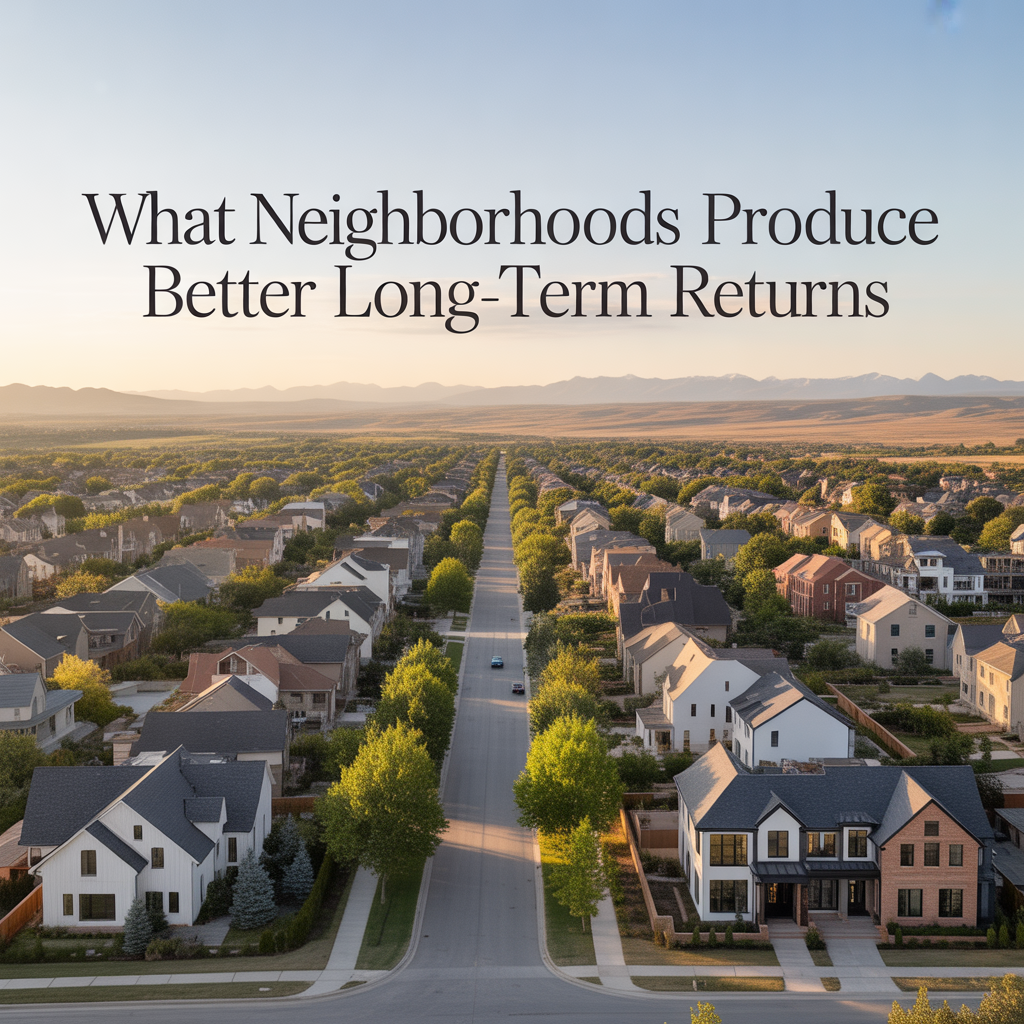
This is part of the Denver Metro Investor Guide → [Investor Guide]
Colorado’s real estate market rewards patient investors who prioritize neighborhoods with enduring fundamentals over short-term hype. Long-term returns depend on factors like sustained demand, infrastructure resilience, and demographic stability, particularly in the Denver metro area and its suburbs. Understanding these drivers helps buyers and sellers identify areas where property values compound steadily over decades.
Factors Driving Long-Term Value Appreciation
Neighborhoods that deliver superior long-term returns share predictable traits rooted in Colorado’s unique economic and geographic context. Proximity to employment hubs in Denver reduces commute times, which average 25-30 minutes in high-performing suburbs like Highlands Ranch compared to over 45 minutes in outer exurbs. This matters because shorter commutes correlate with higher buyer retention and willingness to pay premiums, as families weigh daily travel against housing costs.
Stable school districts amplify this effect. Areas served by Douglas County School District, for instance, see consistent inflows of relocating professionals from tech and finance sectors, supporting 4-6% annual appreciation in balanced markets. Weather patterns, including heavy snow accumulation, favor neighborhoods with mature housing stock built to modern codes, minimizing maintenance costs that erode net returns.
Ownership costs extend beyond mortgages. Property taxes in Douglas and Arapahoe Counties hover around 0.6-0.7% of assessed value, lower than Denver’s 0.9%, preserving cash flow for long-term holders. These elements compound: a home appreciating at 4% yearly in a low-tax suburb nets higher after-tax gains than one in a high-cost urban core.
Employment Access and Commute Patterns
Commute reliability underpins long-term demand. Neighborhoods along the C-470 corridor, such as Lone Tree and Centennial, benefit from direct access to DTC offices and Denver Tech Center’s 150,000 jobs. Buyers here prioritize 20-minute drives to work, reducing turnover and stabilizing values during economic shifts.
In contrast, northern suburbs like Westminster face I-25 congestion, where rush-hour delays exceed 40 minutes. This deters long-term investment unless offset by affordability, as seen in declining appreciation rates during remote work lulls.
Top-Performing Neighborhoods in Denver Metro Suburbs
Highlands Ranch exemplifies a neighborhood engineered for long-term returns. Developed in the 1980s with planned open spaces comprising 40% of its 22,000 acres, it attracts families seeking equity growth without urban density. Single-family homes here have averaged 5% annual appreciation over 20 years, driven by low vacancy rates and corporate relocations to nearby Lockheed Martin facilities.
Cherry Creek North in Denver proper offers urban appeal with suburban scale. Its walkable retail and top-rated schools draw high-income buyers, yielding 6-7% returns in stable cycles. Ownership costs remain manageable due to condo conversions, appealing to downsizers preserving capital.
Southern Suburbs: Highlands Ranch and Centennial
Highlands Ranch’s master-planned design includes three rec centers and 130 miles of trails, fostering community retention that bolsters values. Buyers behave differently here: 70% are repeat locals upgrading within the neighborhood, signaling confidence in future appreciation. Winter weather tests infrastructure, but elevated drainage systems handle snowmelt effectively, avoiding flood-related devaluations.
Centennial mirrors this profile. Eastridge at Centennial, with homes from the 1970s updated to energy-efficient standards, sees steady demand from United Airlines employees at nearby DIA. Long-term holders benefit from 3-5% yearly gains, outpacing inflation, as limited new construction preserves scarcity.
Western Suburbs: Littleton and Lakewood
Littleton outperforms due to its blend of historic charm and modern amenities. Neighborhoods like Old Littleton attract empty-nesters valuing walkability to brewpubs and light rail, which cuts commutes to downtown Denver to 25 minutes. Appreciation here compounds through generational transfers, with values doubling every 15 years.
Lakewood’s Belmar area shifted from a fading mall to a mixed-use hub, drawing young professionals. Its proximity to Red Rocks Amphitheatre adds cultural pull without lifestyle overload, supporting 4.5% returns amid balanced inventory levels around 4 months’ supply.
Mountain and Foothills Neighborhoods for Balanced Returns
Evergreen in Jefferson County provides foothills access without Vail’s volatility. At 7,200 feet elevation, it demands four-wheel-drive vehicles for winter commutes, filtering buyers to committed locals. Properties here appreciate at 4-5% annually, fueled by remote workers and Denver executives seeking second homes that convert to primaries.
Genesee, adjacent to I-70, benefits from Chatfield Reservoir recreation and proximity to Denver’s core. Housing stock—mostly 1980s ranches on large lots—holds value through low turnover, as owners leverage home equity for improvements rather than selling.
Why Mountains Lag Urban Suburbs Long-Term
Mountain markets like Summit County fluctuate with tourism. Winter Park’s expansions promise short-term lifts, but seasonal vacancy spikes depress net returns for non-investors. Suburbs win for primary residences, where daily utility drives consistent bidding.
Northern Suburbs: Emerging Value Plays
Erie and Lafayette in Boulder County emerge as sleeper hits for long-term investors. Erie’s position between Denver and Boulder taps tech growth from Ball Aerospace, with new builds absorbing demand without oversupply. Commutes via US-36 average 30 minutes to each city, ideal for dual-income households.
Thornton rounds out the north with affordability. Its rapid infrastructure upgrades, including light rail extensions, position it for 5% appreciation as DIA commuters seek alternatives to Adams County sprawl. Buyer behavior shifts here: first-time buyers upgrade within five years, recycling equity locally.
Risks and Mitigation in Colorado Neighborhood Selection
Elevation and weather introduce risks. Neighborhoods above 6,000 feet face higher heating costs—up to 20% more than Denver—impacting affordability metrics. Mitigation lies in energy-audited homes, common in newer Highlands Ranch developments.
Commute evolution matters. Remote work reduced I-25 reliance, but hybrid mandates revive demand for suburbs like Parker, where E-470 tolls ensure 35-minute DIA access. Sellers should price against comparable sales within a 10-mile radius, accounting for these shifts.
Housing stock age varies. Denver metro’s 1970s inventory requires updates for wildfire resilience, a growing buyer priority post-2020 fires. Neighborhoods with HOA-mandated retrofits, like Castle Pines, command premiums.
Ownership Costs Beyond the Mortgage
Taxes and insurance define net returns. Douglas County’s mill levy caps limit escalations, unlike Denver’s TABOR variances. Homeowners insurance averages $2,200 yearly in suburbs versus $3,000 in mountains, due to fire exposure gradients.
HOA fees in planned communities—$300-500 monthly in Highlands Ranch—fund amenities that enhance resale appeal, effectively subsidizing maintenance. Buyers calculate total cost of ownership: a $800,000 home yielding 4% appreciation nets $32,000 pre-tax, minus $10,000 in annual carrying costs.
Buyer and Seller Strategies for Maximizing Returns
Buyers target neighborhoods with under 5 months’ supply, like Centennial, entering in winter when listings peak 20%. Offer 2-3% below list with inspection contingencies, leveraging longer days-on-market (now 60-70 statewide).
Sellers stage for local psychology: highlight commute times and school rankings in listings. Price reductions of 5% close deals faster in balanced markets, preserving equity.
Relocators from California prioritize tax differentials, flocking to no-state-income-tax perceptions (Colorado’s flat 4.4% rate aids retention). Assess via five-year holding periods, modeling 4% growth against 3% inflation.
Conclusion
Neighborhoods like Highlands Ranch, Centennial, and Littleton produce better long-term returns through proven demand drivers: superior schools, efficient commutes, and resilient infrastructure tailored to Colorado’s climate. These areas deliver steady appreciation because they align with buyer priorities—family stability and economic access—rather than transient trends. Serious investors weigh these factors against personal needs for optimal outcomes.
Reach out to me today for a personalized analysis of how these neighborhoods fit your portfolio—let’s discuss your next move.
Get the full Denver Market Insights → [Market Insights]


Littleton’s Ken Caryl for Lockheed Relocations
This is part of Lockheed Martin Relocation → [Lockheed Martin Relocation Hub] & the larger Denver Relocation Hub → [Denver Relocation Hub] Written by: Chad Cabalka Ken Caryl is one of the best-kept “family first” relocation options for Lockheed Martin employees who want foothills scenery, strong neighborhood appeal, and a real suburban lifestyle that still feels connected…


Centennial & Parker for Lockheed Relocations
This is part of Lockheed Martin Relocation → [Lockheed Martin Relocation Hub] & the larger Denver Relocation Hub → [Denver Relocation Hub] Written by: Chad Cabalka Centennial and Parker are two of the smartest suburban choices for Lockheed Martin employees relocating with families because they give you a strong balance of commute flexibility, good neighborhood variety, and…

Highlands Ranch for Family-Friendly Lockheed Relocations
This is part of Lockheed Martin Relocation → [Lockheed Martin Relocation Hub] & the larger Denver Relocation Hub → [Denver Relocation Hub] Written by: Chad Cabalka Highlands Ranch is one of the strongest choices for Lockheed Martin employees relocating with families because it delivers exactly what most parents want after a big move: stable neighborhoods, strong community…