


This is part of the Denver Metro Relocation Guide → [Relo Guide]
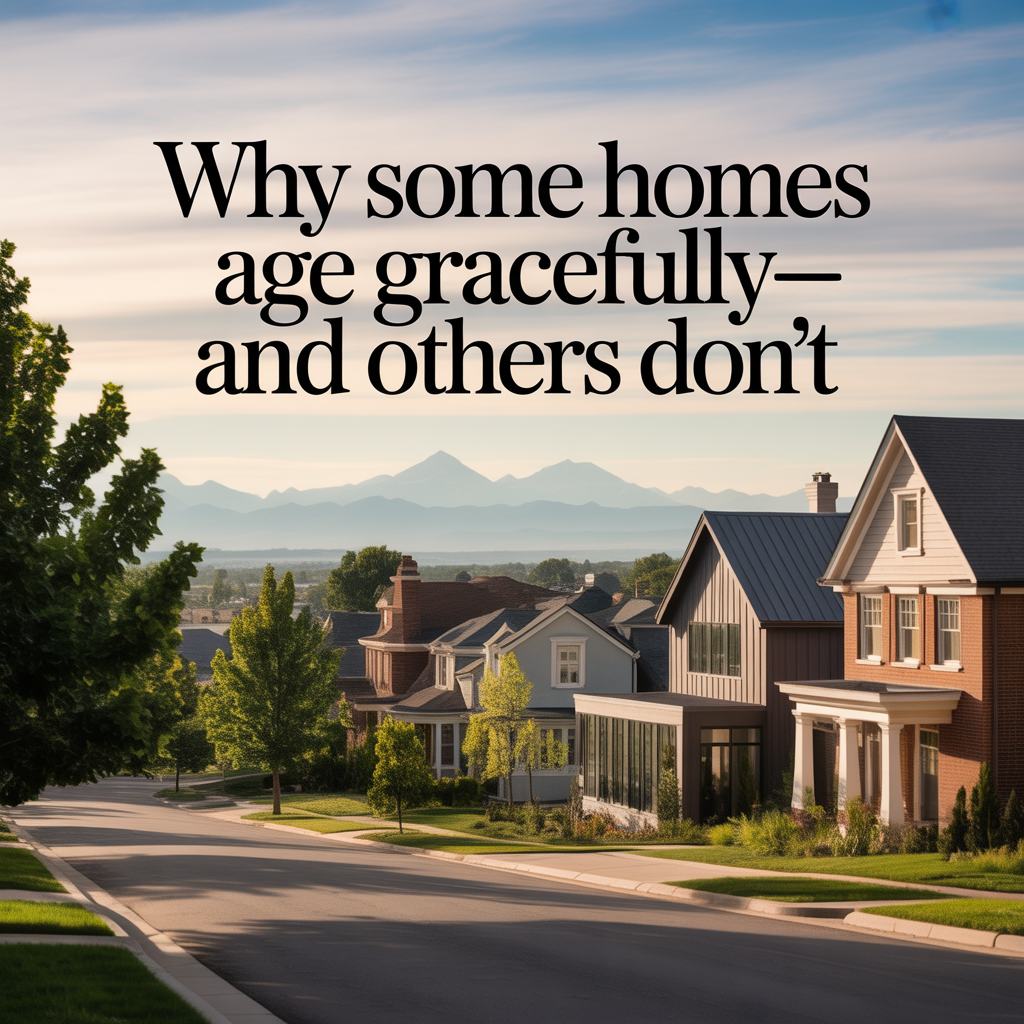
Every home tells a story, but over time, some stories hold their value better than others. In Colorado’s diverse housing landscape—ranging from 1940s brick ranches in Denver to newer subdivisions across Highlands Ranch, Centennial, and Castle Rock—the way a property ages has lasting financial and psychological implications for its owners. The difference between a home that matures into a classic and one that quietly falls behind isn’t luck; it’s a balance of design integrity, maintenance culture, and the evolving preferences of Colorado buyers.
Understanding why certain homes age gracefully helps both buyers and sellers make more strategic decisions. Homes that stand the test of time attract stable demand through changing markets, reducing long-term risk while supporting stronger resale potential.
The Colorado Context: How Local Realities Shape a Home’s Lifespan
Colorado’s real estate market rewards homes that balance resilience and adaptability. Unlike more uniform climates, the Front Range brings rapid temperature shifts, high UV exposure, and dry air that challenge even well-built homes. Materials, layout, and maintenance practices that perform well in other states may not translate neatly to Colorado’s environment or buyer expectations.
Architecture and building practices
Homes built with quality materials—particularly those using stone, brick, stucco, or durable engineered siding—often fare better over decades. In Denver’s older neighborhoods such as Park Hill or Platt Park, solid mid-century craftsmanship continues to attract discerning buyers who appreciate character and permanence. In contrast, production homes built during rapid growth cycles may show age faster, particularly if developers prioritized cost efficiency over construction depth.
Shifts in buyer psychology
Colorado buyers differ from coastal or Midwest markets in subtle but important ways. Many are drawn by lifestyle balance—proximity to work, outdoor access, and functional layouts over excess size. As energy costs, commute preferences, and maintenance awareness evolve, homes that align with these priorities maintain appeal longer. A ten-year-old home with modest, efficient spaces and high-quality finishes often outperforms a same-age property that’s larger but less practical.
Design Integrity and Timeless Proportion
Design decisions made during construction or remodeling play a major role in how a home’s appeal endures. Timeless architecture—rooted in proportion rather than trend—creates visual stability that helps properties age well even as color palettes and finishes come and go.
Why proportion matters more than style
Colorado neighborhoods show wide architectural variation, from Denver’s historic bungalows to sleek contemporary infill projects. Yet across eras, homes that “fit” naturally within their surroundings maintain value better than those chasing short-lived trends. The key is proportion and human scale. Overly tall or narrow designs, heavy rooflines, or awkward massing often feel dated within a decade. Balanced elevations, classic roof pitches, and consistent window patterns create a sense of rightness that endures.
Material authenticity
When materials are used honestly and in their proper context, they weather gracefully. A home that uses real wood, stone, and metal, maintained appropriately, evolves with character. Synthetic substitutes tend to degrade more noticeably, making the property feel tired sooner. Savvy buyers in markets like Boulder or Littleton recognize authenticity and reward it, even if it comes at a higher upfront cost.
The Role of Maintenance Culture
Even the best design cannot overcome neglect. In Colorado, where freeze–thaw cycles and intense sun exposure test every exterior surface, proactive stewardship distinguishes homes that last from those that merely survive.
Predictable maintenance versus deferred surprises
Homeownership is partly about rhythm. Roof inspections, paint upkeep, HVAC servicing, and gutter cleaning are predictable costs that, when managed consistently, protect both structure and perception. Deferred maintenance often shows long before major systems fail, signaling deeper care issues that influence buyer confidence. In some suburban resale markets, “turnkey condition” commands a significant premium, not just for convenience but for the implied assurance of steady care.
Landscaping and environmental fit
Aging gracefully extends to the landscape. Drought-tolerant, regionally appropriate plantings and efficient irrigation systems perform better over time than moisture-heavy lawns or decorative landscaping unsuited to the semi-arid Front Range. A landscape that matures well enhances curb appeal year after year, framing the home in a sense of continuity rather than decay.
Interior Evolution: Layout, Light, and Livability
As lifestyles change, homes that accommodate modern living patterns without significant reconfiguration hold their usefulness—and therefore market relevance—longer.
Functional flexibility
In recent years, buyer preferences have shifted decisively toward flexible, open interiors and efficient footprints. A home that can adapt—through a finished basement, multi-purpose loft, or main-floor office—maintains cross-generational appeal. Conversely, overly compartmentalized layouts or oversized formal spaces, once fashionable, now feel dated and impractical.
The light factor
Natural light is an undervalued but enduring design asset. Colorado’s 300 days of sunshine lend intrinsic brightness to well-oriented homes, but properties with deep overhangs or poorly positioned windows lose the psychological warmth buyers increasingly seek. Light-filled rooms not only feel more inviting; they also age visually better, masking wear and supporting emotional comfort.
Location Stability and Neighborhood Maturity
No home ages independently of its surroundings. A well-built house in a declining area can lose value, while an average home in a maturing or stable neighborhood may rise steadily in both price and permanence.
The importance of neighborhood continuity
Colorado’s long-term housing strength lies in its stable, family-oriented neighborhoods where infrastructure and schools remain consistent. Suburbs like Highlands Ranch, Centennial, and Broomfield have reached a maturity point where amenities, commuting patterns, and community character reinforce property values. Buyers trust these areas because they provide predictability—a critical psychological factor when making major financial decisions.
Transit, noise, and urban proximity
Commute patterns have also shifted post-pandemic. Buyers no longer prioritize proximity solely to downtown Denver; they look for access to regional job corridors and remote-work suitability. Homes that balance accessibility with neighborhood quiet often sustain demand better than those near congested routes, even if prices per square foot start lower. Aging gracefully sometimes means being in a location that grows into long-term equilibrium rather than rapid transformation.
Market Perception and the Psychology of “Well Kept”
In real estate, perception equals value. A home that feels cared for invites trust; one that hints at neglect costs buyers mental energy to evaluate. The psychological comfort of “well-kept” properties consistently drives faster sales and stronger offers.
Visual cues of confidence
Small details telegraph stewardship: clean window tracks, consistent paint sheen, aligned fixtures, quiet doors. These details compound into a broader impression of reliability—a trait that buyers subconsciously associate with structural quality. When two homes are functionally equivalent, the one that “feels” maintained almost always sells first and closer to list price.
Avoiding over-upgrading
Aging gracefully doesn’t mean chasing every design trend or renovation fad. Over-remodeling can break coherence, especially when updates contrast sharply with the home’s original architecture. The most effective updates—neutral kitchens, simplified color schemes, efficient mechanical systems—enhance usability without disrupting identity. In other words, good aging is about thoughtful preservation, not constant reinvention.
Long-Term Ownership Costs and Hidden Value
While appreciation often dominates real estate discussions, ongoing ownership costs shape long-term returns just as powerfully. A home that demands constant cosmetic or mechanical attention diminishes its financial grace, even if its price climbs with the market.
Energy efficiency and operating balance
Colorado’s temperature swings mean energy efficiency plays a direct role in livability and resale appeal. Buyers increasingly value well-insulated envelopes, modern windows, and efficient HVAC systems that reduce volatility in utility costs. A home that performs consistently through seasonal variation signals lasting practicality—another dimension of graceful aging.
Insurance, taxes, and regulatory context
Local property tax structures and homeowners association standards also influence a home’s ability to retain value equitably. Overly restrictive HOAs or inconsistent municipal maintenance (such as snow removal or street resurfacing) can erode buyer confidence. Conversely, stable governance and predictable taxation in most Denver-area communities support steady, long-term appreciation.
What Buyers and Sellers Can Learn from Homes That Age Well
For buyers relocating to Colorado, identifying homes that age gracefully requires looking beyond first impressions. Evaluate structure, proportion, maintenance history, and environmental fit as indicators of durability. For sellers, the key is authenticity—showcase care and updates that reinforce the home’s integrity rather than masking wear.
Sellers who focus on small, cumulative improvements—painting trim, renewing caulk lines, servicing systems—often outperform those who pursue costly, high-profile remodels right before listing. Buyers, meanwhile, should view patina as character, not defect, if the underlying systems and structure show consistent upkeep. The market rewards honesty and care more than cosmetic novelty.
Conclusion: Real Estate Grace Is Built Over Time
Homes that age gracefully are not accidents. They result from balanced design, attentive maintenance, and alignment with Colorado’s climate and culture. In the long run, value follows integrity—both in structure and stewardship. Understanding these dynamics helps homeowners make decisions that preserve not just resale price but also daily quality of life.
For those considering buying, selling, or relocating within the Denver metro or surrounding suburbs, I can provide detailed, property-specific insight into how each home’s design, upkeep, and neighborhood context may influence its long-term performance.
Reach out to me to discuss how your current or future home might hold its value—and age gracefully—in Colorado’s evolving market.
Get the full Denver Market Insights → [Market Insights]



Littleton’s Ken Caryl for Lockheed Relocations
This is part of Lockheed Martin Relocation → [Lockheed Martin Relocation Hub] & the larger Denver Relocation Hub → [Denver Relocation Hub] Written by: Chad Cabalka Ken Caryl is one of the best-kept “family first” relocation options for Lockheed Martin employees who want foothills scenery, strong neighborhood appeal, and a real suburban lifestyle that still feels connected…


Centennial & Parker for Lockheed Relocations
This is part of Lockheed Martin Relocation → [Lockheed Martin Relocation Hub] & the larger Denver Relocation Hub → [Denver Relocation Hub] Written by: Chad Cabalka Centennial and Parker are two of the smartest suburban choices for Lockheed Martin employees relocating with families because they give you a strong balance of commute flexibility, good neighborhood variety, and…

Highlands Ranch for Family-Friendly Lockheed Relocations
This is part of Lockheed Martin Relocation → [Lockheed Martin Relocation Hub] & the larger Denver Relocation Hub → [Denver Relocation Hub] Written by: Chad Cabalka Highlands Ranch is one of the strongest choices for Lockheed Martin employees relocating with families because it delivers exactly what most parents want after a big move: stable neighborhoods, strong community…