


This is part of the Denver Home Financing Guide→ [Denver Home Financing Guide]
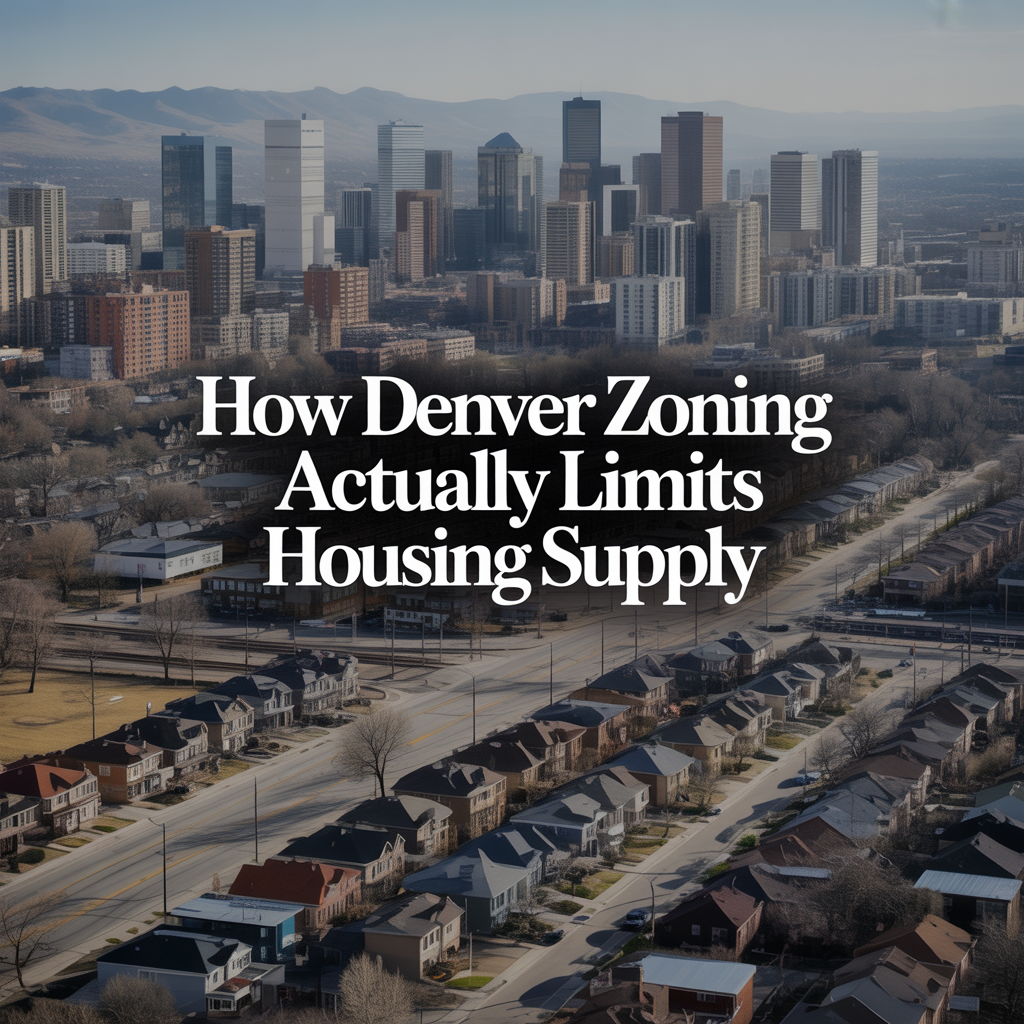
Denver’s zoning rules shape almost every aspect of housing supply in the metro area, from how many homes can be built on a block to which types of units are even legal to construct. These rules are not abstract policy; they directly influence what buyers can find, what sellers can command, and how quickly the region can respond to demand shocks.
Why Zoning Matters For Denver Housing
Zoning is the primary tool that determines what can be built, where it can be built, and at what intensity. In a market with sustained demand like Denver, those constraints are a major driver of both the quantity and the composition of homes delivered each year.
For serious buyers and sellers, the key implications are:
- Limited zoned capacity for multifamily and “missing middle” housing keeps a large share of Denver’s housing stock in relatively low-density, higher-cost forms.
- When zoning slows new production, even modest demand growth can translate into higher prices and tighter competition in desirable neighborhoods.
How Denver Zoning Limits What Can Be Built
Single-unit zoning and “missing middle” gaps
Across Colorado, a large share of residential land allows housing but restricts the most space‑efficient, lower‑cost formats such as duplexes, townhomes, and small apartment buildings. Denver reflects this pattern: local analysis has found that the most affordable housing types are allowed on only a minority of residentially zoned land, with large areas effectively reserved for single‑unit homes.
This matters because:
- Single‑unit zoning caps how many households can live near jobs, transit, and established amenities, even when demand is clearly there.
- Restricting duplexes, triplexes, and fourplexes prevents gradual, block‑by‑block increases in density that could add supply without changing neighborhood character overnight.
For buyers, the result is fewer options in central and “inner ring” neighborhoods at price points below the detached‑home tier. For long‑time owners, this often translates into higher land values but also fewer opportunities to right‑size to nearby smaller homes.
Lot sizes, height limits, and form rules
Even when multifamily or attached housing is technically allowed, form‑based rules—minimum lot sizes, maximum heights, setbacks, and lot coverage limits—can sharply reduce how many units pencil on a given site. Developers may find that by the time they meet parking, open space, and height requirements, the feasible unit count is too low to justify land and construction costs.
Key ways these constraints limit supply:
- Large minimum lot sizes reduce the number of buildable parcels and favor larger, more expensive homes over smaller formats.
- Height and bulk limits near transit and job centers keep buildings shorter and less dense than what the underlying demand would support.
In a city like Denver, where land near transit corridors and downtown has high underlying value, these design limits directly translate into fewer doors delivered per acre.
Policy Layers That Further Constrain Supply
Inclusionary requirements and permitting impacts
Beyond pure use and form rules, recent policy layers have changed the economics of development. Denver’s Expanding Housing Affordability (EHA) ordinance and inclusionary housing requirements apply to projects with 10 or more for‑sale or for‑rent units, generally requiring 8–15% of units to be income‑restricted or an alternative compliance path. While the goal is to increase affordability, the implementation has coincided with a noticeable drop in permitting.
A detailed analysis comparing Denver to Aurora and peer cities found:
- Since EHA took effect in 2022, Denver has seen roughly a 31% reduction in permitted housing units relative to the prior trend.
- Statistical modeling suggests Denver is now permitting about 241–265 fewer homes each month—roughly 2,890–3,180 fewer units per year—than it otherwise would have, largely attributable to the ordinance.
At the same time, the metro area is already permitting far fewer units than needed to close its housing deficit. In 2024, the broader Denver metro issued about 16,615 new housing permits, compared with an estimated 37,520 to 55,331 units needed annually to meet demand and close the gap by 2028. When zoning and policy reduce the number of viable projects, that shortfall deepens.
For buyers and sellers, this means:
- Fewer new units coming online to relieve pressure on resale inventory.
- More persistent competition for well‑located homes, even in years when interest rates or economic conditions should create some breathing room.
Local control, fragmented rules, and regional effects
Colorado’s land‑use framework leaves significant authority with local jurisdictions, which results in a patchwork of zoning and development standards across Denver, its suburbs, and exurban communities. While the state has begun to push for reforms—addressing issues like occupancy limits, minimum parking, accessory dwelling units (ADUs), and transit‑oriented development—implementation varies widely by city and county.
From a market standpoint:
- When inner suburbs allow efficient housing types on only a small share of residential land, demand spills into exurban areas, pushing longer commutes and infrastructure strain.
- When each jurisdiction sets its own rules for parking, height, and density around transit, the overall regional supply near job centers remains constrained, even if some municipalities are more flexible.
For relocating households evaluating the Denver metro, this is why neighborhoods with similar physical characteristics can have very different inventories, pricing, and future development potential.
ADUs and Reform Efforts: Helpful, But Limited
ADUs as a pressure valve, not a full solution
Denver has moved to loosen some zoning constraints, especially around accessory dwelling units. In 2023, the city adopted zoning code changes to remove barriers to ADUs, including more flexible lot dimensions, removal of certain structure‑length caps, and increased maximum floor area on smaller single‑unit lots. By 2024, Denver adopted a citywide ADU measure that allows ADUs in all residential areas and updates owner‑occupancy and HOA restrictions in line with state legislation.
These changes matter because:
- ADUs offer a relatively incremental way to add rental units and multigenerational living options in established neighborhoods without large new buildings.
- For owners, ADUs can create supplemental income or a place for family while making better use of existing land and utility infrastructure.
However, ADUs alone cannot close the region’s supply gap. Even optimistic adoption scenarios yield thousands of units over time, not the tens of thousands of units per year that regional studies suggest are needed. ADUs are a useful tool, but not a substitute for broader changes to zoning capacity and multifamily allowances.
State‑level land use reform
State leaders have increasingly focused on land use as a housing cost driver, tying reforms to areas like transit, parking minimums, and occupancy limits. Public support for allowing more housing near transit and job centers is strong, with recent surveys showing broad backing for higher density in these locations.
For Denver‑area households, these shifts signal:
- Over time, more opportunities for transit‑adjacent housing—if local zoning aligns with state policy goals and infrastructure investment.
- Gradual normalization of higher‑intensity housing near rail lines, major bus corridors, and employment clusters, especially in areas already served by strong road and utility networks.
Still, the day‑to‑day market outcomes you see in listings and pricing remain heavily driven by what is actually allowed—and financially viable—under local zoning in specific neighborhoods.
What This Means For Buyers, Sellers, And Relocating Homeowners
For buyers: evaluating both price and potential
For buyers who plan to hold a home for a meaningful period, zoning is as important as current finishes or staging. It shapes not only today’s price, but also the trajectory of future supply around your purchase.
Practical considerations:
- Prefer neighborhoods where zoning allows a mix of housing types—small multifamily, townhomes, and ADUs—near jobs and transit, as these areas are better positioned to adapt to demand and may offer more liquidity over time.
- Recognize that in heavily single‑unit zones with strict form controls, scarcity can keep prices resilient even in softer cycles, but may also limit nearby options if you later want to downsize or upsize.
Understanding which parts of the metro are effectively “capped” in supply by zoning, and which have room to grow, can help buyers balance long‑term appreciation prospects with their tolerance for future infill and change.
For sellers: reading your zoning as an asset
For sellers, zoning is part of the asset profile, even when it is not explicitly highlighted in the listing. In constrained neighborhoods, limited ability to add new competing units can support values and reduce the risk of sudden overbuilding nearby.
Points to keep in mind:
- If your property allows an ADU, duplex conversion, or small multifamily use under current zoning, that flexibility can add value for buyers who think like small investors or long‑term planners.
- In more restrictive zones, your home’s appeal may hinge on its unique lot, orientation, or condition in a market where new comparable construction is unlikely.
Positioning a property with an informed understanding of what can and cannot be built around it can help align expectations on both sides of the transaction.
For relocating homeowners: choosing submarkets strategically
Relocating households often focus first on commute patterns, schools, and general lifestyle differences between the urban core, inner suburbs, and newer fringe communities. Zoning adds another layer: it explains why certain areas feel “built out” and expensive, while others show active construction and a broader mix of price points.
When comparing submarkets:
- Inner suburbs that allow missing‑middle housing on only a small share of residential land may have persistent tightness in family‑sized housing near established schools.
- Outer suburbs that enable more diverse formats—but perhaps with car‑dependent layouts—may offer more new construction inventory but longer, more variable commutes.
Understanding this trade‑off helps relocating buyers choose not just a home, but a regulatory environment that fits their long‑term plans.
A Calm Takeaway On Denver Zoning And Supply
Denver’s housing challenges are not solely a story of population growth or construction costs. They are also the product of a zoning framework that, for decades, has limited the share of land available for the most space‑efficient, lower‑cost housing types while layering on policies that make many larger projects financially delicate. Recent reforms around ADUs and state land‑use policy are meaningful steps, but they do not, by themselves, resolve the underlying capacity limits.
Serious buyers, sellers, and relocating homeowners who understand these zoning mechanics are better positioned to interpret price behavior, evaluate risk, and make decisions that align with long‑term goals in the Denver metro market.
If you want to understand how your specific neighborhood’s zoning affects your options—whether that means future redevelopment potential, ADU possibilities, or likely supply trends near your next home—reach out to me directly, and we can walk through your situation in detail.
Get the full Denver Market Insights → [Market Insights]



Littleton’s Ken Caryl for Lockheed Relocations
This is part of Lockheed Martin Relocation → [Lockheed Martin Relocation Hub] & the larger Denver Relocation Hub → [Denver Relocation Hub] Written by: Chad Cabalka Ken Caryl is one of the best-kept “family first” relocation options for Lockheed Martin employees who want foothills scenery, strong neighborhood appeal, and a real suburban lifestyle that still feels connected…


Centennial & Parker for Lockheed Relocations
This is part of Lockheed Martin Relocation → [Lockheed Martin Relocation Hub] & the larger Denver Relocation Hub → [Denver Relocation Hub] Written by: Chad Cabalka Centennial and Parker are two of the smartest suburban choices for Lockheed Martin employees relocating with families because they give you a strong balance of commute flexibility, good neighborhood variety, and…

Highlands Ranch for Family-Friendly Lockheed Relocations
This is part of Lockheed Martin Relocation → [Lockheed Martin Relocation Hub] & the larger Denver Relocation Hub → [Denver Relocation Hub] Written by: Chad Cabalka Highlands Ranch is one of the strongest choices for Lockheed Martin employees relocating with families because it delivers exactly what most parents want after a big move: stable neighborhoods, strong community…