


This is part of the Long Term Rentals in Denver→ [Long Term Rentals in Denver] a hub of Denver Investing Guide → [Denver Investing Guide]
Written by: Chad Cabalka
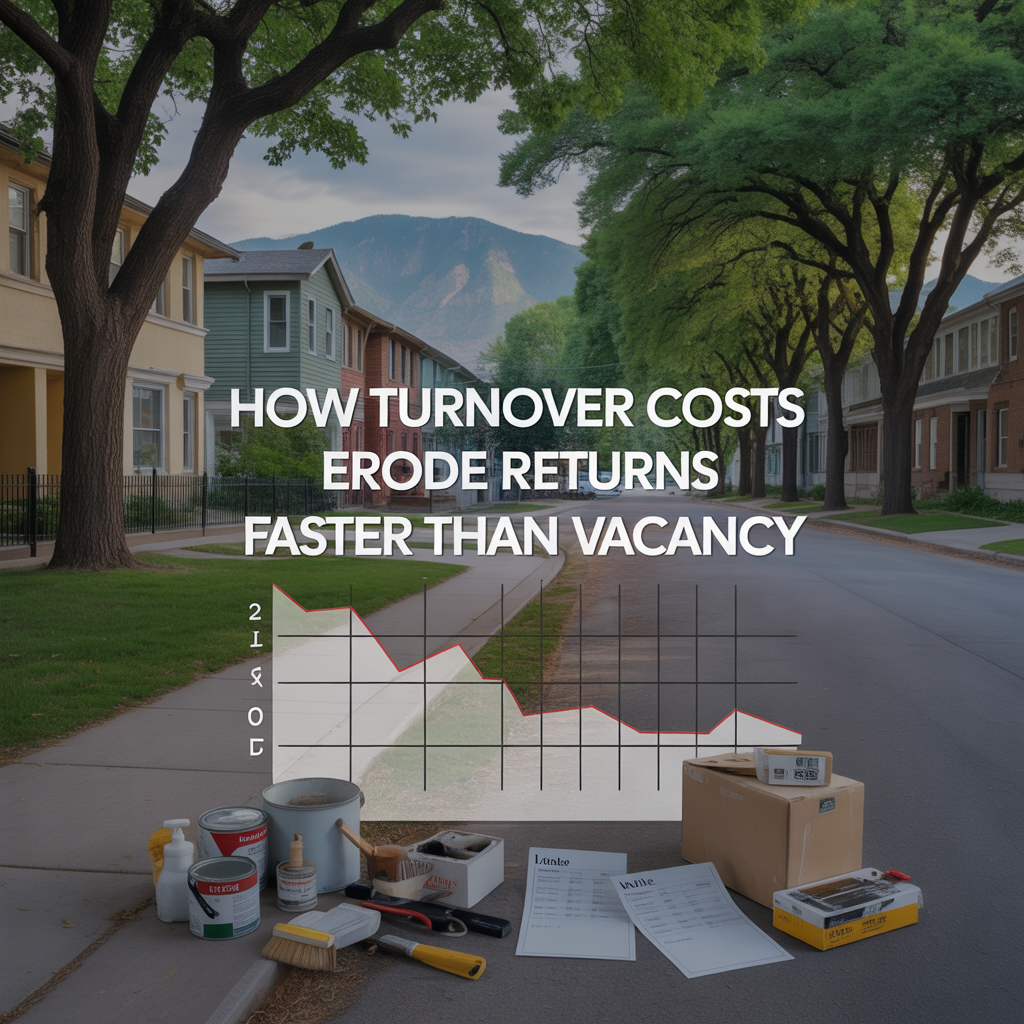
Turnover costs in Denver rentals often exceed vacancy losses by 2-3x because they compound multiple expenses beyond lost rent—cleaning, repairs, marketing, and leasing fees totaling $3,000-$6,000 per event versus $2,800 for one month’s vacancy. While vacancy represents predictable gaps averaging 41 days in the current 6-7% market, turnover triggers immediate outlays during those gaps, accelerated wear from move-in/move-out, and quality risks from tenant screening. For single-family properties generating $2,800 monthly, one turnover erodes 12-18% annual NOI—equivalent to three months’ vacancy without preparation costs—making retention the highest leverage expense control in a softening rent environment.
Denver’s market dynamics amplify this disparity. With 55,000 new units delivered since 2022 driving 7.7% vacancies, lease-up competition demands show-ready condition. RTD-proximate commuters expect fresh paint and flooring, while new construction incentives force concessions on older stock. Understanding turnover’s full lifecycle reveals why stability-focused owners outperform growth-chasers by 2-3% IRR over five years.
The Full Turnover Cost Spectrum
Vacancy loss calculation proves simple: $2,800 rent x 41 days = $3,800 opportunity cost. Turnover compounds this baseline across six categories averaging $4,900 total.
Cleaning and minor cosmetics consume $800-$1,500 immediately post-move-out. Professional services charge $0.25-$0.40/square foot for 2,000 sq ft homes, plus $300-$600 carpet refresh. Denver’s dust accumulation demands deeper cleaning than humid markets, while pet damage averages $400 extra.
Repairs surface during vacancy inspections, averaging $1,200-$2,500. Hail-damaged trim, worn appliances from short-term tenants, and scuffs accumulate faster than vacancy alone suggests. Highlands Ranch owners report $800 gutter resets post-fall turnover; Aurora landlords face $1,500 plumbing diagnostics on 1970s galvanized lines.
Marketing and showings add $300-$800. Professional photography ($200), listing fees across Zillow/Apartments.com ($100/month), and signage ($100) compete against new construction’s virtual tours. Peak seasons (March-August) double sponsored ad costs as 8,500-unit inventory floods platforms.
Tenant screening runs $50-$150 per applicant, with five to ten showings typical. Background/credit pulls, employment verification, and reference checks filter 80% of applicants. Denver’s mobile workforce increases no-shows, extending costs.
Administrative overhead—move-out inspections, lease paperwork, deposit reconciliation—consumes 15-25 hours at $30-$50 hourly management rates, or $450-$1,250 direct. HB25-1090 compliance documentation adds 2-4 hours per cycle.
Concessions close deals but sacrifice $500-$1,500 upfront—one-half month free rent proves common against Class A incentives. Total: $4,900 midpoint, 1.6x vacancy loss alone.
Turnover Accelerates Physical Deterioration
Vacancy preserves properties through disuse; turnover accelerates wear through physical handling. Moving furniture gouges walls ($200-$500 drywall patches), scuffs hardwood ($300 buffing), and stresses appliances ($400 diagnostics). Short-term tenants treat properties transactionally, doubling service calls versus long-term occupants familiar with systems.
Denver’s climate compounds damage during transitions. Spring hail exposes turnover roofs needing $8,000 patching before showings. Winter vacancies reveal ice dam rot from fall neglect ($3,000-$8,000). Summer monsoons hit fresh move-ins with foundation leaks ($2,500 cleanup), while fall turnovers uncover HVAC strain from summer heat ($1,200 service).
Compounding occurs across systems. Carpet wear from moving necessitates $2,000 replacement, stressing flooring substructure. Paint touch-ups mask deeper moisture intrusion from poor caulking. Each cycle compounds, doubling five-year capex from $15,000 (stable) to $30,000+ (50% turnover).
Quality Risk Premium Exceeds Vacancy Math
Turnover screening introduces asymmetric downside absent in vacancy alone. 80% applicant rejection yields 20% acceptance carrying unknown risks—evictions (2-3% incidence), property damage exceeding deposits ($1,500 average claims), or abbreviated tenancies renewing turnover cycles.
Denver’s tenant pool splits predictably. Capitol Hill young professionals average 18-month stays chasing amenities. Highlands Ranch families extend 36+ months valuing schools. Screening misfires cost disproportionately: one poor six-month tenant triggers $10,000 total (turnover x2 + damage), versus $3,800 pure vacancy.
Management time compounds losses. Vacancy allows scheduled maintenance; turnover demands immediate coordination across vendors during compressed timelines. Property managers report 30-40 hours per cycle versus 10-15 for renewals, valued at $1,000+ opportunity cost.
Market Timing Amplifies Turnover Pain
Denver’s leasing cycle creates predictable pain points. Peak demand (March-August) coincides with school transitions, compressing 41-day averages into 25-day rushes demanding accelerated prep. Off-peak vacancies (November-February) extend 60+ days but surface winter maintenance invisible during occupied periods.
New construction timing hurts established owners. 12,000 units under construction target March 2026 deliveries with one-month-free incentives, pulling tenants mid-cycle. Owners face accelerated turnovers into competitive seasons, doubling marketing costs and concession pressure.
Submarket dynamics vary impact. RTD corridors lease 20% faster, compressing turnover windows but demanding higher cosmetic standards. Exurban Brighton extends 60-day vacancies but saves $500 cleaning through lower expectations. DTC-proximate properties face amenity competition, sacrificing $800-$1,200 concessions.
Compounding Financial Erosion Patterns
Turnover erodes returns through three mechanisms vacancy lacks: immediate cash outlay, accelerated capex, and quality variance.
Immediate costs hit reserves directly. $4,900 turnover drains $3,800 vacancy equivalent plus $1,100 net outlay, stressing DSCR from 1.3 to 1.1. Multiple annual cycles cascade portfolio-wide, blocking refinancing.
Capex acceleration compounds geometrically. 50% turnover doubles five-year wear versus 25% vacancy impact, escalating $15,000 planned reserves to $30,000 reactive spend. Denver’s hail cycles align with turnover peaks, doubling roof budgets from $4,000 to $8,000 annually.
Quality variance introduces 20-30% NOI volatility absent in vacancy math. Poor selections trigger eviction cycles (30-60 days + $3,500 legal), damage claims exceeding deposits, and negative reviews extending future vacancies 15-20 days.
Strategic Mitigation Beyond Retention
Minimize turnover damage through preparation, not elimination. Pre-turnover inspections ($200) reveal $1,500 issues before vacancy hits. Vendor pre-arrangements cut cleaning from $1,200 to $800 (30% discount). Digital leasing—virtual tours, e-signatures—trims marketing from $600 to $350.
Bulk turnover kits save 25%: $2,000 paint/carpet bundles across three properties cost $1,500 each. Off-season concessions focus on split incentives ($400/month x3) versus full-month free. Professional photography ROI hits 5-7x through 20% faster lease-up.
Submarket Turnover Cost Profiles
Costs vary meaningfully across Denver metro. Highlands Ranch single-family averages $4,200 (low vacancy offset by $1,500 HOA resets). Capitol Hill condos hit $5,800 (high turnover offset by $800 cleaning economies). Aurora fourplexes cascade at $9,500 total (unit-wide plumbing).
RTD corridors save $600 marketing but demand $1,200 cosmetics. DTC-proximate properties face $1,000 concessions against Class A amenities. Exurban saves $400 cleaning but adds $1,800 vacancy drag.
Measuring True Turnover Impact
Calculate retention-adjusted yield: (gross rent – vacancy days – turnover costs) ÷ value. $2,800 unit with 40% turnover yields 3.8% versus 5.2% at 20% turnover despite identical vacancy math. Track trailing twelve-month turnover dollars, not days.
Portfolio operators weight stable submarkets higher during supply pressure. Individual owners target sub-$4,000 annual turnover through cosmetic discipline.
Conclusion
Turnover erodes Denver rental returns 2-3x faster than vacancy through compounded preparation costs, accelerated physical deterioration, and quality screening risks totaling $4,900 per event. Vacancy represents opportunity cost; turnover demands immediate cash while compounding future expenses through wear and risk.
Strategic preparation—pre-inspections, vendor scale, cosmetic discipline—halves damage while retention preserves the baseline. In 6-7% vacancy cycles, turnover control separates 5% yield achievers from 3% underperformers.
For Denver turnover cost analysis, retention optimization, or portfolio yield enhancement, reach out. Targeted strategies minimize controllable expenses across submarkets and cycles.
Get the full Denver Market Insights → [Market Insights]


Littleton’s Ken Caryl for Lockheed Relocations
This is part of Lockheed Martin Relocation → [Lockheed Martin Relocation Hub] & the larger Denver Relocation Hub → [Denver Relocation Hub] Written by: Chad Cabalka Ken Caryl is one of the best-kept “family first” relocation options for Lockheed Martin employees who want foothills scenery, strong neighborhood appeal, and a real suburban lifestyle that still feels connected…


Centennial & Parker for Lockheed Relocations
This is part of Lockheed Martin Relocation → [Lockheed Martin Relocation Hub] & the larger Denver Relocation Hub → [Denver Relocation Hub] Written by: Chad Cabalka Centennial and Parker are two of the smartest suburban choices for Lockheed Martin employees relocating with families because they give you a strong balance of commute flexibility, good neighborhood variety, and…

Highlands Ranch for Family-Friendly Lockheed Relocations
This is part of Lockheed Martin Relocation → [Lockheed Martin Relocation Hub] & the larger Denver Relocation Hub → [Denver Relocation Hub] Written by: Chad Cabalka Highlands Ranch is one of the strongest choices for Lockheed Martin employees relocating with families because it delivers exactly what most parents want after a big move: stable neighborhoods, strong community…