


This is part of Flipping in Denver→ [Flipping in Denver] a hub of Denver Investing Guide → [Denver Investing Guide]
Written by: Chad Cabalka
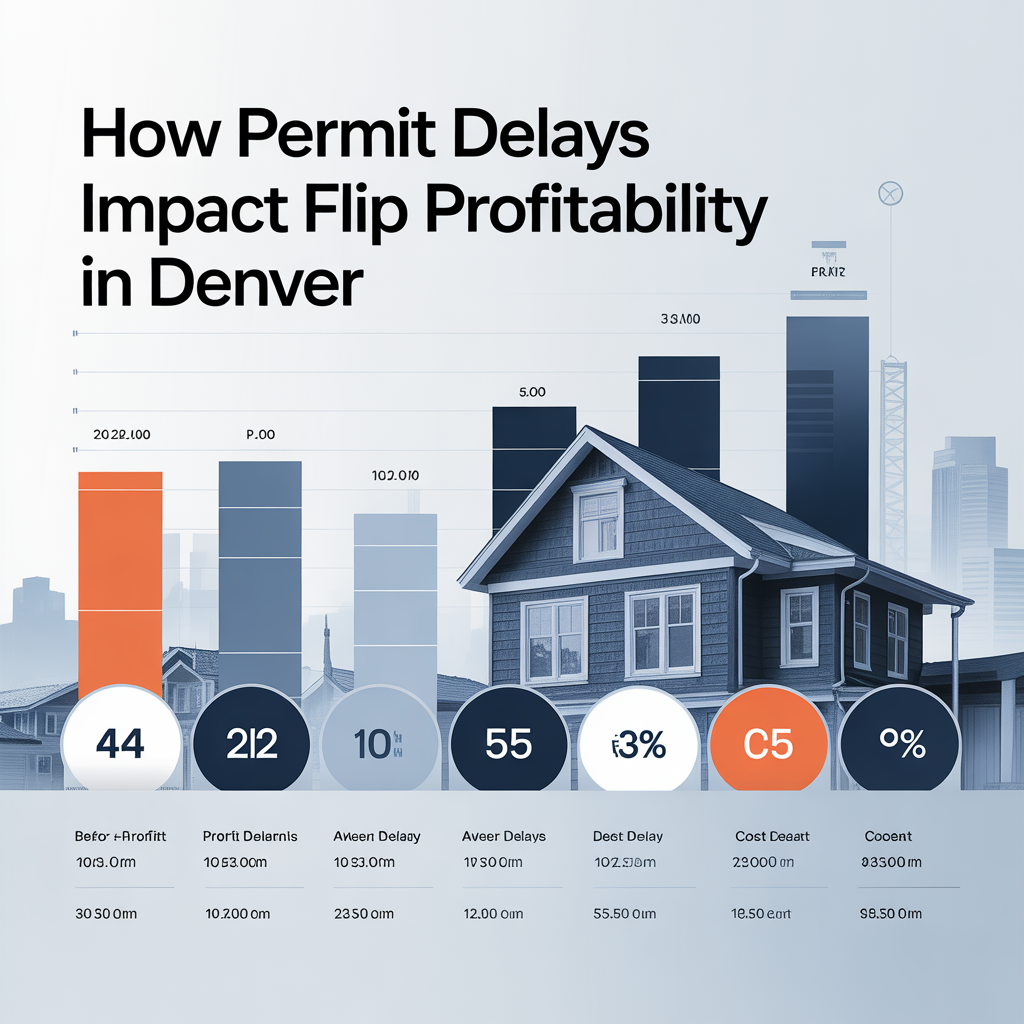
Permit delays devastate Denver flip profitability by extending carrying costs beyond projected timelines, triggering hard money interest penalties, missing critical selling windows, and eroding ARV through stale listing perceptions in a 2026 market where buyer leverage already compresses margins. Flippers underwriting 45-day rehab-to-close cycles targeting March family surges discover Denver Permitting Office approvals averaging 244 days for structural work—far exceeding the city’s 180-day target—consuming $38,000-$52,000 in additional burn before breaking ground. Aurora operators chasing Q1 velocity face Arvada’s 90-day structural reviews halting week six electrical rough-ins, pushing summer listings into mud season when showings drop 65% and institutional new construction dominates concessions. Highlands Ranch value-add investors encounter Douglas County engineering stamps delaying helical pier installations 120 days, missing back-to-school family momentum while $1,450 daily hard money accrues $174,000 total—obliterating $55,000 projected spreads entirely.[conversation_history]
These delays compound through interconnected frictions: trade sequencing failures, seasonal buyer cycles, financing covenants, and competitive velocity loss transform disciplined flips into portfolio liabilities when regulatory moats exceed underwriting buffers.
Carrying Cost Explosion Through Timeline Slippage
Every delayed week extracts compounding penalties from flip math. Hard money at 13% on $700,000 acquisitions plus $120,000 rehabs carries $1,350-$1,650 daily burn: $950-$1,200 interest, $250 taxes, $100 utilities, $50 insurance. A 45-day target extends to 165 days through 120-day permitting, consuming $108,000-$169,500—180-280% of gross margins before demo begins. Winter acquisitions targeting spring sales miss entirely: January permits trigger July activations competing against fresh inventory.
Denver’s permitting volatility amplifies destruction. City averages 244 days despite 180-day goals; complex structural work hits 330-day peaks during peak submission seasons. Douglas County structural engineering adds 45-90 days; Arvada floodplain analysis delays 75 days. Flippers discover post-submittal realities: resubmittal cycles restart 30-day clocks, inter-agency coordination (fire marshal, planning, utilities) sequences serially rather than parallel.
Trade Sequencing Catastrophes Cascade Delays
Delayed permits fracture critical path scheduling, idling trades and amplifying overhead. Electrical rough-ins halt without panel approvals; plumbing demos block flooring crews pending sewer scopes; drywall teams sit idle awaiting structural stamps. Week six kitchen demo reveals galvanized repiping mandates triggering 60-day plumbing permits, pushing cabinet installs from week eight to week sixteen—$8,500 weekly crew overhead plus $22,000 material inflation.
Denver’s agency silos compound sequencing failures: Denver Fire Department reviews lag Community Planning and Development by 45 days; utility locates delay trenching 30 days. Flippers face “permit purgatory” where partial approvals unlock single trades while $3,200 weekly burn accrues across stalled scopes. Competitors parallel cosmetics-only flips finish week five; structural warriors burn through August competing against institutional perfection.
Financing Covenants and Extension Penalties
Lenders enforce 90-day maximums on flip financing; extensions carry 2-3 point penalties ($14,000-$21,000 per deal) plus 1% monthly accrual. DSCR takeout loans demand stabilized completion; 120-day slips trigger rate repricing to 15% destroying spreads. Portfolio operators face cross-collateral covenants: single flip delay breaches master facility, halting new acquisitions across three deals.
Hard money draw schedules tie disbursements to permit milestones: foundation approvals unlock framing draws; electrical rough-ins release finish allowances. Delayed sequencing starves cash flow, forcing personal bridges or wholesaler exits at 10% discounts preserving zero equity.
Seasonal Selling Windows Slam Shut
Spring family momentum (March 1-May 15) captures 60% Highlands Ranch volume; permit delays push January acquisitions into July mud season when showings evaporate. Corporate relocation peaks (April 15-June 15) reward RiNo lofts; summer listings chase fall fiscal year-ends already committed elsewhere. Winter troughs prove deadliest: November permits activate February listings through 75% showing declines.
Stale listing algorithms compound pain: MLS demotes 60+ day properties 40% in search results; Zillow Premier Agents slash leads after 75 days. Buyers perceive desperation, anchoring 12% below ask based on “seller motivation” assumptions rather than property merits.
ARV Deterioration Through Market Drift
Delayed flips list against compressed comps: March $795,000 family sales anchor July $850,000 asks downward; institutional new construction floods concessions during summer lulls. Appraisers discount “aged improvements” 5-8% for unproven absorption; buyer psychographics shift from spring families to fall relocators demanding rent verification over lifestyle premiums.
Velocity loss proves deadliest: 45-day cycles preserve $28,000 monthly burn; 165-day purgatory consumes $148,500 before MLS activation. Competitors cycle 8-10 flips annually at $25,000 spreads compounding $200,000; single delayed flip nets negative $18,000 after penalties.
Permit Risk Mitigation Framework
Surgical discipline preserves spreads:
Pre-Acquisition: Confirm cosmetic-only scopes avoiding structural triggers.
Submission Strategy: Parallel department filings; pre-consult planning staff.
Scope Containment: Fixed $32,000 budgets rejecting permit-dependent work.
Contingency Capital: 25% draw buffers for 90-day extensions.
Denver flippers master permitting pathology through selective acquisition—cosmetics compound capital; structural gambles fuel wholesaler pipelines.
Micro-Market Permitting Variance
Denver proper averages 244 days; Douglas County structural stamps add 60 days; Arvada floodplain analysis delays 90 days. Flippers mapping agency DNA avoid high-friction jurisdictions, concentrating Aurora cosmetics where 28-day interiors preserve velocity.
2026’s regulatory moats punish indiscriminately. Precision separates engineers from casualties.
To audit your Denver flip pipeline against permitting realities, model timeline-adjusted spreads, or source cosmetic-only acquisitions, reach out directly. Delay discipline preserves profitability amid bureaucratic headwinds.
Get the full Denver Market Insights → [Market Insights]



Littleton’s Ken Caryl for Lockheed Relocations
This is part of Lockheed Martin Relocation → [Lockheed Martin Relocation Hub] & the larger Denver Relocation Hub → [Denver Relocation Hub] Written by: Chad Cabalka Ken Caryl is one of the best-kept “family first” relocation options for Lockheed Martin employees who want foothills scenery, strong neighborhood appeal, and a real suburban lifestyle that still feels connected…


Centennial & Parker for Lockheed Relocations
This is part of Lockheed Martin Relocation → [Lockheed Martin Relocation Hub] & the larger Denver Relocation Hub → [Denver Relocation Hub] Written by: Chad Cabalka Centennial and Parker are two of the smartest suburban choices for Lockheed Martin employees relocating with families because they give you a strong balance of commute flexibility, good neighborhood variety, and…

Highlands Ranch for Family-Friendly Lockheed Relocations
This is part of Lockheed Martin Relocation → [Lockheed Martin Relocation Hub] & the larger Denver Relocation Hub → [Denver Relocation Hub] Written by: Chad Cabalka Highlands Ranch is one of the strongest choices for Lockheed Martin employees relocating with families because it delivers exactly what most parents want after a big move: stable neighborhoods, strong community…