


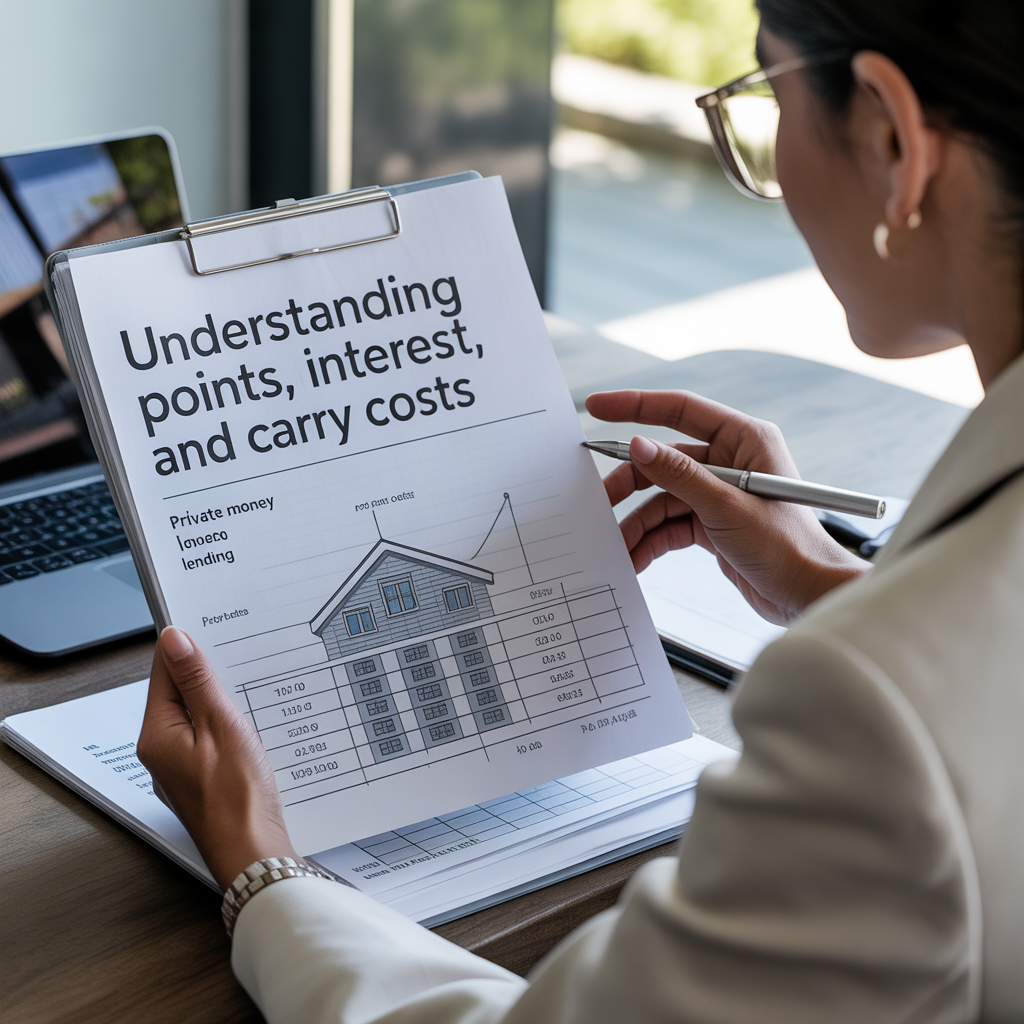
This is part of Denver Home Financing Guide → [Denver Home Financing Guide] & Private Money → [Private Money]
Written by: Chad Cabalka
Points, interest, and carry costs represent the true price tag of private money loans in Denver—often catching first-time borrowers off guard when excitement over fast closings fades into monthly reality. These three elements work together like compound interest on steroids, turning a $500,000 Congress Park duplex deal into $45,000+ in financing expenses over six months if not planned carefully. Understanding their mechanics upfront lets you calculate real profitability in our 2026 market, where private money runs 9-12% versus banks’ 6-7% long-term rates, ensuring your equity survives the bridge to conventional financing.[history]
Points: The Upfront Entry Fee
Points function as origination fees—essentially prepaid interest charged as a percentage of your loan amount, typically 2-4 points (2-4%) in Denver’s private lending market. On a $400,000 loan at 3 points, you pay $12,000 at closing, rolled into the loan or wired separately, compensating lenders for quick capital deployment without bank-style underwriting. This one-time hit feels painful but buys speed—7-10 day closings that win Sunnyside multiple-offer battles where banks need 45 days.
Lenders price points by risk: clean-title Virginia Village flips get 2 points at 65% LTV; riskier Globeville rehabs with foundation work hit 4 points at 70% LTV. In 2026’s balanced inventory (3.8 months supply), experienced borrowers negotiate down to 1.5-2 points by proving track records—I’ve seen repeat investors save $8,000 per deal this way. The key comfort? Points don’t compound monthly like interest; pay once, move forward.
Interest: The Monthly Carrying Charge
Interest accrues daily at 9-12% annually on private loans, often interest-only payments that defer principal to the balloon date (6-24 months out). A $450,000 RiNo loan at 10.5% costs $3,938 monthly, totaling $23,625 over six months—compare that to a bank mortgage’s $2,400 principal-and-interest at 6.75%. Denver lenders favor interest-only structures during rehabs, preserving cash flow when rental income or sales haven’t kicked in yet.
Rates tier by property strength: Park Hill rentals with leases secure 9-10%; raw land or incomplete Lakewood flips push 11-13% reflecting execution risk. Post-2025 Fed cuts, top-tier deals dip toward 8.75%, but averages hold 10.25% per recent lender data. Your long-term peace hinges on short holding periods—interest compounds painfully if timelines stretch from contractor delays or soft sales like 2023’s brief dip.
Carry Costs: The Silent Profit Eater
Carry costs encompass everything beyond points/interest: property taxes ($4,200 yearly on $550K assessed value), insurance ($2,100 annually), utilities ($450/month vacant), HOA dues ($150/month in Highlands Ranch), and misc (HOA estoppics $350, permits $1,200). A 90-day Aurora flip carries $8,500 beyond loan payments; six months balloons to $22,000, slashing 20% off projected ROI. These expenses run regardless of tenant status or rehab progress, hitting hardest when ARVs underperform comps.
Denver specifics amplify this: 2026 property tax rates average 0.78% metro-wide, but Douglas County (Highlands Ranch) hits 0.92% while Denver proper stays 0.71%. Winter utility spikes add $200/month to vacant flips; permit delays in historic Congress Park tack $3,000+ in holding. Savvy borrowers budget 1.5% monthly of purchase price for carries, building buffers that turn tight deals profitable.
Breaking Down Total Cost Structure
| Cost Type | Example: $450K Loan @ 70% LTV | 6-Month Total | Denver Impact Example |
|---|---|---|---|
| Points (3%) | $13,500 upfront | $13,500 | Funds RiNo close in 8 days |
| Interest (10.5%) | $3,938/month x 6 | $23,625 | Eats $4K/mo during rehab |
| Property Taxes | $1,575/6 months | $1,575 | Highlands Ranch Q2 bill |
| Insurance/Util | $1,200 + $2,700 | $3,900 | Vacant Wheat Ridge winter |
| Total Carry | $42,600 (9.5% of loan) | $42,600 | 20% ROI → 12% actual |
This table reveals why 65% LTV deals (lower loans) save $7,000+ versus 75%—smaller principal shrinks all components proportionally.
Layered Impact on Denver Deals
Stack these costs against timelines: a $525,000 Park Hill duplex purchase with $75,000 rehab pencils at $800,000 ARV (22% spread). At 3 points ($15,750), 10% interest ($26,250/6mo), and $9,500 carries, total financing hits $51,500—dropping ROI from 22% to 13.5% after reserves. Conservative planners build 25% gross margins to absorb this; optimists celebrating “18% spread” wake to thin profits.
Neighborhood math varies wildly: RiNo condos carry higher HOAs ($300/month) but faster flips (45 days); Lakewood single-families tax heavier but rent immediately at $3,200/month. 2026’s 4-6% appreciation cushions some pain, but balanced supply means 10-15% price corrections in overbuilt pockets like outer I-25 corridor. Master this math pre-offer—your financial stability depends on it.
Strategies to Minimize Total Burden
Shorten timelines ruthlessly: 90-day flips cut interest/carries 50% versus 180 days, preserving $18,000 on average deals. Negotiate interest-only with draws tied to inspections, starving cash during cosmetic phases. Bring 35% down (under 65% LTV) to slash loan size 15%, dropping all costs proportionally—$450K becomes $385K, saving $9,500 total.
Build lender relationships for 1-2 point deals; track record trumps rate-shopping. Pre-arrange refi partners for day-90 cash-out at 6.75%, turning expensive bridges into wealth ramps. Families bridging Centennial-to-Edgewater find deferred interest (no payments til sale) preserves liquidity during transitions—critical when carrying two mortgages.
Long-Term Financial Peace Formula
These costs test discipline most: borrowers treating private money like long-term debt drown in 11% payments while banks offer 30-year amortization at half the rate. The proven path flips fast (under 120 days), refis winners, repeats selectively—compounding equity through Denver’s steady growth. I’ve guided families who cut carries 30% through neighborhood selection alone, turning $50K flips into $150K portfolios over five years.
Emotional toll matters too: predictable math eliminates midnight sweats over tax bills or rate resets. Sustainable investors sleep knowing spreads exceed costs by 8% minimum, building generational stability.
When Costs Signal Walk-Away
If total carry exceeds 12% of loan annually without 25%+ gross spread, reconsider—$60K financing on $500K deals leaves no error room for 2026’s permit delays or buyer pickiness. Compare against hard money (10-14%) or portfolio lines (8-9%) for repeaters. Denver rewards matching tools to timelines, not forcing expensive fits.
Your Path to Cost Clarity
Ready to run precise numbers for your next Denver deal—from Five Points multi-family to Highlands Ranch bridge? Reach out for that practical conversation where we map points, interest, and carries against your specific property and timeline. With 25+ years decoding metro lending costs, I deliver the straightforward math that turns opportunities into sustainable wins—no hype, just the reliable guidance your family or portfolio deserves. Let’s connect and eliminate the guesswork today.
Get the full Denver Market Insights → [Market Insights]


Littleton’s Ken Caryl for Lockheed Relocations
This is part of Lockheed Martin Relocation → [Lockheed Martin Relocation Hub] & the larger Denver Relocation Hub → [Denver Relocation Hub] Written by: Chad Cabalka Ken Caryl is one of the best-kept “family first” relocation options for Lockheed Martin employees who want foothills scenery, strong neighborhood appeal, and a real suburban lifestyle that still feels connected…

Centennial & Parker for Lockheed Relocations
This is part of Lockheed Martin Relocation → [Lockheed Martin Relocation Hub] & the larger Denver Relocation Hub → [Denver Relocation Hub] Written by: Chad Cabalka Centennial and Parker are two of the smartest suburban choices for Lockheed Martin employees relocating with families because they give you a strong balance of commute flexibility, good neighborhood variety, and…

Highlands Ranch for Family-Friendly Lockheed Relocations
This is part of Lockheed Martin Relocation → [Lockheed Martin Relocation Hub] & the larger Denver Relocation Hub → [Denver Relocation Hub] Written by: Chad Cabalka Highlands Ranch is one of the strongest choices for Lockheed Martin employees relocating with families because it delivers exactly what most parents want after a big move: stable neighborhoods, strong community…