


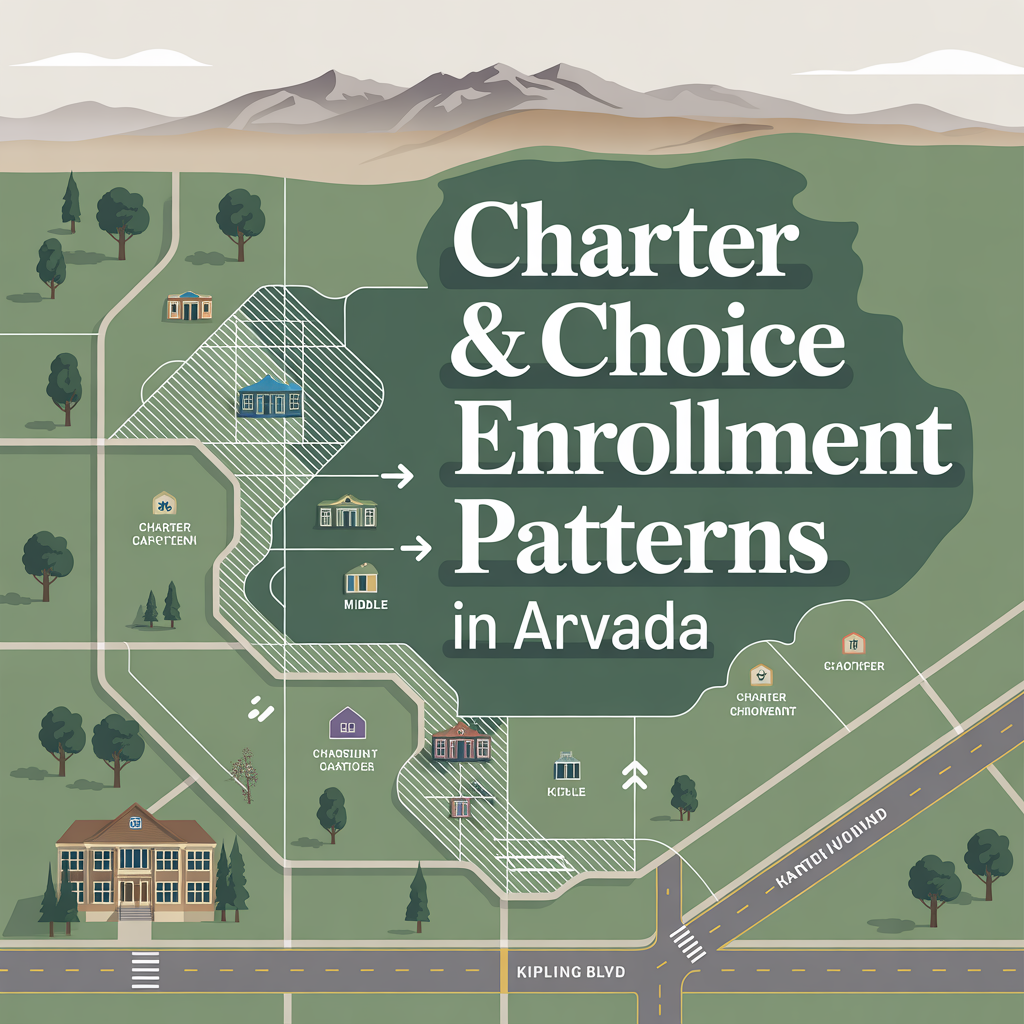
This is part of Littleton Lifestyle Hub → [Littleton Lifestyle Hub] & Littleton Real Estate Guide → [Littleton Real Estate Guide]
Written by: Chad Cabalka
Here is a 1,400–1,600‑word long‑form article on charter and choice enrollment patterns in Arvada, written in the voice of a Denver–area real estate professional with deep local knowledge of Arvada families and schools.
How Arvada Families Use Charter & Choice Schools: A Real‑World Look
In the Denver metro area, school decisions are rarely as simple as “which neighborhood school am I assigned to?” That’s especially true in a city like Arvada, where families routinely look beyond their assigned Jeffco neighborhood schools and explore charter schools and the district’s choice enrollment options. Over many years working with families choosing homes in Arvada, I’ve come to see that the most important thing isn’t just which school type is used, but why and how it fits into a family’s actual life.
For parents, this system offers flexibility, but it also adds complexity. A home in Arvada might feed into a well‑regarded neighborhood school, or it might be a launchpad for a daily commute to a charter or choice school that better matches a child’s learning style or family priorities. The real impact of this pattern shows up not in rankings or websites, but in morning routines, work schedules, bus stops, and how families feel about their neighborhood over time.
This isn’t about pushing any one path; it’s about understanding how Arvada families actually use charter and choice options, what that means for daily life, and how to think about school decisions when choosing where to live.
How Choice Enrollment Works in Jeffco
Jeffco Public Schools runs a structured choice enrollment system that allows families to apply to attend schools outside their neighborhood attendance zone. In Arvada, this means families can apply to a range of Jeffco schools beyond the assigned elementary, middle, and high school.
The process is annual. Families submit applications during specific windows, and schools assign seats based on space, sibling priority, and sometimes waitlists. Placement is not guaranteed, but many families successfully enroll in schools farther from home, especially if they apply early and rank schools strategically.
For Arvada families, common choices include:
- Jeffco magnet schools with specialized themes (STEM, arts, language immersion, etc.).
- Comprehensive high schools with strong athletics, academics, or career programs (like Warren Tech or Ralston Valley).
- Smaller schools or alternative programs that offer a different pace or teaching style.
This system is a powerful tool for families who are clear about what kind of school environment they want, but it also requires planning. Families need to understand transportation (bus routes, school runs, or driving), time to and from school, and the long‑term stability of the school (for example, a school that’s already heavily impacted may not have spots from year to year).
Charter Schools in the Arvada Area
Arvada itself doesn’t have a large number of standalone charter schools, but it sits within the Jeffco district, which authorizes and supports a network of charter schools serving Arvada families. These schools are publicly funded but operate independently, with their own boards, curricula, and often more focused models.
Common charter models that attract Arvada families include:
- K–8 or K–12 schools with a strong emphasis on personalization, small class sizes, or project‑based learning.
- Schools with a Montessori, classical, or faith‑based approach.
- Specialized schools that emphasize STEM, performing arts, or outdoor education.
These schools appeal to families who want something different from the traditional neighborhood school — whether that’s a smaller, more intimate environment, a specific teaching philosophy, or a curriculum that aligns with family values.
For homebuyers, this means that even if a home is in a neighborhood that feeds into a neighborhood school, the family may still intend to use a charter school as their main plan. That’s a realistic and common path, but it introduces a few practical considerations: transportation, school hours, and how that school’s culture fits into the overall family rhythm.
Typical Enrollment Patterns in Arvada
From working with hundreds of families in Arvada, a few clear patterns emerge in how families approach charter and choice:
Young families with small children often look at neighborhood schools first, then consider options once they’re in the community. Many families move into Arvada assuming they’ll attend their Jeffco neighborhood school, and then decide after a year or two whether to stay or explore choice or charter schools. This is especially common in the Arvada and Arvada West articulation areas, where elementary schools are close to homes, walkable, and feel like a natural part of the neighborhood.
Families with a strong preference for a certain school model (Montessori, language immersion, STEM, etc.) often plan their home search around choice or charter access. These families are more likely to prioritize homes that are reasonably close to the school they want, or at least in a location where daily transportation is manageable. They tend to start researching options early, during the home search, and build their school plan into the neighborhood decision.
High school–age families often look at choice primarily through high school options. Many families decide that their neighborhood elementary and middle schools are a good fit but then actively pursue choice for high school, especially if they’re interested in a school with a strong career and technical program, specialized academics, or a particular athletic reputation. This is a very common pattern in Arvada, where families keep the neighborhood elementary school but then choose Ralston Valley, Warren Tech, or another Jeffco choice high school.
These patterns are not right or wrong; they’re just how families adapt the system to their lives. The key is matching that pattern with the right home — a home that supports the school plan, not one that feels like a constant compromise.
How This Affects Daily Life
The quiet impact of charter and choice enrollment is how it reshapes routines. In Arvada, it’s not unusual for families to build their entire morning around a school different from the one they’re assigned to by address.
For example, a home in an Arvada neighborhood that feeds into Arvada West schools might actually send its children to a charter school in Wheat Ridge or Lakewood. That means earlier mornings, more driving, and less time for spontaneous walks or bike rides to the neighborhood school. Conversely, a home that is close to a desired charter school can feel freeing and convenient, with shorter commutes and more time for extracurriculars or family time after school.
Transportation is usually the biggest practical factor. Families using choice or charter schools often have to:
- Drive their children to school, especially if bus routes are limited or inconvenient.
- Arrange carpools with other families using the same school.
- Plan around school hours that may differ from the neighborhood school (longer days, different start times, or four‑day weeks).
For working parents, these details matter deeply. A school that feels ideal on paper can become a daily burden if it requires long commutes, rigid schedules, or constant logistical juggling. That’s why, in advising families, the discussion is never just “which school is the best,” but “which school fits into the life we actually live?”
How This Shapes Long‑Term Stability
Over the years, the families who feel most settled in Arvada are usually the ones whose school decisions align with their neighborhood choice. Stability isn’t guaranteed by any one school, but it’s much easier to build when the school and the neighborhood feed into a consistent, predictable rhythm.
For families heavily reliant on choice or charter schools, a few long‑term questions come up repeatedly:
- Is the school plan stable for the next 6–10 years, or will it likely change as grades change or space becomes limited?
- How much extra time and energy does the school commute require, and how does that affect work and family life?
- Would a different home, closer to the desired school, actually reduce stress and free up time over the long term?
These aren’t theoretical questions. They come up at parent meetings, in PTO conversations, and in living rooms when families are deciding whether to stay in their current home or move to better match their school plan.
The most grounded approach is to treat the school decision as part of the housing decision from the start. That doesn’t mean chasing the “perfect” school, but it does mean being honest about how much transportation, time, and planning a given school path will demand, and then choosing a home that supports that reality.
Practical Advice for Arvada Families
If you’re thinking about using charter or choice schools in Arvada, here are a few practical steps that can help you make a sustainable, long‑term decision:
- Start with a clear school plan, then match it to location. If you’re confident about a specific charter school or Jeffco choice school, research its enrollment process, waitlists, and transportation options before finalizing a home.
- Factor in the commute. Map out the drive or bus route on a school day, at actual school hours, under normal weather conditions. Estimate how much extra time and cost that will add to your family’s routine.
- Talk to current families at the school. Ask about transportation, parent involvement, after‑school activities, and how the school feels as students move from elementary to middle to high school.
- Consider backup options. If the preferred school doesn’t work out, what is plan B? How viable is the assigned neighborhood school, and how easy would it be to switch back into the neighborhood system if needed?
- Think about the long arc, not just kindergarten. A school that feels ideal for K–5 may feel very different in 6–12, and the same is true for transportation, bus routes, and extracurricular options.
The goal isn’t to pick the “best” school, but to find a school and neighborhood that together create a rhythm that feels manageable and sustainable for years.
A Local Advisor’s Perspective
Over my years in Denver real estate, I’ve learned that the most important part of a school decision isn’t ratings or test scores, but how that school fits into the everyday life of a family in Arvada. Charter and choice options offer real flexibility, but they also ask families to make intentional tradeoffs: convenience versus specialization, consistency versus variety, neighborhood integration versus a different school culture.
If you’re thinking about where to live in Arvada, and how charter and choice schools fit into your family’s path, I’d be glad to sit down and walk through the practical realities — not with a sales pitch, but as a local who’s seen how families’ lives in Arvada actually unfold from season to season, year after year. I can help you understand which neighborhoods support which schools, how choice and transportation tend to play out, and how to make a decision that feels confident now and stable for the long term.
Get the full Denver Market Insights → [Market Insights]


Littleton’s Ken Caryl for Lockheed Relocations
This is part of Lockheed Martin Relocation → [Lockheed Martin Relocation Hub] & the larger Denver Relocation Hub → [Denver Relocation Hub] Written by: Chad Cabalka Ken Caryl is one of the best-kept “family first” relocation options for Lockheed Martin employees who want foothills scenery, strong neighborhood appeal, and a real suburban lifestyle that still feels connected…


Centennial & Parker for Lockheed Relocations
This is part of Lockheed Martin Relocation → [Lockheed Martin Relocation Hub] & the larger Denver Relocation Hub → [Denver Relocation Hub] Written by: Chad Cabalka Centennial and Parker are two of the smartest suburban choices for Lockheed Martin employees relocating with families because they give you a strong balance of commute flexibility, good neighborhood variety, and…

Highlands Ranch for Family-Friendly Lockheed Relocations
This is part of Lockheed Martin Relocation → [Lockheed Martin Relocation Hub] & the larger Denver Relocation Hub → [Denver Relocation Hub] Written by: Chad Cabalka Highlands Ranch is one of the strongest choices for Lockheed Martin employees relocating with families because it delivers exactly what most parents want after a big move: stable neighborhoods, strong community…