


This is part of Centennial Lifestyle Guide → [Centennial Lifestyle Hub] & Centennial Real Estate Guide → [Centennial Real Estate Guide]
Written by: Chad Cabalka
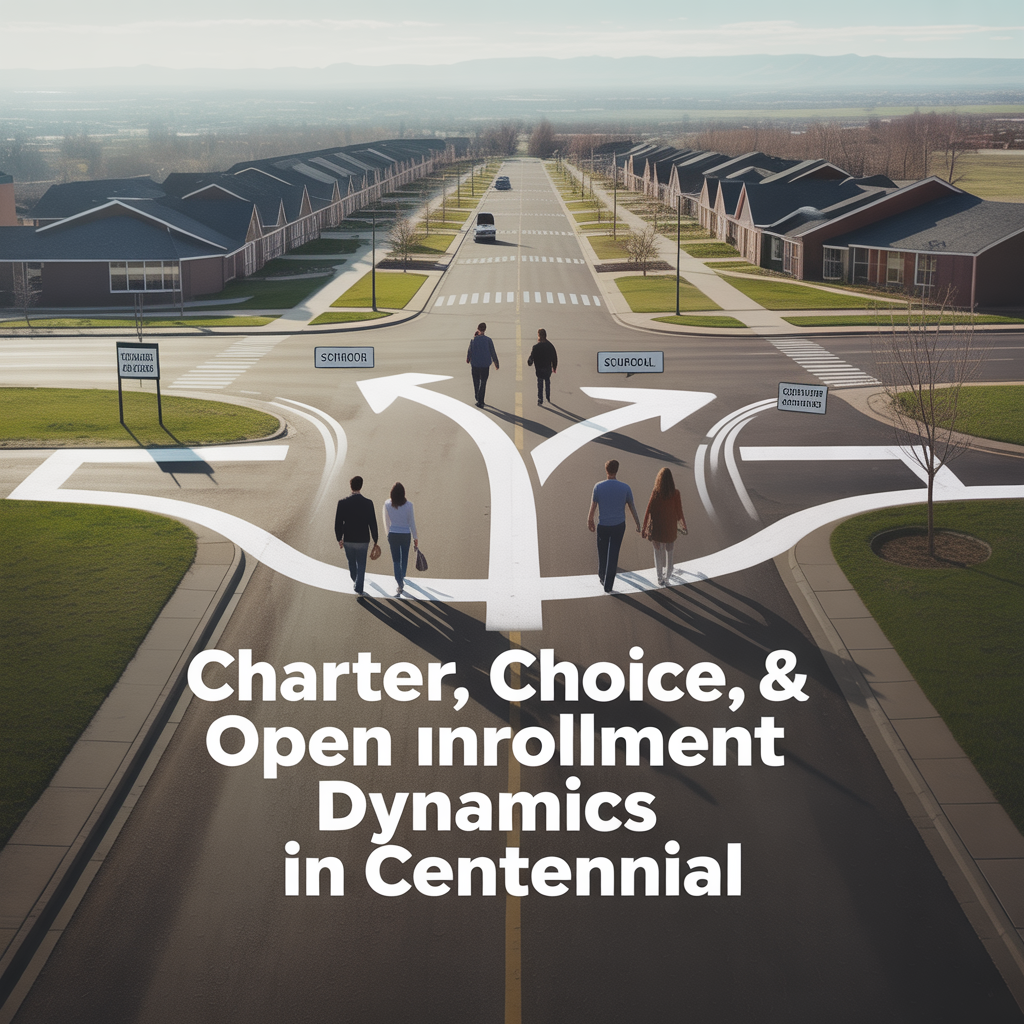
If you’ve spent any time navigating public education in the south metro, you’ve probably heard the terms “charter,” “choice,” and “open enrollment” tossed around like they’re interchangeable. In Centennial, they’re anything but. Each represents a different way families can shape their children’s education—and each comes with its own rhythm, trade‑offs, and long‑term implications for how you choose a neighborhood and a home.
As someone who’s lived and worked in Denver for decades, I’ve watched these options quietly reshape how families think about school zones. It’s no longer enough to ask, “Which school am I assigned to?” The real question is, “What mix of district, charter, and open‑enrollment options actually fits my family’s life?”
What “Charter” Means in Practice
Charter schools in Colorado are public schools, not private ones. They don’t charge tuition, and they’re open to any student who applies, though space is limited. What makes them different is autonomy: charters operate under a contract (“charter”) with an authorizer—often a district or the state—giving them flexibility over curriculum, staffing, and schedule.
In and around Centennial, charter options include schools like Cherry Creek Academy (Core Knowledge–focused, K–8), Littleton Academy (K–8), and others that draw students from Arapahoe, Douglas, and Jefferson counties. These schools tend to emphasize specific models—classical curriculum, project‑based learning, STEM, or arts‑focused programs—rather than a one‑size‑fits‑all approach.
For families, that can mean a better fit for a particular learning style. For example, a child who thrives in a highly structured, content‑rich environment may do very well at a Core Knowledge charter, while another might prefer a more flexible, experiential model. The challenge is that charters are still public schools, so they must follow state testing and accountability rules, even as they innovate within the classroom.
Choice Schools and District “Innovation” Models
Beyond stand‑alone charters, many families in Centennial also consider choice schools within their home district. These are district‑run schools that operate under a special designation—often called “innovation” or “magnet” models—giving them more freedom over schedule, staffing, and programming while remaining part of Cherry Creek, Littleton, or Douglas County.
In Littleton Public Schools, for instance, Centennial Academy of Fine Arts Education serves students from Centennial and beyond, emphasizing arts‑integrated instruction. Cherry Creek has similar specialized programs embedded within its network. These schools are attractive because they blend the stability of a district with a focused academic or cultural focus.
The trade‑off is capacity. Because they’re still part of the district, they often cap enrollment and may require applications or lotteries. Families who count on a specific choice school need to plan early—sometimes years in advance—because these seats fill quickly.
Open Enrollment: How It Works in Centennial
Colorado’s open enrollment law lets families apply to attend public schools outside their assigned attendance zone, including schools in other districts. In Centennial, that means a child assigned to a Littleton school can apply to attend a Cherry Creek school, or a Douglas County charter, and vice versa.
Here’s how it typically plays out:
- Families submit applications during a defined window, often in the fall or early winter.
- Schools and districts review applications based on capacity, sibling priority, and sometimes other criteria.
- If accepted, the family can enroll—but transportation is usually not provided unless the district offers a limited bus route.
For Centennial families, this can feel like freedom: the ability to “shop” for the best‑fit school rather than being locked into one boundary. In practice, though, it often introduces new logistics. A child might attend school in Greenwood Village, while the family lives in Southglenn, creating a daily commute that adds time and complexity to mornings and afternoons.
How Charter and Choice Options Affect Centennial Neighborhoods
When more families begin using charters and open enrollment, the relationship between home address and school community starts to loosen. Two neighbors on the same street may send their kids to entirely different schools—one to a district elementary, another to a charter, and a third to a choice school across the county line.
This can dilute some of the traditional neighborhood cohesion that comes from everyone feeding into the same elementary. Block parties, carpool groups, and after‑school hangouts may scatter across multiple campuses instead of clustering around one school. At the same time, it can create new communities—families who meet through a shared charter or choice program and build friendships that cross municipal boundaries.
For homeowners, the impact is subtle but real. In neighborhoods where many families “opt out” of their assigned school, the local school may feel less central to daily life, even if it remains strong academically. That can influence how people talk about the area when they list a home or describe it to buyers.
Common Misconceptions About Charter and Choice
One of the most persistent misunderstandings is that charter schools are “better” or “worse” than district schools by default. In reality, Colorado’s charter sector is diverse. Some charters are highly selective in practice (through culture, expectations, or application barriers), while others serve a broad cross‑section of students. Performance varies just as it does across district schools.
Another misconception is that open enrollment is a guaranteed path to a preferred school. Families sometimes assume that because the law allows them to apply, acceptance is automatic. In high‑demand years, popular charters and choice schools can have long waitlists, and siblings of enrolled students often receive priority.
Finally, many relocating families underestimate how transportation affects their routine. Driving 20–30 minutes each way for drop‑off and pickup may be manageable for a few years, but it can become a strain as schedules grow more complex with sports, clubs, and part‑time jobs.
How to Think About Charter, Choice, and Open Enrollment Over Time
For families making long‑term decisions in Centennial, it helps to treat these options as part of a broader lifestyle plan, not just a short‑term academic choice. Ask:
- How much time are we willing to spend commuting to school?
- Do we value the stability of a neighborhood school where our kids will grow up with the same classmates, or do we prioritize a specific curriculum or program?
- How will our choice affect after‑school activities, friendships, and our own work schedules?
It’s also important to recognize that preferences can change. A child who thrives in a small, structured charter in elementary may need the broader course offerings and extracurriculars of a large district high school later on. Planning for that transition—whether it means switching back to the home district or finding another charter—requires foresight.
For homeowners, understanding these dynamics can influence where and how they buy. Some families choose to live closer to a preferred charter or choice school, even if it means a slightly smaller home or higher price. Others prioritize neighborhood schools and accept that their children may stay within the district system for consistency.
Practical Guidance for Centennial Families
If you’re weighing charter, choice, or open‑enrollment options in Centennial, here are a few concrete steps:
- Start with your home district’s map. Confirm which schools your address feeds into, then explore what charters and choice schools are within a realistic commute.
- Visit in person. Charter and choice schools often host open houses or tours. Seeing the culture, asking about class sizes, and talking to current parents can reveal more than any ranking.
- Ask about transportation. Clarify whether the school or district provides any bus routes, and if not, factor in the time and cost of driving.
- Consider the long arc. Think beyond kindergarten: how will this choice affect middle and high school transitions, sports eligibility, and college preparation?
For buyers and sellers, it’s also worth noting that while some families prioritize charters or choice schools, others still place a premium on being within a strong neighborhood school zone. That diversity of preferences is part of what keeps Centennial’s housing market resilient through different cycles.
The Long‑Term View: Stability and Flexibility
At its best, Colorado’s mix of district schools, charters, and open enrollment gives families real agency. In Centennial, that means you’re not stuck with a single path. You can stay within your assigned school, explore a charter that aligns with your child’s learning style, or apply to a choice school that offers a specialized program.
The key is to balance flexibility with stability. A school that fits your child’s needs today should also support them five or ten years down the road. And a home that fits your family’s educational plan should also support your long‑term goals for community, commute, and quality of life.
If you’re trying to untangle how charter, choice, and open enrollment options might affect your family’s plans in Centennial—or how they could influence where you buy or sell—I’m always glad to talk through it. After decades of working with families in these neighborhoods, I’ve seen how these decisions quietly shape daily life for years. Let’s have a conversation that’s grounded in your family’s rhythm, not just the latest trend.
Get the full Denver Market Insights → [Market Insights]



Aurora Southlands Living For Aerospace And Defense Families
This is part of Lockheed Martin Relocation → [Lockheed Martin Relocation Hub] & the larger Denver Relocation Hub → [Denver Relocation Hub] Written by: Chad Cabalka Relocating to Denver for Lockheed Martin changes the home search fast, because Waterton Canyon is not the kind of campus you casually “figure out later.” The southwest metro drives the whole…


Best Neighborhoods For Buckley Space Force Base Commuters
This is part of Lockheed Martin Relocation → [Lockheed Martin Relocation Hub] & the larger Denver Relocation Hub → [Denver Relocation Hub] Written by: Chad Cabalka If Buckley Space Force Base is the anchor of your move, the best neighborhoods are usually in east and southeast Aurora, with the strongest practical options around Southlands, Murphy Creek, East…
C-470 Commuting Strategy For South Denver Aerospace Workers
This is part of Lockheed Martin Relocation → [Lockheed Martin Relocation Hub] & the larger Denver Relocation Hub → [Denver Relocation Hub] Written by: Chad Cabalka If you work at Waterton, split time between Waterton and the DTC, or live anywhere in the south metro with a Lockheed Martin paycheck attached to it, C-470 is the corridor…