


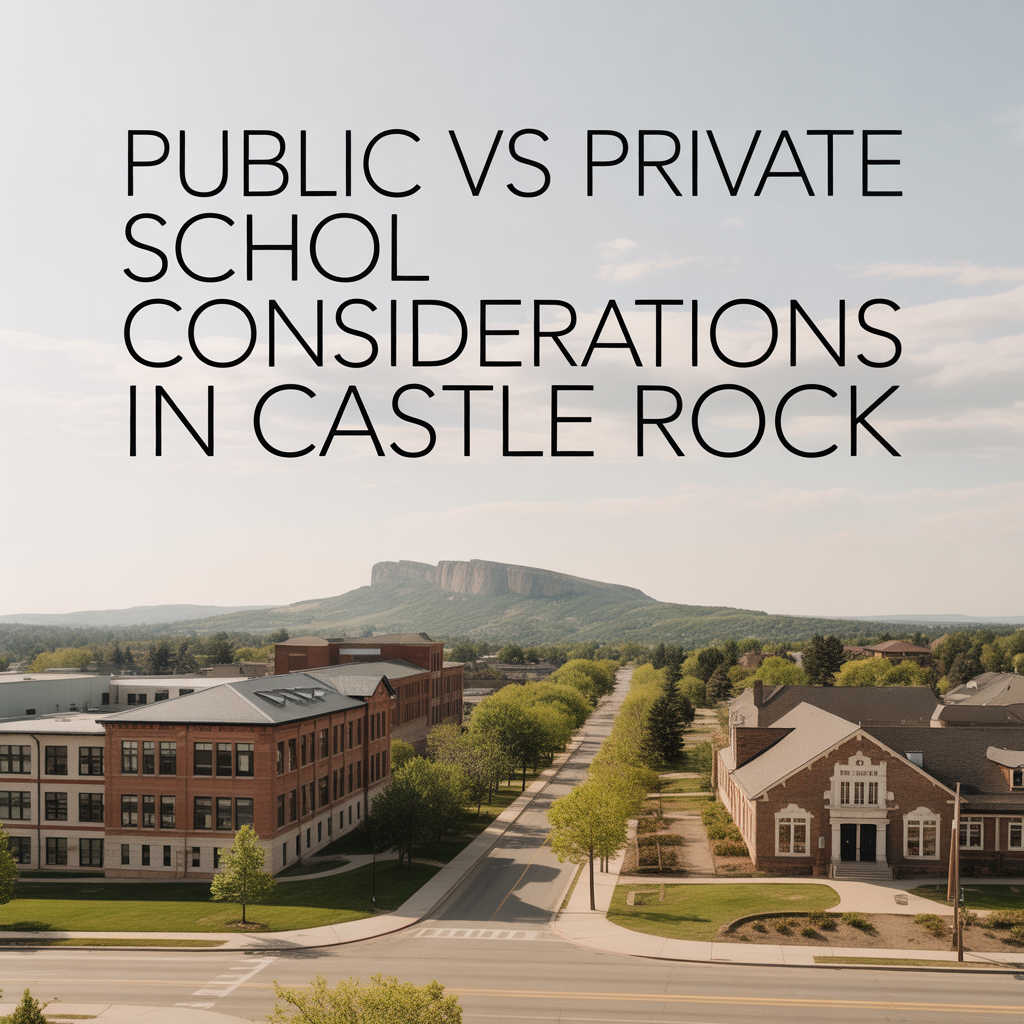
This is part of Castle Rock Lifestyle Guide → [Castle Rock Lifestyle Hub] & Castle Rock Real Estate Guide → [Castle Rock Real Estate Guide]
Written by: Chad Cabalka
Public and private school choices in Castle Rock shape more than just where your child spends the day — they influence your commute, your housing budget, your community ties, and how your long‑term plans feel over time. In a town anchored by a strong public system but with a growing mix of private and charter options, most families aren’t asking “Which is better?” but “Which fits our life best?”
The Local Landscape: Public, Private, and Charter in Castle Rock
Castle Rock sits in Douglas County School District, which is consistently one of the stronger‑performing public districts in Colorado by test scores and overall ratings. For the 2025–26 school year, roughly 97% of K–12 students in Castle Rock attend public schools, including charters, while about 3% are in private schools. That alone tells you a lot: the default path here is public, with private and specialized options as intentional deviations rather than the norm.
Public options in and around Castle Rock include neighborhood schools and high‑performing charters such as American Academy and Aspen View Academy, which function as part of the public system but often have distinctive programs or teaching models. Private options are fewer in number and smaller in enrollment, often faith‑based or specialized, and many families looking at private schools also consider nearby communities like Castle Pines, Parker, and Highlands Ranch.
Cost and Budget: Tuition vs Housing Dollars
From a home search perspective, one of the biggest differences between public and private paths is how you allocate your dollars over time.
With a public or public‑charter route, most of your investment goes into the home itself and property taxes, with no tuition required. Many Castle Rock buyers choose to stretch a bit on purchase price or prioritize a particular neighborhood because they feel the local public schools justify that long‑term commitment.
With private school, even modest tuition numbers add up across several children and several years. That ongoing cost can affect:
- How high you’re comfortable going on a mortgage.
- Whether you can take on a fixer‑upper vs. needing move‑in ready.
- How much room you have in the budget for travel, activities, or future college savings.
Some families deliberately buy “under” their maximum budget in Castle Rock so they can redirect that margin toward tuition at a private or specialized school they feel matches their child’s needs. Others do the opposite: they commit to a highly rated public feeder pattern and use the savings to upgrade their lifestyle or accelerate financial goals.
Academics, Supports, and Fit
Academically, Castle Rock’s public schools generally perform above Colorado averages in both math and reading. Many neighborhood and charter schools earn strong ratings and offer advanced coursework, STEM emphasis, arts programs, or language options, especially when you factor in the broader Douglas County offerings.
Private schools, by contrast, tend to differentiate on:
- Smaller class sizes and more individualized attention.
- Religious or values‑based education and community.
- Specialized approaches (for example, Montessori or tailored learning for students who don’t thrive in traditional models).
The real question for Castle Rock families is usually not “Which system is stronger overall?” but “Does my specific child need something the public system doesn’t easily provide?” That might be a particular faith context, a specific learning style, or a level of structure or flexibility that feels different from the typical public classroom.
It’s also worth noting that Douglas County’s public and charter schools include alternative and non‑traditional options — such as Daniel C. Oakes and home‑education support programs — which can offer a middle ground between standard public and full‑time private pathways.
Daily Logistics: Commutes, Carpools, and Community
Public school choices in Castle Rock are often tied tightly to where you live. Neighborhood schools and their feeder patterns create natural community circles: kids walk or bus together, parents see each other at drop‑off, and after‑school life tends to cluster around nearby parks and fields. When you buy within a feeder you like, your home and your daily routine usually line up.
Private schools often loosen that geographic link. You may find yourself:
- Driving to another part of Castle Rock, Castle Pines, Parker, or even Highlands Ranch for drop‑off and pick‑up.
- Building social ties that are less neighborhood‑based and more school‑based.
- Coordinating carpools across a wider area instead of just within your subdivision.
For some families, that’s a worthwhile trade‑off; the school community becomes their primary “neighborhood.” For others, especially with multiple kids in different schools, the extra driving and split schedules wear thin over time. When I’m advising families, we spend as much time tracing those daily routes on a map as we do comparing test scores.
Long‑Term Outlook: Flexibility, Resale, and Stability
From a long‑term planning perspective, public and private choices in Castle Rock play out differently.
A home in a strong public school feeder area tends to benefit from steady demand, because the vast majority of local families are following that path and future buyers often make school alignment a top filter in their search. That doesn’t mean every house in a “good” zone sells instantly, but it does mean you’re aligning your property with a broad, stable buyer pool.
If your plan relies heavily on private school, you’re less dependent on immediate school boundaries when you buy, but future buyers of your home may not share your priorities. You’ll want to think about:
- How the assigned public schools will look to the next owner, even if your own kids never attend them.
- Whether the neighborhood itself — parks, trails, access to downtown Castle Rock or I‑25 — offers enough appeal beyond the school question.
- How long you realistically plan to carry tuition and whether your housing choice gives you a backup plan if your needs or finances change.
Families sometimes move into Castle Rock expecting to go private indefinitely, then later decide to shift into the public system when finances, commutes, or kids’ needs evolve. Choosing a home that keeps that door open — by sitting in a public feeder you’d be comfortable with if you ever needed it — gives you more flexibility.
How to Approach the Decision Like a Local
When I walk Castle Rock families through public vs private considerations, we rarely land on a one‑size‑fits‑all answer. Instead, we work through a few key questions:
- What do you value most in your child’s daily experience — class size, faith context, peer group, specialized programs, or walkable neighborhood connections?
- How much driving are you realistically willing to absorb during busy seasons, in winter weather, and with multiple kids?
- Would you rather put more of your monthly budget into the house (location, lot, finishes) or into tuition, knowing both are long‑term commitments?
- Do you want your primary community to be your street and subdivision, or your school community, even if it’s across town?
Those answers tend to point clearly toward a public/charter‑centered plan, a private‑school‑anchored plan, or a hybrid strategy that might change as your kids hit different ages.
If you’re wrestling with these questions as you think about living in or around Castle Rock, I’m always happy to sit down and unpack them with you. Not as a checklist or a pitch, but as someone who’s watched hundreds of local families live with these choices over many years.
We can look at specific neighborhoods, talk through what your mornings and evenings would actually feel like with each option, and line up your school decisions with a home search that supports them instead of fighting them. If that kind of grounded, real‑world perspective sounds useful, reach out and we’ll have a straightforward conversation about what fits your family and your future here in Castle Rock.
Get the full Denver Market Insights → [Market Insights]


Littleton’s Ken Caryl for Lockheed Relocations
This is part of Lockheed Martin Relocation → [Lockheed Martin Relocation Hub] & the larger Denver Relocation Hub → [Denver Relocation Hub] Written by: Chad Cabalka Ken Caryl is one of the best-kept “family first” relocation options for Lockheed Martin employees who want foothills scenery, strong neighborhood appeal, and a real suburban lifestyle that still feels connected…

Centennial & Parker for Lockheed Relocations
This is part of Lockheed Martin Relocation → [Lockheed Martin Relocation Hub] & the larger Denver Relocation Hub → [Denver Relocation Hub] Written by: Chad Cabalka Centennial and Parker are two of the smartest suburban choices for Lockheed Martin employees relocating with families because they give you a strong balance of commute flexibility, good neighborhood variety, and…

Highlands Ranch for Family-Friendly Lockheed Relocations
This is part of Lockheed Martin Relocation → [Lockheed Martin Relocation Hub] & the larger Denver Relocation Hub → [Denver Relocation Hub] Written by: Chad Cabalka Highlands Ranch is one of the strongest choices for Lockheed Martin employees relocating with families because it delivers exactly what most parents want after a big move: stable neighborhoods, strong community…