


This is part of Castle Rock Lifestyle Guide → [Castle Rock Lifestyle Hub] & Castle Rock Real Estate Guide → [Castle Rock Real Estate Guide]
Written by: Chad Cabalka
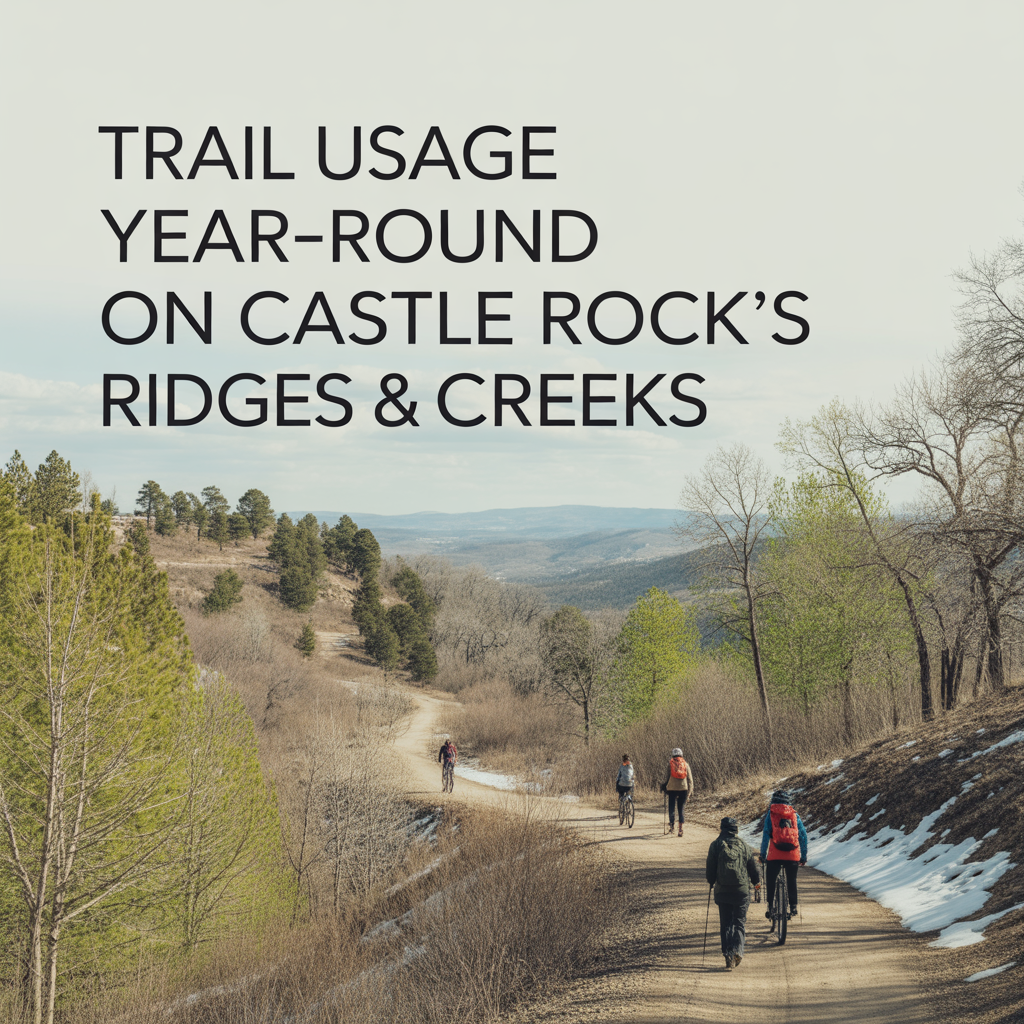
Castle Rock’s trails don’t really have an “off season”; they just trade users and shift between ridges and creeks as conditions change.
Big-picture: why they stay busy
Castle Rock has roughly 75 miles of soft-surface and paved trails, with about 27–30% of town land preserved as parks and open space. The town has intentionally built year‑round routes by combining exposed ridgeline systems (Ridgeline + MAC/Philip S. Miller) with lower, flatter creek corridors like East Plum Creek and the Colorado Front Range Trail segment.
That layout means there is almost always somewhere in town that feels reasonable to walk, run, or ride, even when other sections are icy, muddy, or windy.
Winter: sun, ice, and which trails “win”
Ridges:
- Ridgeline’s singletrack is “smooth and totally exposed,” which lets snow melt quickly in sunny stretches, but wind and aspect create pockets of hardpack and ice on shaded north slopes and in drainage dips.
- The MAC/Philip S. Miller network, with its mix of grades and aspects, gets similar patterns: dry patches on south‑facing sections, slick spots in shade, and occasional wind‑scoured sections on high points.
Creeks:
- The paved Colorado Front Range Trail segment through East Plum Creek and across to Cherry Creek (via Hangman’s Gulch, Woodlands, Escavera, Terrain, and Cobblestone Ranch) becomes the default “keep moving” option in winter, especially for walkers, strollers, and steady‑state runners.
- These 10‑foot‑wide paved sections are graded as “easy” and see consistent use because they’re plowed and melt faster than shaded neighborhood sidewalks, even when adjacent soft‑surface shoulders stay snowy or muddy.
Pattern: in winter, serious trail runners and riders pick their windows on ridges when surfaces are firm or dry, while most daily users slide toward creek corridors and paved, lower‑angle routes when storms or refreeze make dirt a gamble.
Spring: mud season and timing
Ridges:
- As thaw cycles accelerate, ridgeline trails get muddy, especially on north aspects and in drainages. Short, steep climbs on the Ridgeline/MAC systems can go from frozen‑solid morning footing to mid‑day mud quickly.
- Early and late in the day, when the top layer is refrozen, you’ll still see runners and hikers using ridges; mid‑day becomes more of a “skip it or stay on rockier lines” window.
Creeks:
- Paved creek corridors carry more of the load: walkers, families, bikes, and strollers slide to East Plum Creek and the CFRT because they offer long, continuous miles with minimal mud, and any meltwater drains off or evaporates quickly.
- Shoulder‑season wildlife viewing (deer, birds) and the first green along riparian zones also pull people down from the ridges into the creek bottoms.
Pattern: spring is when you really see the value of having both ridges and creeks. People with a “don’t wreck the trail” ethic choose creek‑side pavement in sloppy periods and pick carefully frozen windows on dirt.
Summer: ridges early/late, creeks any time
Ridges:
- On ridges, full sun and exposure make early mornings and evenings prime: runners and mountain bikers use Ridgeline’s 17-ish connected miles and MAC’s loops for hill work, tempo runs, and technical practice before the heat turns them into convection ovens.
- Group runs, like the 5:30 a.m. Friday Ridgeline run mentioned by Trail Runner Magazine, show how locals anchor their week around those high, exposed miles when temperatures are forgiving.
Creeks:
- East Plum Creek and the CFRT segment stay busy throughout the day because they’re graded “easy,” relatively flat, and more sheltered, with occasional shade and water proximity.
- Families and casual cyclists gravitate to these corridors for mid‑day outings when ridgelines feel too hot or windy, and runners use them for speedwork and long steady days.
Pattern: in summer, usage spreads across the entire system—ridges for training and views at cooler hours, creeks for all‑day access and family mileage. Both are “full” but in different ways.
Fall: peak trail season
Fall is when everything lines up:
- Temperatures drop, sun angles lower, and both ridge and creek trails can feel ideal most of the day.
- Ridgeline’s October 50K, half‑marathon, and 10K are timed into this window, using the full trail system as a “test yourself” loop for both elites and recreational runners.
- Leaf color along creeks and the mix of evergreen and scrub oak on ridges pull people out for pure scenery as much as for fitness.
Pattern: fall is the most evenly distributed usage season—ridges and creeks both see heavy use, and the biggest constraint is daylight, not temperature or conditions.
What this means for how you describe it
For your readers, you can frame year‑round usage like this:
- Winter: creeks and paved CFRT/East Plum Creek for daily movement; ridges for careful, window‑dependent training when sun and firmness line up.
- Spring: creeks as the reliability play; ridges for early/late frozen runs and rides, with a “respect the mud” caveat.
- Summer: ridges at dawn/dusk for big views and workouts; creeks all day for families, casual users, and speedwork.
- Fall: everything “turns on” at once—prime season on both ridges and creeks, with races and group runs using the whole network.
That’s why Castle Rock feels like a trail town rather than just a town with trails: between ridges and creeks, there is always somewhere reasonable to go, and residents learn to rotate between those options as the year and conditions change.
Get the full Denver Market Insights → [Market Insights]



Littleton’s Ken Caryl for Lockheed Relocations
This is part of Lockheed Martin Relocation → [Lockheed Martin Relocation Hub] & the larger Denver Relocation Hub → [Denver Relocation Hub] Written by: Chad Cabalka Ken Caryl is one of the best-kept “family first” relocation options for Lockheed Martin employees who want foothills scenery, strong neighborhood appeal, and a real suburban lifestyle that still feels connected…


Centennial & Parker for Lockheed Relocations
This is part of Lockheed Martin Relocation → [Lockheed Martin Relocation Hub] & the larger Denver Relocation Hub → [Denver Relocation Hub] Written by: Chad Cabalka Centennial and Parker are two of the smartest suburban choices for Lockheed Martin employees relocating with families because they give you a strong balance of commute flexibility, good neighborhood variety, and…

Highlands Ranch for Family-Friendly Lockheed Relocations
This is part of Lockheed Martin Relocation → [Lockheed Martin Relocation Hub] & the larger Denver Relocation Hub → [Denver Relocation Hub] Written by: Chad Cabalka Highlands Ranch is one of the strongest choices for Lockheed Martin employees relocating with families because it delivers exactly what most parents want after a big move: stable neighborhoods, strong community…