


This is part of Lakewood Lifestyle Guide → [Lakewood Lifestyle Hub] & Lakewood Real Estate Guide → [Lakewood Real Estate Guide]
Written by: Chad Cabalka
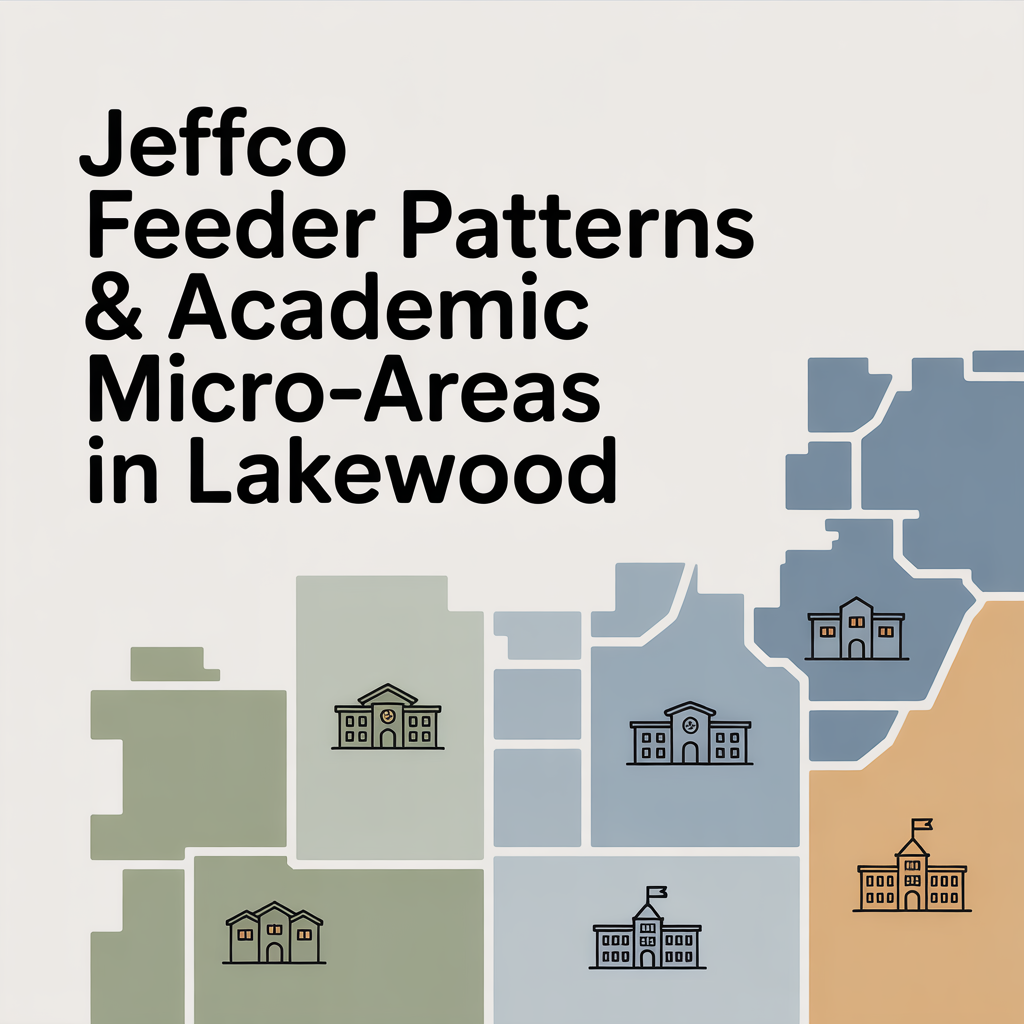
When you’ve lived and worked around Denver long enough, you start to see how invisible lines on a map influence how families choose homes — and how neighborhoods evolve over decades. In Lakewood, those lines often come down to “feeder patterns,” the paths students follow from elementary through high school within Jefferson County Public Schools (Jeffco).
These feeder systems don’t just reflect educational quality. They shape daily life, community identity, and even long-term property stability. For people buying or selling a home in Lakewood — whether in Green Mountain, Applewood, Belmar, or further west toward Bear Creek — understanding these patterns is as critical as knowing the housing market itself.
Jeffco’s schools have maintained a relatively stable reputation for balance and breadth. But within Lakewood, subtle differences in academic micro‑areas — and the perceptions tied to them — quietly steer many homeowners’ decisions long before they sign a contract.
Understanding Feeder Patterns: More Than a Boundary Line
In Jeffco, a “feeder pattern” refers to the sequence of schools that serve a particular geographic area. For example, students in one part of Lakewood might attend Devinny Elementary, then Dunstan Middle, and finally Green Mountain High. In another area, families may feed into Dennison Elementary or Rooney Ranch, then Creighton Middle, and end up at Lakewood High.
These patterns give each community a sense of continuity. Families often stay rooted to keep kids with their classmates as they move through the system, which fosters deep neighborhood connections. Over time, that stability shows up in the real estate market — homes in well-regarded feeder areas tend to hold value more consistently, even during broader market fluctuations.
For newcomers, the key is understanding that in Lakewood, “good schools” isn’t a single story. The academic reputation of one feeder pattern might be strong overall but feel different from another that’s equally successful on paper. Each has its own culture, extracurricular focus, and parent engagement tone — all of which matter to families deciding where to live.
The Green Mountain Feeder: Suburban Stability and Recreation Focus
Green Mountain High School’s feeder pattern covers many of Lakewood’s established southwestern neighborhoods — areas that appeal to homeowners seeking outdoor access, mature landscaping, and homes built largely between the 1960s and 1980s.
Families are drawn to the balance: solid academic performance, a close-knit local feel, and proximity to open space. Schools like Rooney Ranch Elementary consistently attract residents who value balanced academics alongside physical wellbeing. The area’s access to Green Mountain Park and the Hayden Green Mountain trail system complements that lifestyle perfectly.
For homeowners, this feeder area reflects steady, long-term ownership. Turnover is relatively modest because people often stay through multiple life stages — from raising kids to eventual downsizing. As a result, home values in these pockets tend to experience gentle, steady appreciation rather than sharp spikes or dips.
The Lakewood High Feeder: Central Access and International Appeal
The Lakewood High School area, serving parts of east and central Lakewood, has built a strong academic reputation anchored by its International Baccalaureate (IB) program — one of Jeffco’s most competitive. It draws families from within and beyond the immediate attendance area, a dynamic that brings energy and diversity to the community.
Schools like South Lakewood Elementary and Creighton Middle feed into this high school, creating a pathway that attracts parents focused on global-minded academics and a balanced student culture. Many families who relocate from urban Denver neighborhoods find this area appealing — it offers shorter commute times to downtown and access to Belmar’s walkable retail core while retaining suburban safety and space.
From a housing perspective, this feeder pattern spans some of Lakewood’s most varied neighborhoods. East of Wadsworth, homes can date back to the 1940s and ’50s; in the southern parts of the boundary, you’ll find mid‑century ranches alongside newer infill homes. This diversity in housing stock tends to buffer the neighborhood from big value swings — it attracts a blend of first-time buyers, move‑up families, and long-term residents seeking central convenience.
The Bear Creek and Alameda Patterns: Emerging Pride Points
Further south and west, Bear Creek High School and Alameda International Jr./Sr. High serve evolving neighborhoods that have seen renewed interest in recent years. These schools represent a dynamic part of Lakewood’s educational landscape.
Bear Creek’s feeder area, which includes schools like Westgate Elementary and Carmody Middle, often appeals to buyers looking for larger-yet-affordable lots with established infrastructure. Proximity to Bear Creek Lake Park and the foothill views add lifestyle value. While some parts have experienced shifts in performance metrics over time, families with a long view often recognize the opportunity here — houses remain competitively priced relative to central Lakewood, while community investment continues to strengthen both facilities and programs.
Alameda International, which rebranded several years ago to emphasize its international curriculum, reflects Lakewood’s changing demographics and adaptive spirit. Homeowners in its feeder zone often cite community diversity and proximity to Denver as key draws. Over the past decade, modernization projects and curricular expansions have re‑energized the area’s appeal, creating a sense of momentum that reminds many longtime locals of how Green Mountain felt 25 years ago: quietly up‑and‑coming.
Applewood’s Unique Academic Identity
In northwest Lakewood — technically shared with parts of Wheat Ridge and Golden — Applewood stands out both academically and culturally. It’s served primarily by the Wheat Ridge High feeder, though many residents open enroll to nearby programs given their proximity to various high-performing Jeffco schools.
Applewood’s character lies at the intersection of tradition and progress. The housing stock is older and often lovingly maintained, with broad lots and mid-century architecture. Elementary schools like Stober and Prospect Valley have long histories of strong community support. For families that prioritize neighborhood feel and stability over program prestige, this part of Lakewood remains one of the city’s most loyal long-term communities.
Property turnover here is famously low. When homes do sell, they tend to draw multiple generations of Lakewood residents — buyers who grew up nearby and are eager to return. This continuity fuels both school involvement and sustained property values, making Applewood a case study in how community identity reinforces neighborhood longevity.
How Perception Shapes Price: The Human Side of Feeder Patterns
In every market, school ratings influence home demand, but in Lakewood, it’s less about test scores and more about fit. Two families might interpret the same academic data entirely differently depending on what they value most: international curriculum, athletic programs, STEM focus, or classroom size.
That nuance matters because feeder patterns in Lakewood often overlap zones of similar value ranges. For instance, a home a few blocks north of Alameda may feed to Lakewood High rather than Bear Creek High — and that subtle shift can influence buyer interest, even if both schools perform comparably.
Over time, these perceptions — sometimes decades in the making — create “academic micro‑areas,” small zones within Lakewood where community identity, school pathways, and property character blend. Real-life decisions stem less from raw data than from stories: parents talking at soccer practice, alumni sharing experiences, or neighbors helping one another during remote learning years.
Those narratives accumulate, shaping neighborhood identity in ways statistics can’t capture.
The Long-Term View: Why Planning Matters More Than Picking
For Denver‑area homeowners — especially those moving within Lakewood — the smarter long-term approach is planning around feeder patterns rather than chasing the top-rated school of the moment. School rankings fluctuate; what doesn’t change quickly is the fabric of the neighborhoods they serve.
Families who think beyond just schooling years often find the best long-run stability. Consider how your life and priorities may evolve: proximity to trails, commutes, and local retail may become just as important as school logistics.
In my years advising families here, I’ve seen buyers start out with rigid “must‑have” lists based on a single school rating, then realize that the neighborhood culture — friendships on the block, local activities, and everyday routines — has a much more lasting impact. When your community fits, the stress of boundaries fades. When it doesn’t, no school score offsets that disconnect.
How Lakewood’s Layout Influences Academic Choice
Lakewood’s central structure — east‑west corridors like Colfax, Alameda, and Jewell, intersected by north‑south routes like Kipling and Wadsworth — means feeder zones often align along natural commuting and commercial routes rather than strict geographic logic.
This layout shapes school choice in subtle ways. Parents who work downtown might prioritize a home in the Lakewood High feeder for easier morning access to I‑6. Those commuting to the foothills or Lakewood Tech Center near Union Boulevard may prefer the Green Mountain or Bear Creek feeders to avoid cross‑traffic.
The availability of open enrollment — something Jeffco families have embraced for years — adds even more flexibility, but it doesn’t override practicality. A ten‑minute shorter morning drive often feels more valuable after a few years than a reputation advantage that exists mainly on paper.
Preparing to Buy or Sell Within a Feeder Boundary
If you’re buying, take time to walk school campuses, attend events, and talk with current parents. Online metrics rarely reflect what makes a community magnetic. Ask yourself how the surrounding neighborhood feels: the pace of life, the upkeep of homes, the age diversity of residents.
If you’re selling, remember that buyers’ emotional perception of your feeder area can influence showing activity as much as your listing photos. It’s worth highlighting not just the school name but how connected the neighborhood is — walking routes, playground access, community sports, and volunteer networks often carry more weight than nominal test scores.
The most informed Lakewood homeowners view feeder patterns as one component of a long-term investment — a lifestyle marker, not a single deciding line.
Looking Ahead: Stability Through Understanding
Jefferson County’s approach to education has always favored flexibility — neighborhood schools with open enrollment options layered in, allowing families to tailor choices without uprooting. That adaptability is part of why Lakewood remains one of Denver’s most stable suburbs.
Even as housing prices across the metro area fluctuate, these micro‑areas maintain their rhythm. They evolve slowly, grounded in the same principles that built them: strong public schools integrated with established neighborhoods where people still know their neighbors and care about local programs.
For buyers, that means Lakewood offers something rare — a community where you can choose based on values, not just value.
A Local Note
After decades of working and living here, I’ve learned that understanding Lakewood isn’t about memorizing statistics or comparing school charts. It’s about reading the story each neighborhood tells through its streets, its parks, and its schools. Feeder patterns are part of that story — not just educational routes, but threads of continuity that tie generations of families to the same hillsides, the same playgrounds, and sometimes, even the same cafeteria tables.
If you’re thinking about a move within Lakewood and want to better understand how feeder boundaries, commute patterns, or community dynamics might shape your decision, I’d be glad to have that conversation. Not a sales call — just a chance to trade notes, share insights, and help you navigate what truly matters for your next chapter here in Jefferson County.
Get the full Denver Market Insights → [Market Insights]



Littleton’s Ken Caryl for Lockheed Relocations
This is part of Lockheed Martin Relocation → [Lockheed Martin Relocation Hub] & the larger Denver Relocation Hub → [Denver Relocation Hub] Written by: Chad Cabalka Ken Caryl is one of the best-kept “family first” relocation options for Lockheed Martin employees who want foothills scenery, strong neighborhood appeal, and a real suburban lifestyle that still feels connected…


Centennial & Parker for Lockheed Relocations
This is part of Lockheed Martin Relocation → [Lockheed Martin Relocation Hub] & the larger Denver Relocation Hub → [Denver Relocation Hub] Written by: Chad Cabalka Centennial and Parker are two of the smartest suburban choices for Lockheed Martin employees relocating with families because they give you a strong balance of commute flexibility, good neighborhood variety, and…

Highlands Ranch for Family-Friendly Lockheed Relocations
This is part of Lockheed Martin Relocation → [Lockheed Martin Relocation Hub] & the larger Denver Relocation Hub → [Denver Relocation Hub] Written by: Chad Cabalka Highlands Ranch is one of the strongest choices for Lockheed Martin employees relocating with families because it delivers exactly what most parents want after a big move: stable neighborhoods, strong community…