


Financing a Home in Denver → [Denver Home Financing Guide] & For more info on Buying in the Denver Metro Area → [Denver Metro Home Buying Process]
Written by: Chad Cabalka
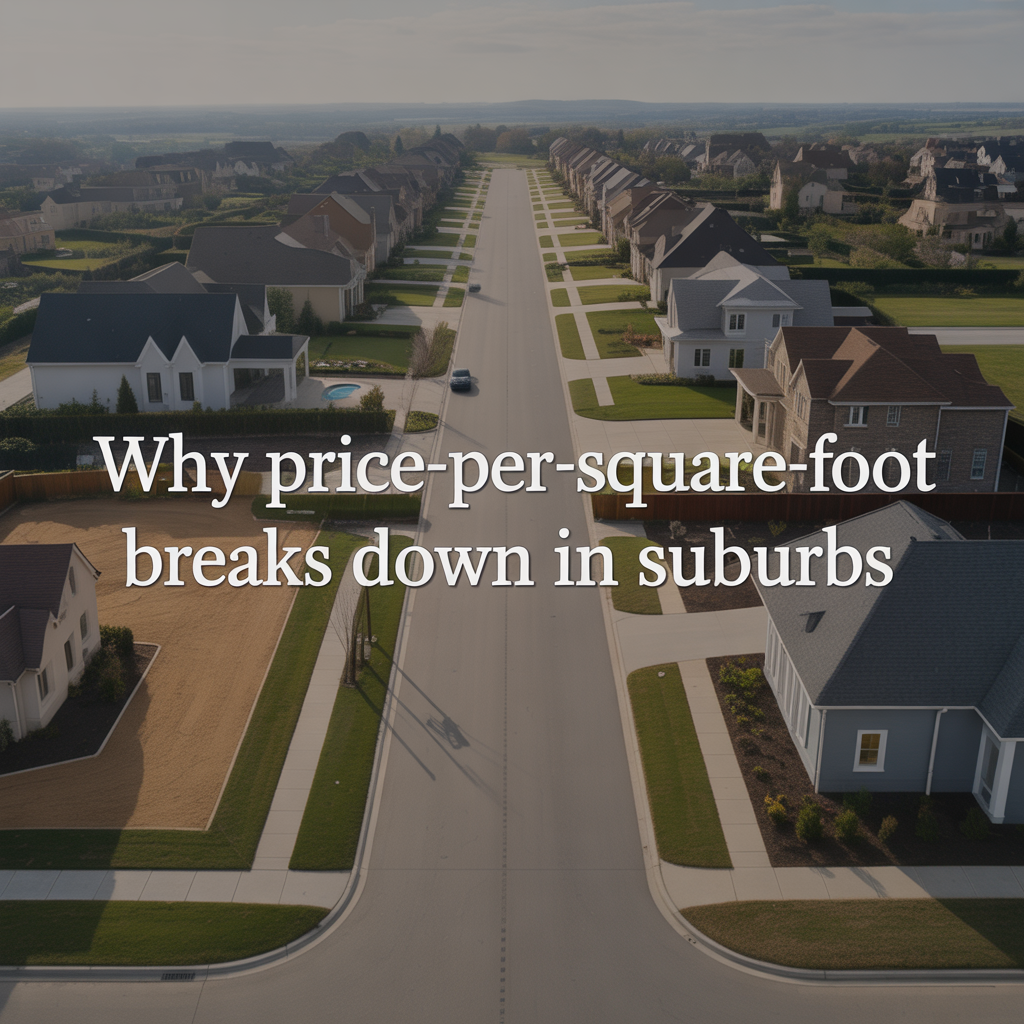
In Denver’s suburbs—places like Littleton, Aurora, Wheat Ridge, and the surrounding bedroom communities—price‑per‑square‑foot breaks down as a reliable benchmark because homes are too different in size, lot, age, and lifestyle to be meaningfully compared on a “per‑foot” basis. A buyer might see one 2,000‑square‑foot house listed at $400 per square foot and another at $280 and assume the second is a better deal, when in reality they’re buying very different products: one with a tiny lot in a walkable area, the other with a big yard in a car‑dependent pocket.
Why Price‑Per‑Square‑Foot Misleads in Suburbs
In dense urban pockets like Park Hill, Sunnyside, or Hilltop, homes are often similar in age, size, and lot constraints, so price‑per‑square‑foot can be a rough but useful shorthand. In the suburbs, that same metric falls apart because:
- Lot size and outdoor space matter more. A 2,500‑square‑foot ranch in Littleton with a large, flat backyard is not the same “product” as a 2,500‑square‑foot townhome in Aurora with no yard. Yet both might be evaluated at a similar $/sq ft, even though the value drivers are completely different.
- Schools, parks, and commute distance vary sharply. Two homes in the same suburb can be miles apart in terms of school quality, access to trails, or drive time to Denver, yet sit at similar $/sq ft. That makes the metric misleading for lifestyle‑driven buyers.
- Age and condition diverge more. Older, smaller homes on big lots often trade at lower $/sq ft than newer, compact builds, even when the older home is the better long‑term fit for a family‑oriented buyer.
How Suburban Buyers Actually Value Homes
In practice, suburban buyers care far more about total package than $/sq ft:
- Yard size and privacy for kids, pets, and entertaining.
- School district and safety for long‑term stability.
- Commute time and access to Denver (I‑25, E‑470, light rail, bike routes).
- Future flexibility—room to add a garage, ADU, or pool.
A home that’s “cheap per square foot” but sits on a tiny lot, in a noisy subdivision, or far from good schools may actually be a worse value than a slightly more expensive home with a big yard and better schools, even though the $/sq ft looks higher.
Why Citywide or County‑Level $/Sq Ft Is Especially Misleading
Metro‑wide or county‑level price‑per‑square‑foot figures smooth out these differences, making the market feel more uniform than it is. For example:
- Denver County might average around $320–$380 per square foot, but that blends high‑density condos in the core with larger, lower‑density homes on the edges.
- A suburb like Littleton can have a median $/sq ft around $280, while Wheat Ridge sits closer to $328, even though both are “Denver suburbs.”
When suburban buyers anchor to a single $/sq ft number, they risk either overpaying for a small, constrained lot or underestimating the value of a larger, more flexible property that happens to have a lower $/sq ft.
How to Use Price‑Per‑Square‑Foot More Wisely
The metric isn’t useless; it just needs to be used carefully:
- Compare within very narrow bands. Use $/sq ft only among homes that are similar in age, style, lot size, and location (e.g., 1970s ranches on 0.25+‑acre lots in the same school zone).
- Treat it as a sanity check, not a rule. If a home is way below or above typical $/sq ft for its exact micro‑market, dig into why (condition, lot, HOA, school, etc.).
- Prioritize total value. Ask: “Does this home give me the space, schools, and lifestyle I want?” before letting $/sq ft dictate the decision.
In Denver’s suburbs, where lifestyle, lot size, and school quality often matter more than square footage, that shift—from “per‑foot” thinking to total‑package thinking—is what keeps buyers from overpaying for the wrong kind of home.
Get the full Denver Market Insights → [Market Insights]



Littleton’s Ken Caryl for Lockheed Relocations
This is part of Lockheed Martin Relocation → [Lockheed Martin Relocation Hub] & the larger Denver Relocation Hub → [Denver Relocation Hub] Written by: Chad Cabalka Ken Caryl is one of the best-kept “family first” relocation options for Lockheed Martin employees who want foothills scenery, strong neighborhood appeal, and a real suburban lifestyle that still feels connected…


Centennial & Parker for Lockheed Relocations
This is part of Lockheed Martin Relocation → [Lockheed Martin Relocation Hub] & the larger Denver Relocation Hub → [Denver Relocation Hub] Written by: Chad Cabalka Centennial and Parker are two of the smartest suburban choices for Lockheed Martin employees relocating with families because they give you a strong balance of commute flexibility, good neighborhood variety, and…

Highlands Ranch for Family-Friendly Lockheed Relocations
This is part of Lockheed Martin Relocation → [Lockheed Martin Relocation Hub] & the larger Denver Relocation Hub → [Denver Relocation Hub] Written by: Chad Cabalka Highlands Ranch is one of the strongest choices for Lockheed Martin employees relocating with families because it delivers exactly what most parents want after a big move: stable neighborhoods, strong community…