


Buyer Fears→ [Buyer Fears] & For more info on other fears Phoenix Real Estate → [Phoenix Real Estate Fears Guide]
Written by: Renee Burke
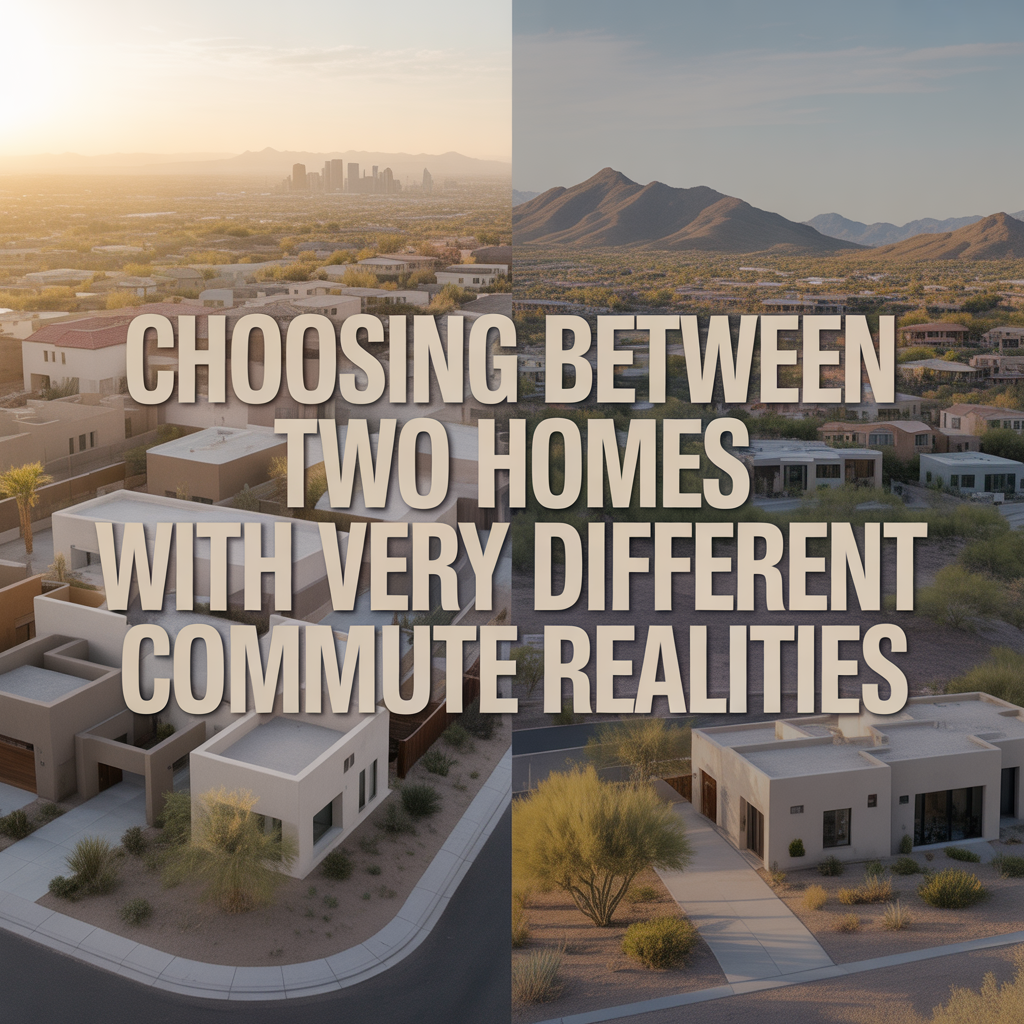
There’s a moment in nearly every home search when two very different homes rise to the top of your list. One might be newer, sitting quietly on the edge of the Valley with a bigger yard and mountain views. The other might be closer in — older but charming, minutes from work, restaurants, and evening conveniences. And there you are, staring at two open browser tabs, wondering which voice inside you to trust: the one that craves more home, or the one that craves more time.
If you live and work in the Phoenix metro area, you already know this decision runs deeper than just property lines and price per square foot. Commute realities here can shape your rhythm of life — where you grocery shop, which schools you consider, what time your evenings begin, how much energy you have left to live your actual life once the workday ends. So when you’re choosing between two great homes with very different commute patterns, what you’re really deciding is the kind of daily life you want to lead.
Understanding the Phoenix Commute Landscape
Phoenix is unique in the way it sprawls — a wide, sun-soaked basin of interconnected cities that flow together but each carry their own beat. From East Valley communities like Mesa, Gilbert, and Queen Creek to the West Valley’s Goodyear, Peoria, and Surprise, our freeways stretch like arteries pulsing toward downtown and its growing job corridors.
It’s not just “how far” something is from work. It’s when you drive, which direction the sun hits you, how traffic patterns shift seasonally, and what your alternatives are if an accident clogs I‑10 or the 101.
A buyer moving from Central Phoenix to North Scottsdale may only add 15 miles to their one-way drive, but during peak hours, that can mean an extra 30 minutes sitting in traffic along the Loop 101. Conversely, someone choosing a home in Ahwatukee near the South Mountain Preserve might find their commute smoother than expected if they work downtown — a straight shot up the 10, rarely plagued by the heavy backups we see in the Northwest corridor.
The Trade Between Space and Time
It’s tempting to fall in love with “more house” — the kind with that extra bedroom, or the quarter-acre lot with palm trees and sunsets that feel private. Those homes often sit farther out, where land is still more plentiful and newer communities showcase wide streets, pocket parks, and modern floor plans.
But every square foot you gain can cost you minutes each day — and those minutes quietly shape your lifestyle.
If you work 9‑to‑5 in central Phoenix but fall in love with a home in Buckeye or San Tan Valley, that might mean spending two hours total on the road daily. Over a year, that’s the equivalent of more than three full work weeks just commuting. Some people don’t mind that trade, especially if they work remote part-time, or enjoy decompression time in the car.
Others find the drive wears thin quickly — particularly once summer hits, and driving home at 5:30 PM means facing the west sun and triple-digit heat.
The question becomes not just, “Can I handle this commute?” but “Does this commute support the life I want to live?”
Lifestyle Anchors That Matter More Than You Think
When weighing two homes with very different commute times, it helps to look beyond work hours. Ask yourself where your everyday life really happens — and what your weekends look like.
- Schools and Activities: If kids are in sports, music lessons, or after-school programs, consider their drive times, too. A “shorter work commute” might not save time overall if you’re zigzagging across the Valley each evening.
- Errand Loop: Think about your weekly rhythm — groceries, gym, hair appointments, coffee runs. A strategically located home can trim small frustrations that add up.
- Evenings and Social Life: If you love dining out, attending games, or visiting friends, proximity to the parts of town that feed your energy matters. Commuting 45 minutes home from work and then another 30 minutes back into town for dinner can start feeling unsustainable.
- Outdoor Access: For some, being near the McDowell Sonoran Preserve or South Mountain trails is worth any added miles. Others find they rarely use those local amenities if their work schedule dominates daylight hours.
In essence, your commute isn’t a number — it’s a lifestyle pattern. Phoenix drives your habits more than you might think because of how spread out we are.
The Emotional Equation Behind Each Option
Here’s something I see often: buyers first weigh commute strictly as “time lost.” But the reality is more nuanced. The emotional energy tied to your commute matters just as much as the minutes themselves.
If you find calm in a 30-minute drive home with music or a podcast, that time can be restorative. But if stop-and-go traffic compounds your stress, even a shorter route can feel draining.
Similarly, your home environment can recharge or deplete you. A quieter suburban neighborhood where evenings are peaceful might offset a longer commute. On the flip side, living closer in — near Central Phoenix, Arcadia, or Tempe — can mean less house but more vibrancy: shorter errands, walkable spots, and spontaneous after-work plans.
Try this simple exercise: imagine a typical Tuesday, six months after you’ve moved. Picture leaving work on a warm summer evening. In each scenario, trace the drive home, the dinner hour, and how much energy you still have for your family, exercise, or rest. One vision will usually feel better — and that feeling is worth trusting.
Future Flexibility and the Remote Reality
One of the biggest shifts in the last few years has been flexible work — hybrid schedules that reshape commute math entirely. If you work from home two or three days a week, a longer drive the other days might feel far more manageable.
Still, future-proofing matters. Even if your current job allows flexibility, consider what would happen if that changed. A home that only works with today’s schedule may feel mismatched later.
Also, remember that Phoenix infrastructure keeps evolving. Major expansions like the South Mountain Freeway (Loop 202) have already transformed certain commutes. Planned improvements on the Loop 303 and I‑17 corridors could make outlying areas more connected over the next five years. Local insight — understanding where growth corridors meet new employment centers — can help you choose a location that balances convenience now and value later.
Financial Context: Commute and Cost of Living
While gas and wear on your car matter, the real financial angle lies in time value. A less expensive home farther out may stretch your dollar today, but calculate what your time and vehicle costs add up to monthly — and how they compare to buying slightly closer in.
For example, driving 25 extra miles a day, five days a week, at an average of 25 mpg and $3.70 per gallon equals roughly $80 a month in fuel alone. Add maintenance, depreciation, and time, and the “cheaper” home might not be as cost-effective as it seems.
On the flip side, homes closer to central job hubs like Midtown, Tempe, or the Scottsdale Airpark often hold value well, precisely because they save that daily friction. The market knows this — which is why shorter-commute areas tend to appreciate steadily even when outer suburbs surge and cool cyclically.
Making the Decision with Clarity, Not Regret
When two homes compete in your heart — one stretching your commute, the other stretching your budget — there isn’t a universally “right” choice. There’s only the home that best aligns with your priorities now and your peace of mind later.
If you’re someone whose day is full from morning to night, reclaiming that drive time may be priceless. If you crave quiet mornings, sunsets over the White Tank Mountains, and don’t mind podcasts behind the wheel, the extra miles may feel like a fair trade.
What I encourage my clients to do is this:
Spend one full week timing your real commute during rush hour. Feel what it’s actually like. Then, spend a Saturday exploring the neighborhoods near both homes — grab coffee, run an errand, see how your day flows. You’ll often find your decision becomes clearer once you experience both lifestyles, not just imagine them.
A Personal Note
I’ve watched the way different commutes shape families and routines here — the young couple who moved closer to Central Phoenix to catch more sunlit evenings together, the family in Peoria who gladly traded freeway time for bigger backyards, the remote professional who split the difference in Chandler because it balances both.
Each story is a reminder that in our Valley, geography and identity intertwine. The decision isn’t just about buying a home. It’s about choosing the balance that supports who you are and what your days deserve to feel like.
A Warm Invitation
If you’re in that stage — torn between two good options with two very different commute realities — please know you don’t have to figure it out alone. I spend every day helping Phoenix-area buyers untangle these questions with practical insight and heart.
Let’s talk through what your real days will feel like in each home, how your priorities might evolve, and which location will serve you best long after move‑in day.
When you’re ready, reach out — and we’ll walk this decision together, at your pace, with clarity and confidence.
Get the full Phoenix Market Insights → [Market Insights]


-
Cost of Living in Rhode Island: Housing, Taxes, Utilities, and Everyday Expenses
-

What If My Commute Becomes Worse Than Expected?
-

How Aging Home Systems Affect Property Value
-

Energy Efficiency Upgrades for Phoenix Homes
-
How to Plan for Major Home System Replacements
-

When Phoenix Homeowners Should Replace Water Heaters
-

Repair vs Replace Decisions for Phoenix HVAC Systems
-
Creating a Long-Term Home Maintenance Plan
-

How Often Phoenix Homes Should Be Professionally Inspected
-
Early Warning Signs of Major Home System Failures
-

How Preventative Maintenance Protects Phoenix Property Value
-

The Best Annual Home Maintenance Plan for Phoenix Homes
-

Electrical Safety Inspections for Older Phoenix Homes
-

Why Whole-Home Surge Protection Matters in Arizona
-

Preparing a Phoenix Home for Electric Vehicle Charging
-

Signs Your Home’s Electrical System Is Overloaded
-
When Phoenix Homes Need Electrical Panel Upgrades
-

Water Pressure Problems in Phoenix Homes Explained
-

Preventing Irrigation Leaks That Waste Water in Desert Landscapes
-

Signs of Hidden Plumbing Leaks in Phoenix Houses
-

How Long Water Heaters Last in Arizona Homes
-

How Hard Water Affects Plumbing Systems in Phoenix Homes
-

Preventing Water Damage in Phoenix Homes During Storms
-

Roof Maintenance Tips Before Phoenix Monsoon Season
-

How Arizona Sun Damages Roofing Materials Over Time