


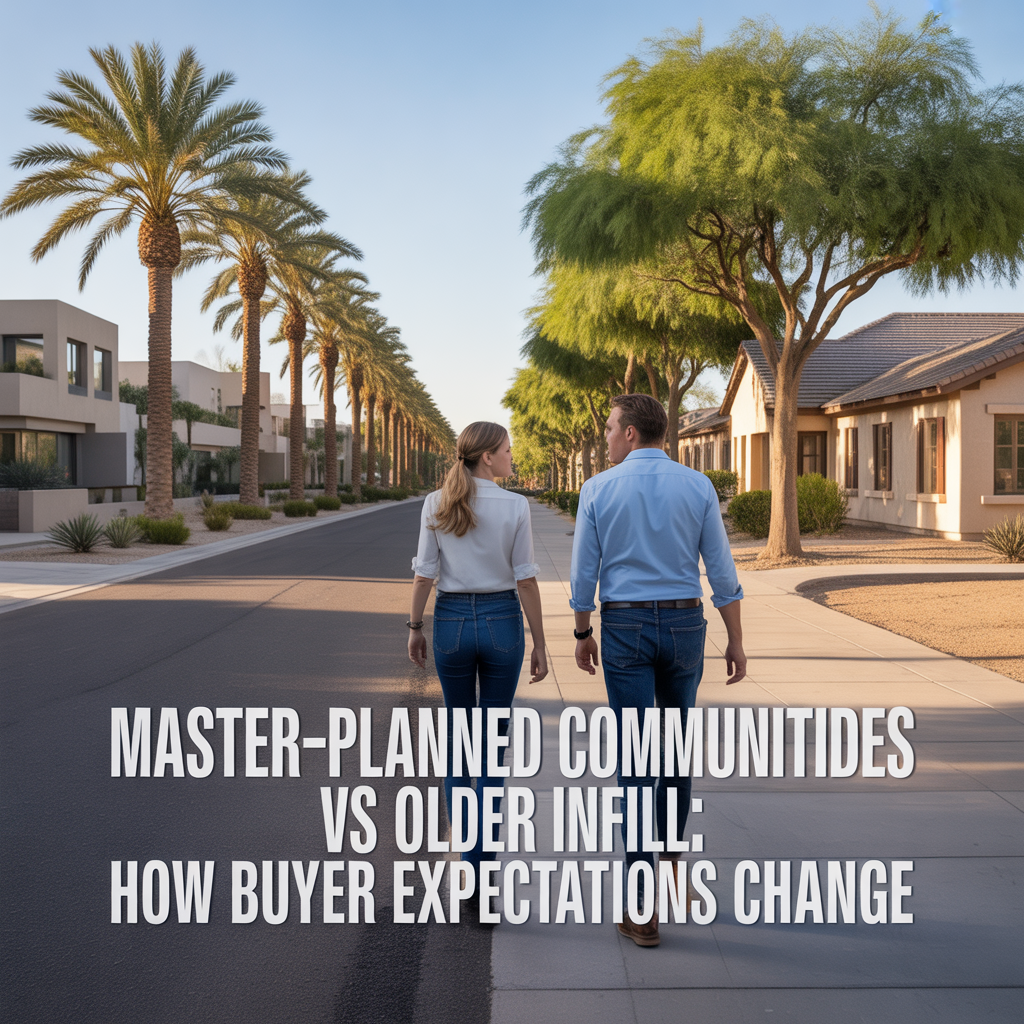
Buyer Fears→ [Buyer Fears] & For more info on other fears Phoenix Real Estate → [Phoenix Real Estate Fears Guide]
Written by: Renee Burke
Phoenix homebuyers often stand at a crossroads: the polished predictability of a master-planned community in Queen Creek or the lived-in character of an older infill pocket in Central Phoenix. One offers curated amenities and modern uniformity; the other, established roots and unique stories etched into the block walls.
What draws them to each isn’t just price or square footage — it’s how each fits their vision of Valley life, from family playdates to quiet sunset walks.
Master-Planned Communities: Designed for Effortless Living
These thoughtfully orchestrated neighborhoods — think Fulton Ranch in Chandler, Power Ranch in Gilbert, or Verrado in West Buckeye — promise a turnkey lifestyle. Wide streets lined with matching pavers, community pools shimmering under palm shade, and trails weaving past pocket parks create instant belonging. Homes built post-2000 lean frame construction with open flows, energy-efficient bones, and HOA-managed perfection.
Buyers here — often growing families or relocators from California — expect:
- Amenity access as standard. Gated entries, fitness centers, event lawns — all funded by $100-$300 monthly dues they view as “buying time” for low-maintenance yards.
- Predictable quality. Warranties on systems, uniform exteriors, and quick drives to top schools like Hamilton High or Agritopia hubs.
- Social ease. Playgrounds buzzing weekends, no surprises in neighborhood vibe.
They’ll pay premiums (10-20% over infill comps) for that seamless fit, but walk if HOAs feel restrictive on solar panels or backyard playsets.
Older Infill: Authentic Roots with Personality
Infill homes fill gaps in established fabric — a 1970s ranch slipped between mid-mods in Arcadia Lite, or a rebuilt 1950s block beauty near Freestone Park in Gilbert. Smaller lots, mature mesquites heavy with shade, and eclectic mixes (bungalow next to a modern flip) define these spots. No master plan, just organic evolution amid South Mountain views or light-rail hum.
Buyers drawn here — locals upgrading, downsizers, or charm-seekers — prioritize:
- Character over cookie-cutter. Exposed beam ceilings, Saltillo tiles, citrus groves whispering Phoenix history.
- Flexibility and value. Lower or no HOAs ($0-$150), bigger parcels for pools or RVs, room to personalize without committee nods.
- Location legacy. Walk to coffee in North Central, quick freeway hops to Sky Harbor, rooted schools like Arcadia without new-build premiums.
They negotiate harder on dated systems but stretch budgets for that “neighborhood soul” — often netting better per-square-foot value.
Expectation Breakdown: What Each Buyer Demands
Preferences shift sharply by type — here’s how:
| Feature | Master-Planned Expectation | Older Infill Expectation | Negotiation Impact |
|---|---|---|---|
| Amenities | Pools, trails, events included | Parks nearby, no dues | MPC buyers pay 5-10% more for HOA perks; infill saves on fees |
| Home Age/Style | 5-15 years, uniform modern | 20-60 years, eclectic charm | Infill buyers reward renovations; MPC flags builder-grade wear |
| Lot/Privacy | Small, shared greenbelts | Larger, mature fencing | Infill wins RV gates; MPC offers low-water communal turf |
| Schools/Commute | Master-planned districts, 10-min drives | Legacy zones, walkable cores | Families split: MPC for playgrounds, infill for history |
| Resale Outlook | Steady appreciation via design | Unique appeal in hot pockets | Both strong, but infill flips faster to lifestyle seekers |
| Price/Sq Ft | $325-$425 (Gilbert MPCs) | $350-$500 (Arcadia infill) | Infill edges central demand |
MPC suits structured lives; infill feeds free spirits.
Neighborhood Nuances Guide the Choice
Phoenix’s mosaic amplifies differences:
- East Valley MPCs (Gilbert, Chandler): Families expect resort-style perks near SanTan Village. Buyers grill on sub-HOA rules for holiday lights.
- West Valley MPCs (Verrado, Trillium): Active adults want trails to White Tanks; negotiate entry fees against White Tank views.
- Central Infill (Arcadia, North Central): Young pros crave Biltmore walks; older systems ok if pebble pools gleam.
- South/North Infill (Ahwatukee, Moon Valley): Downsizers love block privacy; no-HOA flexibility trumps clubhouses.
MPC growth surges outer rings; infill revitalizes urban hearts, drawing walkability fans as light rail expands.
Lifestyle: The True Decider
MPC buyers envision barbecues by community lakes, kids biking cul-de-sacs — low-effort community. Infill appeals to those planting roots amid saguaros, hosting under citrus canopies — high-reward authenticity.
In balanced markets, MPC homes pend fast to touring families; infill lingers for “the one,” then bids emotional highs.
Seller Strategy: Meet Expectations Head-On
MPC? Stage amenity life — kayaks by the fake lake. Disclose every HOA rule. Infill? Heritage polish — vintage fixtures shining, yard bursting heritage oranges. Highlight no-fee freedom.
Both thrive priced to type: MPC uniform, infill story-driven.
If you’re thinking about making a move in Phoenix, you don’t have to figure it out alone. Let’s match your home — master-planned polish or infill heart — to the buyers dreaming exactly that. With thoughtful insight and steady support, we’ll align expectations for your strongest sale.
Get the full Phoenix Market Insights → [Market Insights]


-

Dog Parks, Playgrounds, and Family-Friendly Parks in Tempe
-

Canal Paths and Bike Trails Connecting Tempe Neighborhoods
-

Papago Park Hiking Trails and Tempe Outdoor Access
-
Parks and Green Spaces Across Tempe Neighborhoods
-

Tempe Town Lake Paths, Running Trails, and Daily Recreation
-

Breweries, Coffee Shops, and Lakefront Hangouts Around Tempe Town Lake
-

Parking, Rideshare, and Event Traffic Around Tempe Dining Districts
-

Late-Night Activity and Residential Quiet Zones Near Entertainment Areas
-

How ASU Influences Tempe’s Restaurant and Nightlife Scene
-

Dining Options in South Tempe Neighborhood Corridors
-
Walkable Restaurants and Coffee Shops in Downtown Tempe
-
Mill Avenue Restaurants, Bars, and Nightlife Near Arizona State University
-

How School Choice, Charter Options, and ASU Influence Education Options
-

Living Near Schools vs Residential Pockets in Tempe Neighborhoods
-

Parent Communities and School Networks in South Tempe Neighborhoods
-

How High School Boundaries Affect Commute Direction
-
Neighborhood-Based School Routines vs Cross-Corridor Runs
-

After-School Sports at Tempe Diablo Stadium and Local Parks
-

School-Day Traffic Patterns Along Rural, McClintock, and Baseline
-

How Often You Leave Tempe for Phoenix, Scottsdale, or Chandler
-
Noise, Game Days, and Event Cycle Patterns
-

Dining and Social Gravity Along Mill, Apache, and Baseline
-

Tempe Town Lake and Greenbelt Access You’ll Actually Use
-

Loop 101, US-60, and Arterial Efficiency by Corridor
-
True Walkability Near Mill Avenue vs Drive-First South Tempe