


Long-Term & Exit Strategy Fear→ [Long-Term & Exit Strategy Fear] & For more info on other fears Phoenix Real Estate → [Phoenix Real Estate Fears Guide]
Written by: Renee Burke
Every once in a while, a perfectly smart buyer will pause mid-transaction — not because they’re uncertain about the home, but because they’re uncertain about the future. The whisper usually sounds something like this:
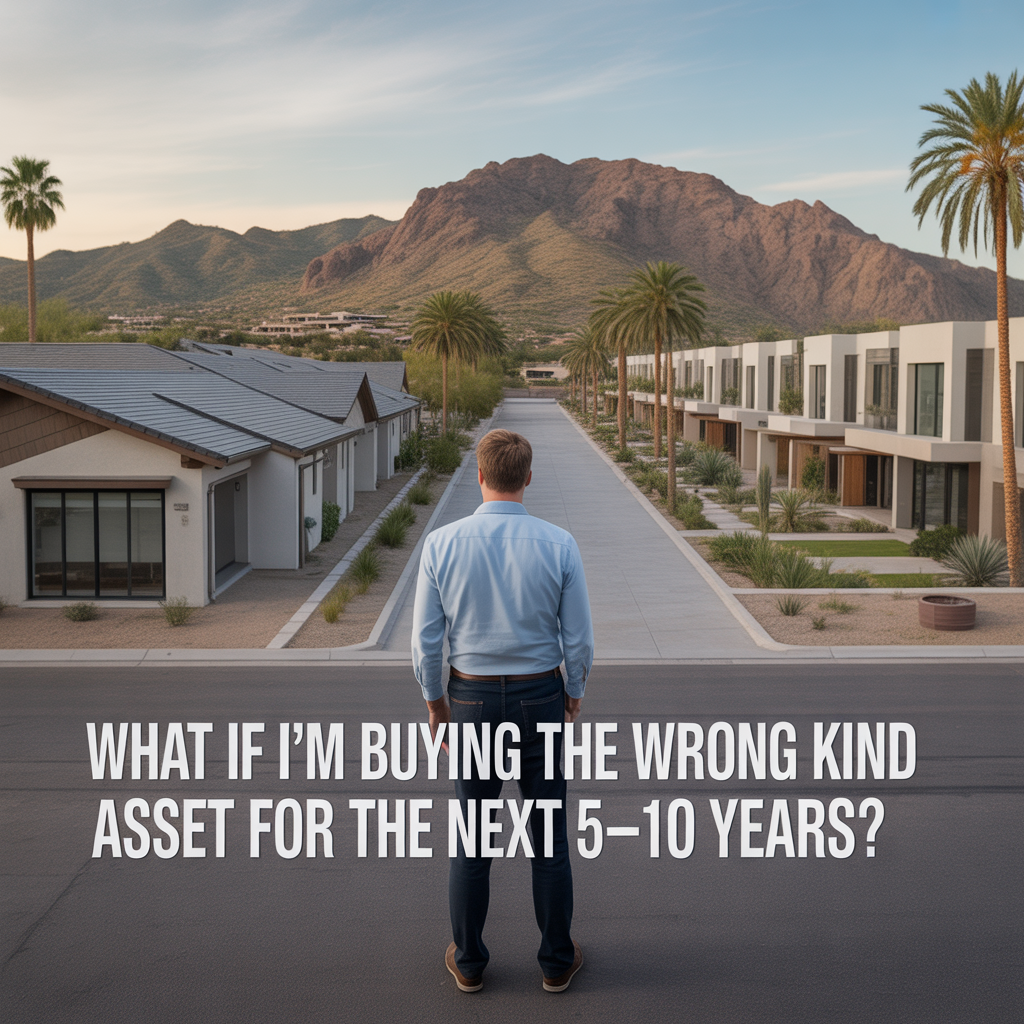
“What if I’m buying the wrong kind of asset for where the world — or Phoenix — is headed?”
That question isn’t anxiety. It’s awareness. It’s a sign you’re thinking like a long-term steward of your investment, and that’s a good place to be. Because in a region evolving as quickly as Phoenix, foresight can be just as valuable as location.
So let’s step into that question calmly and honestly — what it means, how the local market is shifting, and what it really takes to future-proof your next purchase over the next 5–10 years.
Why So Many People Feel This Way Right Now
The past few years have reminded all of us that nothing in real estate is static. Prices rose, interest rates recalibrated, and our city kept growing outward — changing the balance between lifestyle and investment in subtle ways.
If you sense uncertainty about “the right kind of property,” you’re probably reacting to three overlapping realities:
- Technology and worklife are changing housing demand. Remote or hybrid work has shifted priorities — buyers want quiet, usable space more than raw square footage.
- Affordability pressures are reshaping where people live. Demand continues to stretch beyond core Scottsdale and Downtown toward places like Verrado, Queen Creek, and Desert Ridge.
- The definition of “prime” is evolving. Ten years ago, proximity to major commute routes defined value. Today, it’s lifestyle anchors: nearby trails, restaurants, wellness amenities, and strong school districts.
The instinct to choose a property with flexibility — one that aligns with how people actually live now — is not just wise; it’s strategic.
Understanding “Asset Type” in Human Terms
When we say “asset,” it’s easy to imagine spreadsheets, not skylines. But in Phoenix real estate, the term really describes three intertwined qualities of a property: livability, liquidity, and longevity.
- Livability means comfort — not just yours, but future buyers’ too. Does it make daily life easy and intuitive in our desert climate?
- Liquidity reflects how readily it might resell or rent if life shifts.
- Longevity asks whether its style and structure will age gracefully over time.
A home strong in all three is rarely the “wrong” asset — even if conditions change.
What Holds Up Best in the Phoenix Market
After years of watching how our market behaves through cycles, I’ve seen a few repeating patterns. Certain property types tend to hold desirability through thick and thin — because they reflect enduring local truths rather than seasonal trends.
- Quality single-story homes on larger lots. Phoenix buyers adore easy flow and privacy. These remain in constant demand, especially among retirees and families.
- Lock‑and‑leave townhomes with thoughtful management. As part-time residency grows, well-run HOA communities near urban cores retain strong appeal.
- Homes with character and shade. Desert-friendly design, mature landscaping, and north/south orientation never go out of style here — they simply make life more comfortable.
- Walkable micro‑locations. Places blending access and charm — Roosevelt Row, Agritopia, Kierland, Gilbert Heritage District — tend to appreciate steadily because they anchor lifestyle convenience.
When a property genuinely fits its environment, it rarely ages out of the market’s favor.
How Phoenix Demand Is Likely to Evolve
Projecting 5–10 years ahead isn’t fortune-telling — it’s reading the city’s trajectory. Ours remains one of population growth, but also of sophistication.
- Smarter energy use. Solar integration, efficient HVACs, and heat-resilient materials will increasingly separate premium homes from dated ones.
- Infill and redevelopment. Central and mid‑core neighborhoods will continue to densify. That brings both demand and opportunity for those who value proximity and renovated properties.
- Lifestyle alignment. Buyers will increasingly choose homes that balance indoor serenity with outdoor access — homes that support well-being, not just display it.
So when you’re choosing a home, think beyond what’s trending today. Instead, ask: “Does this property align with how life in Phoenix is genuinely heading?”
If the answer is yes — energy‑efficient, livable, connected — you’re already building forward.
When “Wrong Asset” Fears Hide Something Deeper
Often, what buyers describe as doubt about “the investment” is really an emotional mismatch:
- They love the home but worry it’s too specialized or rural.
- They want a rental backup plan but dislike high‑density neighborhoods.
- They crave views and privacy but fear isolation or longer commutes.
These aren’t deal‑killers — they’re personal alignment questions. And when you solve for balance rather than absolutes, the worry starts to quiet.
In other words: you don’t need a prediction machine; you need clarity on your lifestyle priorities and tolerance for change. Those are your real cornerstones.
The Cost of Over‑analyzing
There’s wisdom in planning carefully — and danger in chasing perfection.
I’ve seen buyers tie themselves in knots trying to “time” asset type to a 10‑year projection, only to miss years of comfort and appreciation waiting for certainty that never really exists.
Our market rewards participation more than hesitation. Phoenix ownership has historically favored those who buy thoughtfully and stay adaptable. Even if you don’t pick the single perfect model, you’ll almost always benefit from our region’s underlying strength — job growth, sunshine, and migration.
So plan — but also allow space for joy.
A Real‑World Example
A few years back, a client bought a mid-size home in McCormick Ranch. At the time, peers teased that single‑story ranches weren’t “as hot” as ultramodern new builds farther north. Fast forward five years: downsizers, second‑home buyers, and families all wanted exactly what she owned — central, shaded, and timeless.
Her “quiet choice” became one of the most resilient assets in her portfolio.
That’s how Phoenix tends to work: the home that suits living well outlasts the one designed to impress momentarily.
How to Choose the Right Kind of Asset — Confidently
When I guide clients who want both lifestyle and investment security, I focus on a few anchors:
- Location hierarchy. Start with stable infrastructure — schools, hospitals, trail systems, commuting corridors — before chasing size or finishes.
- Condition and efficiency. Systems matter. Roofs, mechanicals, insulation, orienting toward natural shade — these age better than cosmetic trends.
- Community trajectory. Look for areas receiving reinvestment — local businesses, street improvements, park upgrades. They signal durability.
- Lifestyle fit. Desirability is emotional. If a neighborhood makes you exhale when you arrive, chances are others feel it too.
- Versatile layout. Spaces that flex — home office, guest suite, low‑maintenance yard — match future demographic demand.
Those qualities keep your asset “in season,” even as tastes evolve.
If You’re Already Second‑Guessing
Let’s say you’ve already closed or you’re mid‑transaction and this thought hits: “What if I picked wrong?”
Take a moment. Pull perspective back. Are market conditions truly against you, or is it that life has you peering too far ahead without solid footing in the present?
Often, short‑term doubt fades once you settle in and feel the home functioning for you day to day. The only real “wrong” purchase is one made blindly — without context or confidence. If you chose with intention and clarity, you’re not behind at all; you’re simply growing into the next layer of ownership wisdom.
A Gentle Closing Thought
Buying a home is part financial, part instinct. You’re choosing not just shelter, but a setting for your next season of life. It’s natural to question future value, but true security comes from buying what ages gracefully — in style, efficiency, and livability.
Phoenix rewards people who buy with both eyes open: realistic about numbers, but rooted in the joy of daily life here. That kind of asset — one anchored in our desert’s rhythm — doesn’t just survive the next decade. It thrives through it.
A Warm Invitation
If you’re feeling unsure about what kind of property makes sense for your goals in Phoenix — or want to talk through how the next decade might shape our neighborhoods — you don’t have to figure it out alone.
Reach out anytime. Together, we’ll find the home that fits your life today and positions you beautifully for tomorrow’s market.
Get the full Phoenix Market Insights → [Market Insights]


-

Repair vs Replace Decisions for Phoenix HVAC Systems
-
Creating a Long-Term Home Maintenance Plan
-

How Often Phoenix Homes Should Be Professionally Inspected