


Market and Timing Fears→ [Market and Timing Fears] & For more info on other fears Phoenix Real Estate → [Phoenix Real Estate Fears Guide]
Written by: Renee Burke
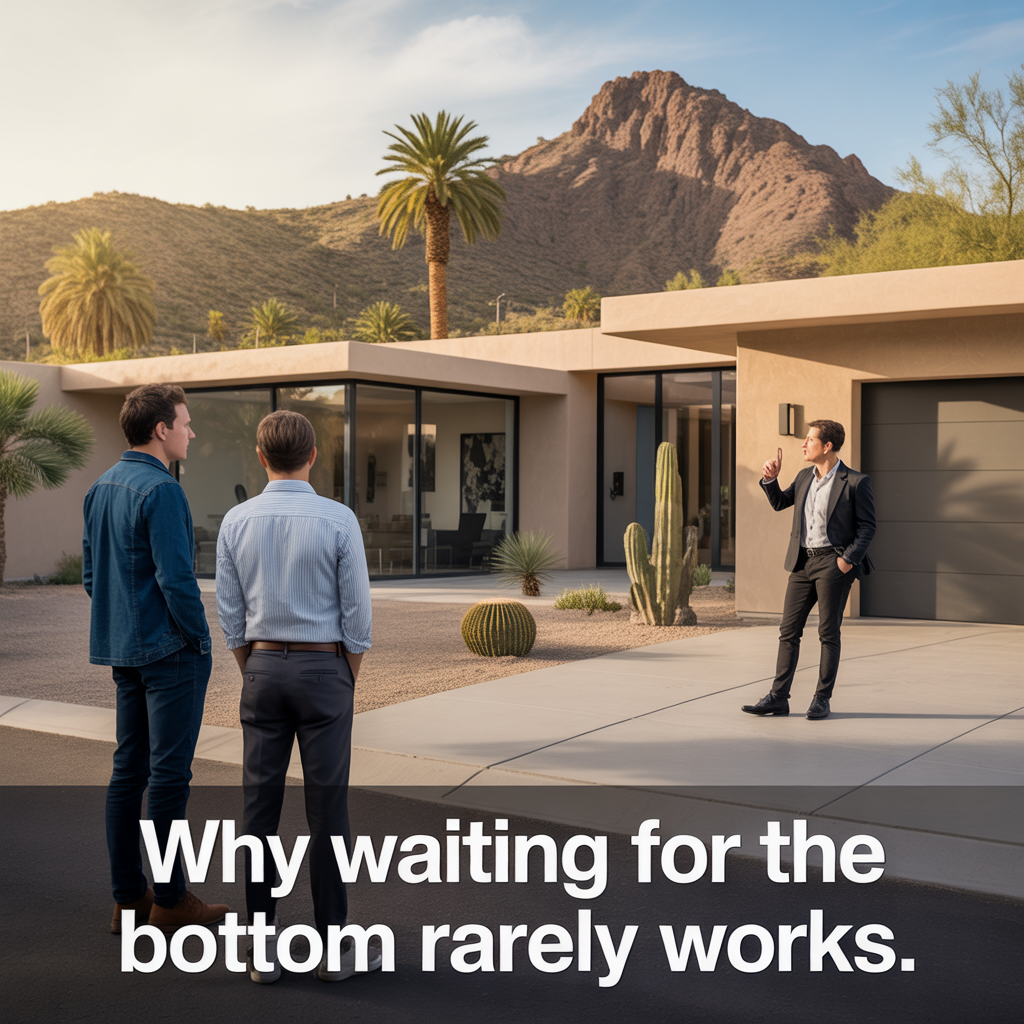
I’ve sat across kitchen tables from so many Phoenix families wrestling with the same quiet question: “Should we wait for prices to hit rock bottom before we buy or sell?” It’s a natural instinct, especially when headlines whisper about softening markets or rising inventory. But after decades navigating our Valley’s unique rhythms, I can share this gentle truth: trying to time the absolute bottom almost always backfires. The real opportunity lies in understanding why—and moving when your life needs align with smart, local realities.
The Illusion of a Clear “Bottom”
Markets don’t ring a bell at the bottom. Here in Phoenix, they shift gradually, like the sun easing over South Mountain. You might see median prices dip—say, from $475,000 to $450,000 in a softening phase—but pinpointing the exact low is like chasing a mirage. By the time data confirms “the bottom,” buyers flood back in, inventory tightens, and prices rebound.
Think of our 2011-2012 correction. Those who waited for one more percentage point drop missed the steady climb that followed, building 200%+ equity over the next decade. Or post-2008: bargain hunters who held out too long watched institutional cash snap up foreclosures, flipping the script before families could re-enter. Phoenix’s fundamentals—endless migration, job hubs like TSMC, precious little buildable land—pull values up faster than most realize once momentum turns.
Why “Waiting” Costs More Than You Think
Time isn’t neutral in real estate. Every month you hesitate, you’re not just pausing—you’re paying.
- Rent keeps climbing. Valley rents average $2,200+ for a decent three-bedroom, outpacing any short-term price dip. Buy a year later at a supposed “bottom,” and you’ve handed landlords $26,000 you could’ve built into equity.
- Rates fluctuate. If you wait through a dip expecting 5% mortgages, only to face 6.5% again, your payment jumps $300 monthly on a $500K home—erasing any savings from a 5% price drop.
- Opportunity slips. That Arcadia charmer or Ahwatukee pool home you loved? It sells to someone who didn’t wait, often at a stable price because lifestyle gems hold firm.
I’ve watched clients lose six figures in combined rent and appreciation by playing the waiting game. Phoenix rewards action over perfection.
The Rebound Happens Faster Here
Our market snaps back with desert resilience. Even in softer phases—like the balanced inventory we’re seeing now—demand from California transplants, remote workers, and retirees keeps pressure on. Once sellers sense stability (often before stats show it), listings dry up. Builders pull incentives. Bidding returns to hot pockets like North Central or Gilbert.
Local patterns prove it: after every pullback since 2010, Phoenix medians rose 10-20% within 18 months. Why? We’re not Florida with endless condos or Texas with unchecked sprawl. Our supply stays constrained by mountains, regulations, and the “lock-in effect”—homeowners glued to sub-4% rates. Wait too long, and you’re competing again, not negotiating.
Psychology: Fear’s Sneaky Trap
Waiting feels safe—like watching waves from shore. But fear amplifies noise: a Zillow dip here, a price cut there. Meanwhile, life moves. Kids outgrow rooms. Jobs relocate you closer to the 101. Health shifts prompt downsizing. Those needs don’t pause for market cycles.
Sellers face the flip side: “What if I list now and prices fall more?” Yet holding risks lifestyle mismatches—staying in a too-big Paradise Valley estate when you crave Biltmore walks, or a growing family cramped in a West Valley starter. Regret stings worse than paper losses that never materialize.
When Waiting Does Make Sense (Rarely)
I’m not saying rush blindly. Pause if:
- Your finances need work (aim for 20% down, DTI under 36%).
- You’re relocating on a fixed timeline.
- You’re in a niche like ultra-luxury North Scottsdale, where cycles lag.
But even then, monitor your zip—Arcadia inventory at 1.5 months screams “act,” while Buckeye’s 5+ months buys time.
Real Phoenix Examples Ground the Lesson
- The 2022-2023 Softening: Prices eased 5-8% metro-wide. Waiters missed the 2024-2025 stabilization, now facing 6% rates on homes back near peak.
- Gilbert Families: Those who bought mid-dip at $550K saw $40K appreciation by 2026, while renters paid $30K+ extra.
- Investor Wins: Cash buyers in Eastmark didn’t wait—they scooped during uncertainty, renting at premiums today.
Data echoes it: markets bottom quietly, rebound publicly. Phoenix’s 2026 outlook shows steady recovery, not a cliff.
Focus on Your Timeline, Not the Market’s
The healthiest approach? Align with your horizon. Need a forever home near top schools? Buy stable neighborhoods like Agritopia now—rates normalize, equity compounds. Downsizing to Kierland? List thoughtfully; values hold. Investing? Growth corridors reward early birds.
Life’s too precious for market roulette. Phoenix gives second chances, but not infinite ones.
If you’re thinking about making a move in Phoenix—buying before the next wave, selling without second-guessing, or simply sorting through the timing—you don’t have to figure it out alone. I’m here as your local compass, ready to map what’s real for your family, your finances, and your future. Reach out when your heart says go; let’s make your next chapter as smooth and sure as a Sonoran sunrise.
Get the full Phoenix Market Insights → [Market Insights]


-
Cost of Living in Rhode Island: Housing, Taxes, Utilities, and Everyday Expenses
-

What If My Commute Becomes Worse Than Expected?
-

How Aging Home Systems Affect Property Value