


Local Politics and Housing→ [Local Politics and Housing] & For more info on National Politics and Housing → [National Politics and Housing]
Written by: Renee Burke
Across Phoenix and Scottsdale, desert landscaping is no longer just an aesthetic preference—it’s tied directly to water expectations and, increasingly, to how HOAs write and enforce their rules.
Here’s how those three pieces fit together.
What “Desert Landscaping” Actually Means
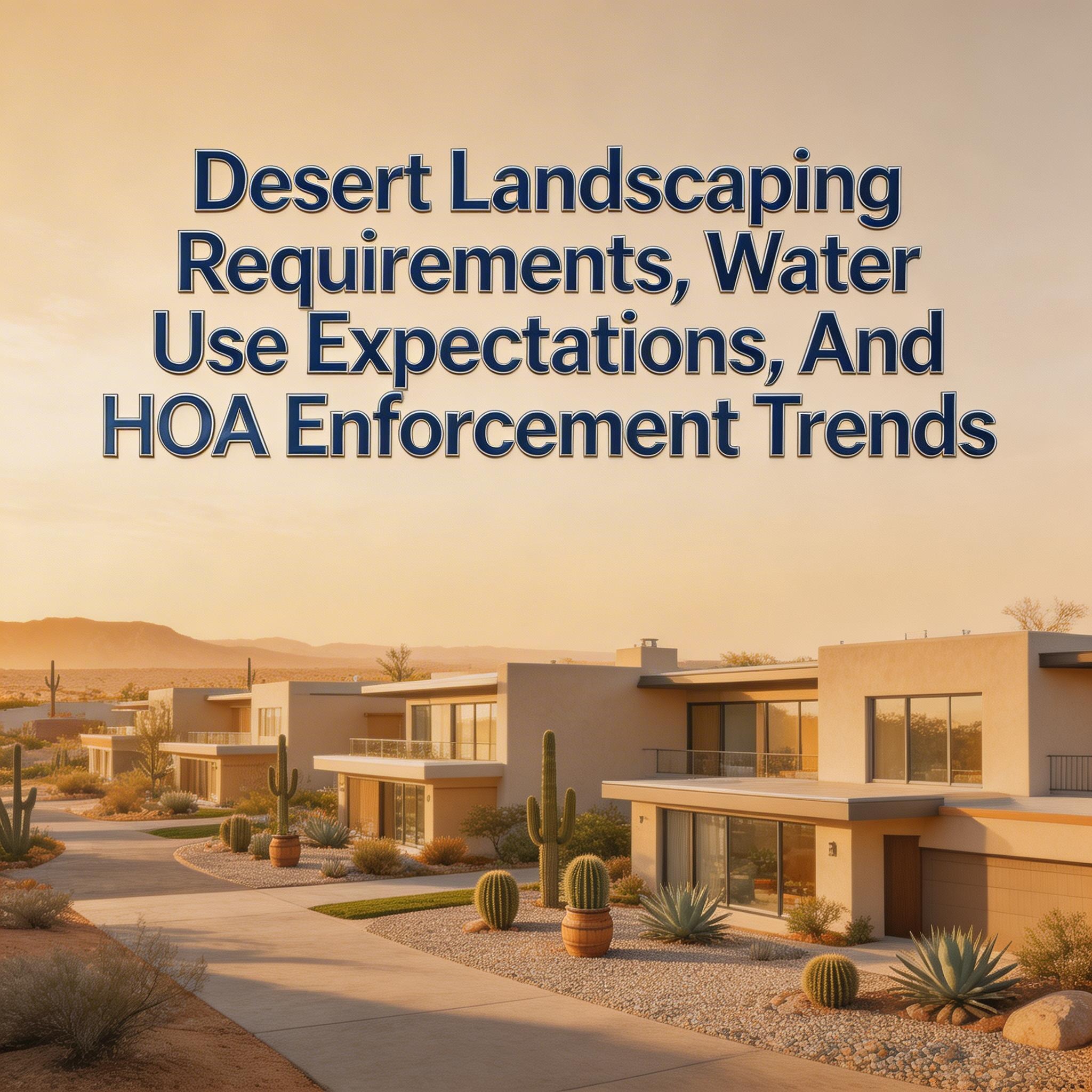
Cities and HOAs in the Valley use slightly different language—xeriscape, low‑water use, desert‑adapted—but they’re all pointing at the same idea: landscapes built around plants that thrive with minimal irrigation, plus hardscape and ground covers that don’t drink.
Typical elements:
- Gravel or decomposed granite as the primary ground cover instead of turf.
- Native or desert‑adapted plants (agave, yucca, desert spoon, lantana, palo verde, mesquite, etc.) that can survive on deep, infrequent watering once established.
- Drip irrigation, smart timers, and zoning by plant type, instead of large spray heads that overshoot sidewalks and streets.
The look ranges from minimal, modern gravel and boulders to lush, layered desert gardens—but the common thread is low ongoing water use.
Water Use Expectations From Cities And Utilities
Phoenix, Scottsdale, and other Valley cities are moving more aggressively to cut outdoor water use, because that’s where a large share of residential consumption sits.
You see that in:
- City conservation programs and guidance
Phoenix offers detailed desert‑landscape guidance and emphasizes replacing high‑water turf with drought‑tolerant plants.
Scottsdale provides rebates for turf removal, smart controllers, and efficient irrigation, directly rewarding owners (and HOAs) who convert to desert‑friendly designs. - Rules that push communities toward lower use
New conservation rules highlighted for 2025+ in Phoenix encourage owners and HOAs to limit or remove thirsty lawns, update irrigation, and reduce waste like overspray and daytime watering. - Public messaging
Cities and water providers consistently frame desert landscaping not as a sacrifice, but as the default, responsible way to live here long‑term.
Over time, this shifts what’s considered “normal.” Lush, wall‑to‑wall turf is increasingly treated as the exception, not the baseline.
How HOAs Turn Expectations Into Requirements
HOAs sit between city rules and individual owners, and many are now updating their standards to match conservation goals.
Common HOA moves:
- Front‑yard requirements
Many associations in places like Paradise Valley and Scottsdale require owners to maintain desert‑appropriate front yards, with specific plant palettes, minimum plant counts, and restrictions on expansive turf. - Approval for changes
Exterior changes—including any major landscape redesign—typically must be approved by the architectural committee before work begins, so HOAs can enforce desert themes and water guidelines right at the design stage. - Shared‑area conversions
For common areas, HOAs are shifting from older, high‑turf designs to more drought‑tolerant layouts, often prompted by rising water bills and city conservation messaging.
Some communities go further and update their CC&Rs or rules to explicitly:
- Limit turf to small play or pet areas.
- Require water‑efficient irrigation systems.
- Prohibit features like large, ornamental lawns that conflict with conservation goals.
Enforcement Trends: From Look And Feel To Water Stewardship
Historically, landscaping enforcement was mostly about appearance—weeds, dead plants, unapproved rock colors. That’s still there, but you now see a second layer: water behavior.
Trends showing up across HOAs:
- Notices and fines for neglected or non‑compliant yards
If an owner lets a desert yard die back or installs high‑water plants against guidelines, HOAs can—and increasingly do—issue violation letters, require corrective work, and levy fines until the yard meets community standards. - Pressure to remove or shrink turf
Even in older communities, boards are asking owners to replace large turf patches, citing both aesthetics and the need to reduce overall water use. - Closer attention to irrigation
HOAs are becoming more willing to call out obvious waste: sprinklers overspraying streets, watering at inappropriate times, or visibly leaking systems. In shared areas, they may hire new landscape firms specifically to upgrade irrigation and reduce waste.
Because HOAs control both design standards and enforcement, they’ve become a practical tool for cities to see conservation messaging actually implemented at the neighborhood level.
Cost, Upfront Work, And Long‑Term Savings
For owners, desert landscaping and compliance can feel like a new cost center at first, but the long‑term math usually favors the shift.
Rough 2026 cost ranges:
- Many desert landscaping projects in Arizona fall between about $3,000 and $15,000, with simple front‑yard refreshes on the lower end and full hardscape/planting redesigns higher.
- Larger, feature‑rich projects with patios, boulders, paths, and lighting can easily exceed $20,000.
Big drivers of cost:
- Size of the yard and amount of existing turf removal or grading needed.
- Choice of rock, stone, and hardscape.
- Number and maturity of plants and trees; large specimen cacti or trees add cost up front.
But once in place:
- Ongoing water bills are typically lower than for traditional turf‑heavy yards.
- Maintenance is more predictable and often less intensive—especially important for second‑home owners or investors.
For HOAs, converting common areas can significantly reduce the association’s water bill and help keep dues from rising as fast as they otherwise might.
A Warm Closing From Renee
If you’re buying or owning in Phoenix or Scottsdale, it’s completely normal to feel a little overwhelmed by all the expectations around desert landscaping, water use, and HOA rules. You want to do the right thing—for the environment, your wallet, and your curb appeal—without stepping on a rule you didn’t know existed.
You don’t have to sort that out alone. This is the kind of practical, on‑the‑ground detail I walk through with clients all the time—what your HOA allows, what the city encourages, and how to design a landscape that looks beautiful, uses water wisely, and keeps you on the right side of enforcement.
If you’re thinking about making a move in Phoenix, you don’t have to figure it out alone. Reach out anytime, and we’ll look at specific communities and their landscaping expectations together, so your next home feels both truly “desert” and truly yours.
Get the full Phoenix Market Insights → [Market Insights]


-

Repair vs Replace Decisions for Phoenix HVAC Systems
-

Creating a Long-Term Home Maintenance Plan
-

How Often Phoenix Homes Should Be Professionally Inspected