


Local Politics and Housing→ [Local Politics and Housing] & For more info on National Politics and Housing → [National Politics and Housing]
Written by: Renee Burke
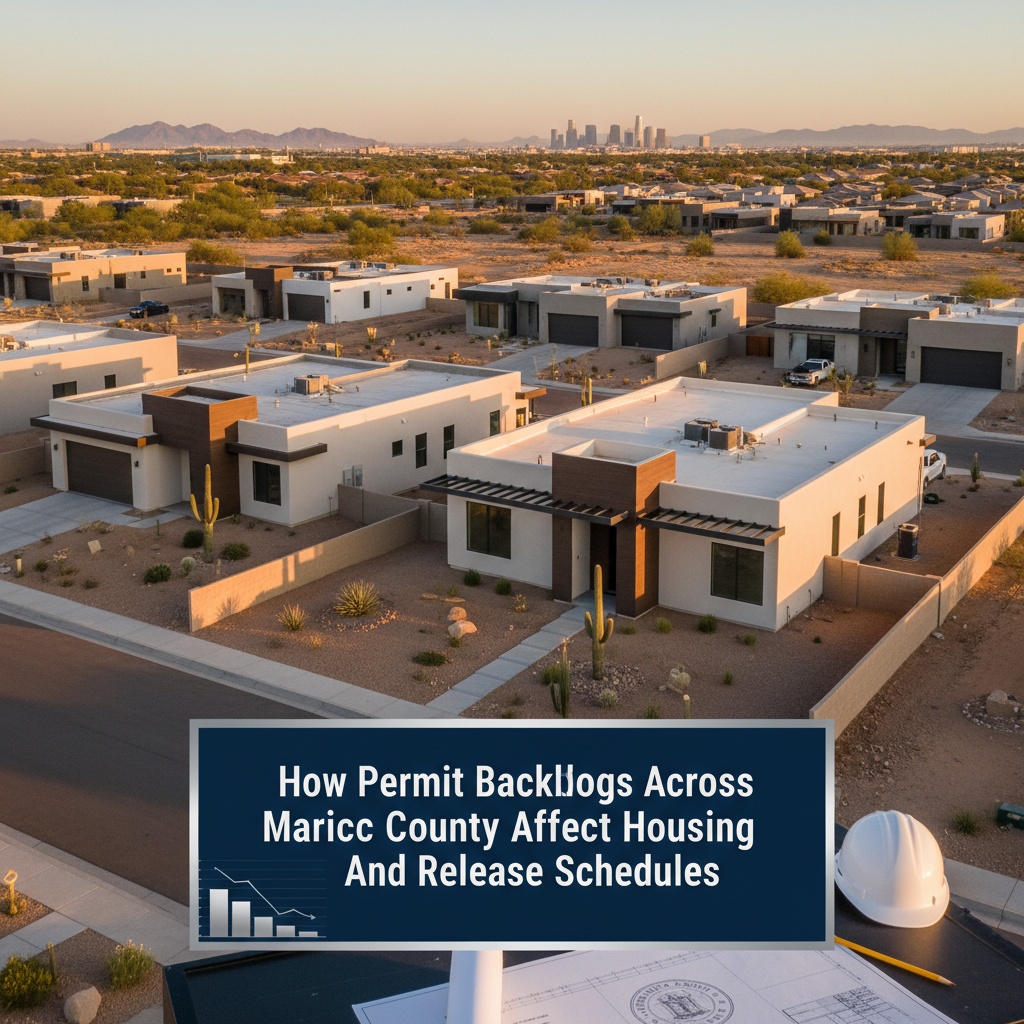
How permit backlogs move in Maricopa County directly shapes how quickly new homes hit the market—and when builders actually feel comfortable releasing lots to buyers.
I’ll walk you through how that works in real life here in the Phoenix metro, in the same calm, clear way I’d explain it across a kitchen island.
What “Permit Backlog” Really Means Here
When you hear “permit backlog,” you’re really talking about a traffic jam inside city and county departments that have to review and approve projects before a single slab gets poured.
In Maricopa County and the individual cities within it (Phoenix, Mesa, Peoria, Buckeye, Queen Creek, and so on), every project touches some combination of:
- Planning and zoning review
- Civil engineering review (drainage, traffic, grading)
- Building safety review (structural, fire, mechanical, electrical)
- Site-specific permits (walls, pools, signage, etc.)
When volume spikes—like it has during recent growth waves—those review teams can only move so fast. Files stack up. Timelines stretch. A “normal” 4–6 week review can quietly become 8–12 weeks or more for certain project types.
From the outside, it just feels like the builder is moving slowly. Inside, they may be dead-stopped waiting on stamped approvals.
How That Slows New Housing Supply
Permit backlogs don’t just delay individual houses; they slow the entire pipeline of future inventory.
Here’s how that plays out in phases:
- Land development gets pushed out
Before homes can be built, builders need approvals for grading, utilities, roads, and drainage. When those civil permits sit in a queue, the ground itself can’t be prepared on schedule. That means fewer finished lots ready for vertical construction six to twelve months down the line. - Vertical building starts later than planned
Even when lots are rough-graded, builders still need building permits for each plan series (or each individual lot, depending on the jurisdiction). Delays here mean trades are scheduled, then rescheduled. Framing crews sit idle or get reassigned. The first sets of homes in a phase start weeks or months late. - Closings slide into future quarters
If a builder expected to pour slabs in March and instead starts in May, the projected closings that were supposed to land in Q4 might slide into Q1 of the next year. That’s not just an internal accounting issue; it means those homes are not available to buyers during key selling seasons. - Future phases get pushed back
Builders plan communities in waves. When Phase 1 runs behind due to approvals, they often delay submitting Phase 2, or they space it out more conservatively. That’s how a backlog today quietly turns into fewer completed homes two or three years from now.
So when you hear people say “we just need to build more,” it’s not always that simple. The paper side of construction—permits, reviews, hearings, and approvals—can be just as much of a bottleneck as materials or labor.
Why Builders “Trickle” Lot Releases When Backlogs Are High
If you’ve ever walked into a sales office and been told, “We’re only releasing a few lots this month,” you’ve brushed against this issue firsthand.
When permit timelines are unpredictable, smart builders adjust their release strategy so they don’t sell homes they can’t reasonably deliver.
Here’s what they do and why:
- Smaller, controlled lot releases
Instead of opening an entire phase, they might release 5–10 lots at a time. This lets them match sales pace to what they believe the city or county can realistically permit and inspect. - Longer advertised build times
You’ll see quoted build times stretch—from 6–8 months to 9–12 months or more. Some of that is construction capacity. Some of it is simply padding for permit uncertainty. - Preference for spec homes
In some Maricopa County submarkets, builders lean more on spec homes (already under construction) because the permitting risk has already been cleared. That’s why certain communities feel like they only “suddenly” have inventory—those homes were started as specs once permits were in hand. - Staggered phase openings
A master-planned community that was originally mapped out for rapid build-out might open in smaller chunks, accessed by internal roads and infrastructure that can be permitted and completed in stages.
As a buyer or investor, this can feel frustrating—especially when you see empty land or partially improved roads and wonder why there aren’t more homes available. Often, the invisible answer lives in a queue inside a permitting office.
The Human Side Inside the County and Cities
It’s easy to picture “the county” or “the city” as a faceless bureaucracy, but behind the counter it’s still just teams of plan reviewers, engineers, and inspectors trying to catch up with one of the fastest-growing regions in the country.
A few realities that matter for your expectations:
- Volume surges: When interest rates dip or major employers announce expansions, submittals surge. Applications for permits, rezonings, and plats all hit the system at once.
- Code changes and new ordinances: Updates to zoning or building codes can temporarily slow approvals as staff train, adjust internal processes, and update checklists.
- Staffing challenges: Hiring and training qualified reviewers and inspectors takes time. Growth here has outpaced the talent pipeline more than once.
None of this is meant as an excuse, just context. When you understand why it takes longer, you can plan more realistically and avoid building your own life decisions on overly optimistic timelines.
How Backlogs Affect Pricing and Negotiation
Permit delays don’t just affect when homes show up—they also influence how builders price and negotiate.
When backlogs are severe:
- Carrying costs rise
Builders carry land, infrastructure loans, and overhead while they wait for approvals. Those extra months of interest don’t disappear; they get baked into the final pricing. - Less aggressive incentives
If a community only has a handful of lots they can release because approvals are slow, they don’t need to offer deep discounts to move product. Scarce, predictable lots are more valuable than an overly aggressive sales pace they can’t build to. - Shift in product mix
Some builders pivot toward townhomes or smaller-footprint homes they can permit and build faster, which changes the mix of what’s available in a given submarket. That can nudge resale prices for nearby existing homes too, especially if there’s suddenly less like-for-like new competition.
For investors, that means a delayed project may still pencil out—but the carrying time, holding costs, and lease-up schedule all need a more conservative assumption. For homeowners, it means your move-in date and rate lock strategy should be built around realistic timeframes, not best-case scenarios.
How This Shows Up in Different Parts of Maricopa County
Every municipality in the county has its own flavor and rhythm. Some are known for being faster at residential permits, others for being thorough but slower, especially on large or complex projects.
In practice, that looks like:
- One city where single-family permits move smoothly but large master-planned communities take longer because of extensive traffic and drainage review.
- Another area where infill projects in established neighborhoods glide through, while edge-of-town subdivisions require more rounds of comments and revisions.
This is part of why seemingly similar floor plans can come to market at very different times depending on whether you’re looking in, say, the far West Valley versus the Southeast Valley. The underlying permitting rhythm is different.
It’s also why local knowledge matters so much. When you understand which cities are tightening processes, revising codes, or pushing large infrastructure studies, you can read between the lines of builder timelines and marketing promises.
What You Can Do as a Buyer or Investor
You can’t personally speed up a plan reviewer’s queue—but you can position yourself in a way that respects reality and protects your own plans.
A few practical moves:
- Ask direct timing questions. Don’t just ask the sales rep when they expect completion; ask whether permits for your phase and floor plan have already been issued or are still in review.
- Clarify contingencies. Understand what happens if approvals are delayed and your close date slides. How flexible is your rate lock? Is your lease end date adjustable?
- Be cautious with “future phase” promises. When a builder talks about amenities or sections coming “in a later phase,” remember those phases depend on future approvals. Treat them as potential upside, not guaranteed.
- Lean on hyper-local insight. Talk with someone who tracks which municipalities historically run slower, which are improving processes, and where builders are quietly shifting resources.
The goal isn’t to scare you off new construction. It’s to give you the context you need so that when timelines move, you feel informed rather than blindsided.
A Gentle Closing Thought
If you’re considering building or buying in Phoenix or anywhere in Maricopa County, it’s completely normal to feel overwhelmed by all the moving pieces—permits, phases, release schedules, interest rates, and your own life timing.
You deserve someone in your corner who can translate what’s happening behind the scenes into clear expectations and smart decisions.
If you’re thinking about making a move in Phoenix, you don’t have to figure it out alone. Reach out anytime. I’m here to help you understand not just the homes and prices, but the timing and process behind them—so you can move forward with calm, confidence, and a plan that truly fits your life.
Get the full Phoenix Market Insights → [Market Insights]


-

Energy Efficiency Upgrades for Phoenix Homes
-
How to Plan for Major Home System Replacements
-

When Phoenix Homeowners Should Replace Water Heaters