


Local Politics and Housing→ [Local Politics and Housing] & For more info on National Politics and Housing → [National Politics and Housing]
Written by: Renee Burke
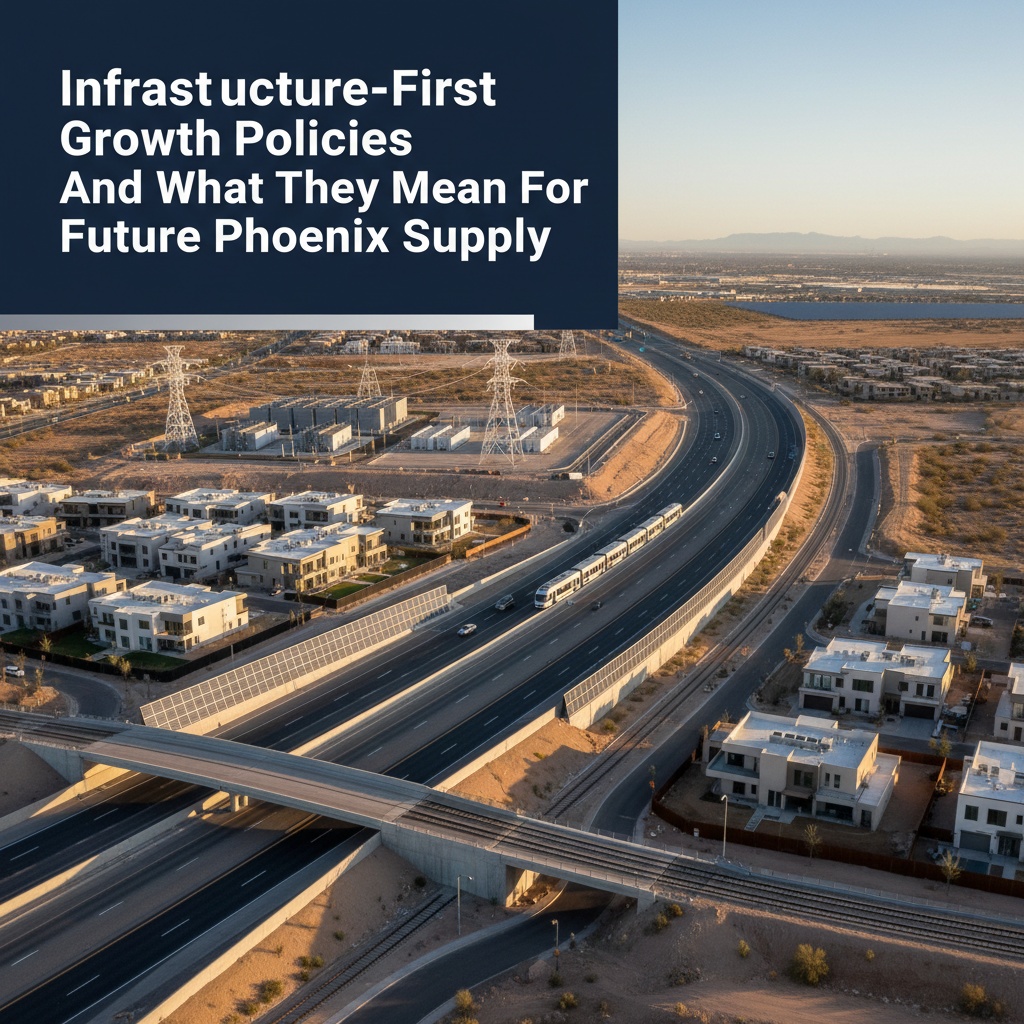
Infrastructure‑first growth policies in Phoenix mean the metro can no longer build wherever there’s dirt; future supply will increasingly follow the corridors where power, water, and access are already in place or realistically fundable.
Here’s how that really plays out for long‑term housing supply.
What “Infrastructure‑First” Really Means Now
For years, Phoenix’s growth model assumed that if demand showed up, infrastructure would follow. Today, that’s flipped: big systems have to pencil first.
Key constraints shaping where future housing can actually go:
- Power capacity: Data centers, semiconductor fabs, and advanced manufacturing projects are absorbing enormous amounts of electricity, and adding new generation or transmission takes years.
- Water certainty: Arizona’s 100‑year Assured Water Supply rules mean you can’t just map lots and start selling; you must prove a long‑term, secure supply, and some fringe areas simply can’t.
- Access and mobility: Freeways, arterial roads, and future transit investments now act as gatekeepers; parcels without realistic connectivity plans are effectively sidelined.
On a map, vast areas look “open.” In practice, many are on hold until power, water, and access catch up—or they never move at all.
Why Some Corridors Will Outperform
Because infrastructure is capital‑intensive and slow to build, growth is concentrating where multiple systems already align:
- Established or expanding freeway corridors (like parts of the Southeast Valley and West Valley) where ADOT has funded or planned widening and new interchanges.
- Areas near major employment anchors—semiconductor plants, advanced manufacturing, logistics hubs—where utilities and road capacity are being upgraded for industrial demand and can support housing as a by‑product.
- Central and infill locations where water, power, and access are already robust, even if land is more expensive.
Institutional capital is increasingly prioritizing these “infrastructure‑ready” submarkets over raw peripheral land, even when the latter is cheaper on a per‑acre basis.
What Gets Left Behind
Infrastructure‑first thinking also creates a shadow inventory of land that looks available but isn’t functionally developable:
- Parcels with uncertain or inadequate water rights, especially in parts of the outer West Valley and some desert fringes, can’t meet 100‑year proof and therefore can’t move into large‑scale housing.
- Sites lacking feasible power upgrades—because nearby substations and transmission are already spoken for by industrial and data center users—remain frozen until new generation or lines are built, which may be a decade‑scale process.
- State trust land, federal land, and isolated private holdings without clear infrastructure financing paths (improvement districts, regional agreements) may stay “paper potential” only.
For future supply, that means the old assumption—“we can always just keep building out”—no longer holds. Some historical expansion corridors will not see the same volume of housing they once did.
How This Shapes Future Housing Mix
Infrastructure‑first policies don’t just decide where Phoenix can grow; they influence what gets built:
- More emphasis on infill and higher‑density formats in infrastructure‑rich cores, because squeezing more homes into well‑served areas is cheaper than extending systems to new edges.
- Master‑planned communities that can internalize infrastructure (schools, collectors, local water/wastewater improvements) will keep an advantage in designated growth corridors.
- Stronger push for efficient, climate‑resilient buildings, because cooling and power costs are rising and infrastructure providers are watching long‑term load profiles.
Over time, you can expect a more pronounced split:
– Fewer, more deliberate new‑build corridors on the fringe,
– More vertical and “missing‑middle” solutions in the core and around major job nodes.
What This Means If You’re Planning Ahead
For buyers and investors looking beyond the next cycle, infrastructure‑first policies offer a kind of roadmap:
- The most resilient neighborhoods and projects will be those with secured water, demonstrated power capacity, and strong access already in place—not just promises on a brochure.
- Land and housing in these infrastructure‑favored areas may feel more expensive upfront but can benefit from more durable demand and less entitlement/infrastructure risk.
- Speculation purely on cheap, outer‑ring land without clear answers on utilities and access is riskier than it used to be; policy and infrastructure timelines can easily outlast your investment horizon.
The big shift is this: Phoenix’s growth story is no longer just about having plenty of land. It’s about having the right land, with the right systems, at the right time.
A Warm Closing From Renee
If you’re looking at Phoenix and trying to decide which side of the Valley, which corridor, or which project type makes sense for the long run, it’s completely normal to feel overwhelmed by all the talk of power, water, and infrastructure.
You don’t have to decode that alone. This is the layer beneath the listings that I live in every day—where future freeways, substations, and water policy quietly determine which neighborhoods will feel supported and which may struggle to take off.
If you’re thinking about making a move in Phoenix, you don’t have to figure it out alone. Reach out anytime, and we’ll look at your options through that infrastructure‑first lens, so you can choose a home or investment that’s aligned not just with today’s map, but with where this city is truly headed.
Get the full Phoenix Market Insights → [Market Insights]


-
Cost of Living in Rhode Island: Housing, Taxes, Utilities, and Everyday Expenses
-

What If My Commute Becomes Worse Than Expected?
-

How Aging Home Systems Affect Property Value