


Local Politics and Housing→ [Local Politics and Housing] & For more info on National Politics and Housing → [National Politics and Housing]
Written by: Renee Burke
Phoenix’s “missing‑middle” housing conversation is really about two competing truths: we need more attainable homes close to jobs and transit, and many neighbors are deeply protective of the character they’ve spent years building around their streets and historic districts.
When those collide, even very gentle density starts to feel threatening.
What “Missing‑Middle” Housing Means In Phoenix
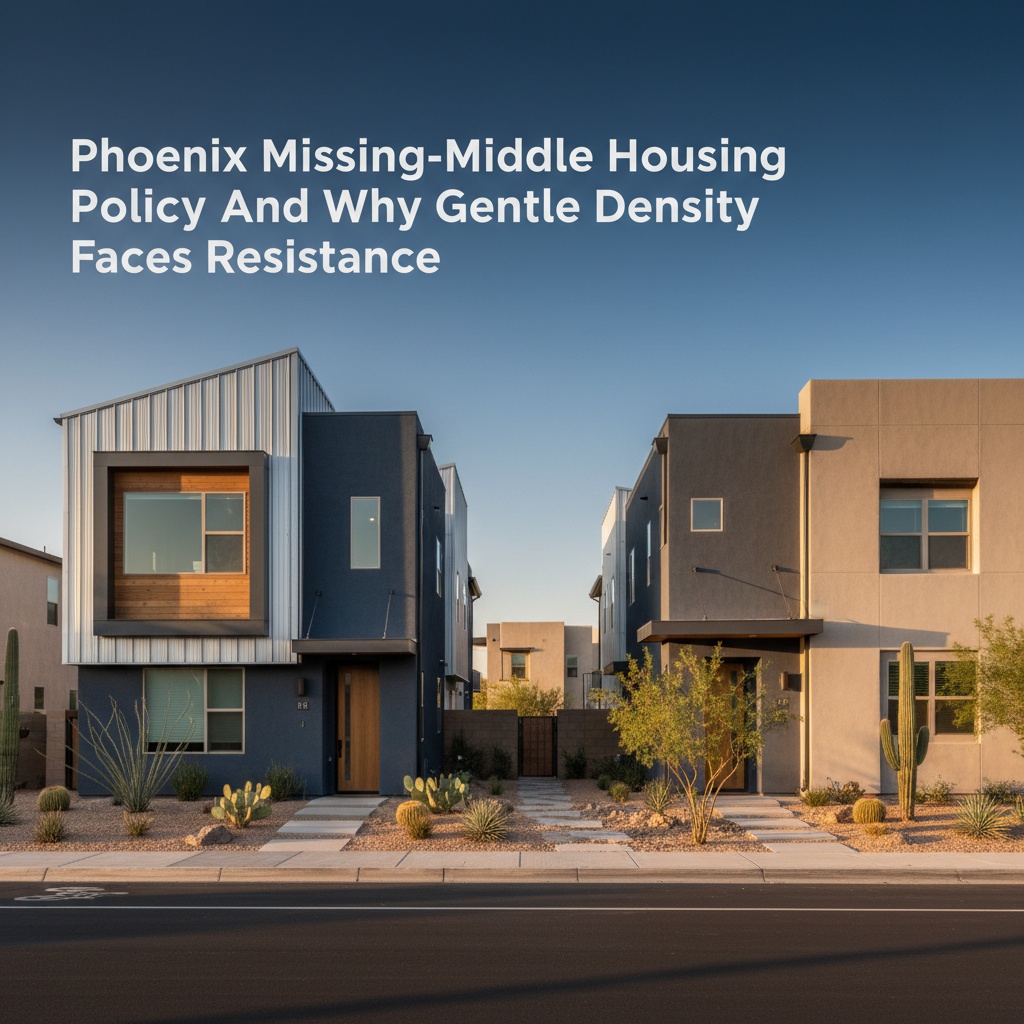
When we say “missing‑middle,” we’re talking about smaller, human‑scaled multi‑unit homes that live quietly in between single‑family and big apartment buildings: duplexes, triplexes, fourplexes, townhomes, and similar formats.
In Phoenix, the state stepped in first. A 2024 Arizona law requires larger cities to allow certain middle‑housing types on lots previously zoned only for single‑family homes within about a mile of downtowns. Phoenix responded with a Middle Housing Overlay District (MHOD)—a text amendment (Z‑TA‑1‑25‑Y) that updates the zoning code to permit these smaller multi‑unit buildings, while still tying them to design and scale standards so they resemble surrounding houses rather than large towers.
On paper, it’s a gentle shift: same lot, slightly more homes, scaled to feel like the neighborhood.
Why Policy Makers Are Pushing Gentle Density
From the policy side, the logic is straightforward:
- Housing shortage and attainability pressure
Arizona is short tens of thousands of units, especially in more attainable price ranges. Lawmakers see missing‑middle housing as one way to add doors without sprawling endlessly outward. - Leveraging existing infrastructure
Allowing duplexes, triplexes, and fourplexes within about a mile of downtown Phoenix makes use of existing transit, roads, utilities, and services instead of stretching them farther out. - More options for diverse households
Not everyone fits the single‑family mold. Multi‑generational families, young professionals, downsizing empty‑nesters, and roommates all benefit when there are more walkable, smaller‑scale options in established areas.
From City Hall’s perspective, gentle density is a “middle path”—a way to add supply that doesn’t radically change skyline or street feel, but does chip away at the gap between incomes and housing costs.
Where The Resistance Comes From
If you sit with people in our historic or close‑in neighborhoods, their resistance isn’t usually about the phrase “duplex” or “triplex” by itself. It’s about deeply rooted fears and lived experience.
The biggest friction points:
- Loss of historic character and architecture
Historic districts like Willo, La Hacienda, and others worry that up‑zoning or overlays will encourage demolitions of contributing homes, threatening the 51% historic‑structure threshold they must maintain to keep their designation. - Fear of “investorization”
Many neighbors believe middle‑housing rules will invite out‑of‑state or institutional buyers to tear down million‑dollar homes and rebuild clusters of higher‑rent units, changing the social fabric and pricing out long‑time residents. - Skepticism about affordability claims
Residents hear “middle housing” marketed as a solution to affordability, but they look at current land values and doubt that new fourplexes will actually rent or sell at prices their teachers, nurses, or young adults can afford. - Traffic, parking, and daily life
Even modest increases in units per lot can feel big on narrow, older streets with limited off‑street parking and aging infrastructure.
So while the policy is framed as “gentle,” the people living in these areas often perceive it as the first step toward a more intense transformation they can’t fully control.
The Historic Neighborhood Flashpoint
Historic neighborhoods have become the emotional center of the resistance.
Phoenix’s middle‑housing ordinance, adopted to comply with state law, applies within a defined radius around downtown—and that includes long‑protected historic districts. Residents in places like Willo packed City Council meetings, arguing that:
- The law could incentivize demolishing older contributing homes in favor of higher‑yield, newer units.
- Their areas already contain a mix of duplexes, older multi‑unit buildings, and accessory units, so they see themselves as “naturally” middle‑housing friendly without state mandates.
In response, some lawmakers introduced House Bill 2375, aiming to carve out exemptions for historic neighborhoods from the statewide middle‑housing mandate, with supporters framing it as an effort to “protect history” and opponents warning that it risks turning the city’s most walkable, transit‑rich areas into untouchable museums.
That tug‑of‑war—between honoring history and making room for new residents—is at the heart of why gentle density faces resistance here.
Why Gentle Density Feels Anything But Gentle
On a zoning diagram, allowing four units instead of one looks modest. On a beloved block, it can feel huge.
A few psychological pieces to keep in mind:
- Attachment to “earned stability”
Many owners in these central neighborhoods bought when areas were rougher, invested heavily, and watched their blocks transform. They experience new rules as a threat to the stability they feel they’ve earned over decades. - Distrust of broad, one‑size‑fits‑all laws
Top‑down mandates from the state can feel insensitive to local nuance. Residents who see existing duplexes and small apartments in their district bristle at being told they need an overlay “for diversity.” - Visual imagination gap
City diagrams show idealized, well‑designed middle housing. Neighbors often picture the worst‑case: boxy, out‑of‑scale buildings, shady operators, and constant turnover. That gap between what’s promised and what they fear creates a lot of heat in public meetings.
So even when the underlying idea is reasonable, the combination of history, emotion, and lived experience turns “gentle density” into a lightning rod.
What This Means For Buyers and Small Investors
For someone considering a home or small investment near downtown Phoenix, missing‑middle policy isn’t abstract—it shapes opportunity and risk.
A few ways it shows up:
- Potential upside in overlay areas
Properties within the Middle Housing Overlay may gain long‑term flexibility for adding a second unit, building a small multiplex, or selling to someone who will. That can support higher land values over time, especially on corner or larger lots. - Heightened political risk in historic or contentious districts
In neighborhoods pushing for exemptions, rules may shift more than once over the next few years. Buying purely for future up‑zoning upside there is riskier, because legislation and local ordinances are still evolving. - Stronger focus on design and neighbor fit
Even where middle housing is allowed, projects that don’t respect scale, setbacks, and character are more likely to face practical resistance—appeals, complaints, or stricter interpretation of design standards.
For an owner‑occupant, this is mostly about understanding what could be built nearby and how your block might slowly change. For a small investor, it’s about threading a needle: using new flexibility thoughtfully without becoming the neighbor everyone rallies against.
A Warm Closing From Renee
If you’re looking at neighborhoods near downtown Phoenix and trying to make sense of missing‑middle policy, you’re not alone. It’s a lot to hold: the need for more homes, the desire to preserve what makes our older districts special, and the very real question of how all this might affect the street you live on.
You don’t have to untangle it all by yourself. This is the kind of nuanced, block‑by‑block conversation I have every week—what the overlay really allows, where resistance is strongest, and how that translates into both lifestyle and long‑term value.
If you’re thinking about making a move in Phoenix, you don’t have to figure it out alone. Reach out anytime, and we’ll walk through specific neighborhoods together, look at how gentle density is likely to play out there, and find a path that honors both your plans and the character of the place you’ll call home.
Get the full Phoenix Market Insights → [Market Insights]


-
Cost of Living in Rhode Island: Housing, Taxes, Utilities, and Everyday Expenses
-

What If My Commute Becomes Worse Than Expected?
-
How Aging Home Systems Affect Property Value