


Local Politics and Housing→ [Local Politics and Housing] & For more info on National Politics and Housing → [National Politics and Housing]
Written by: Renee Burke
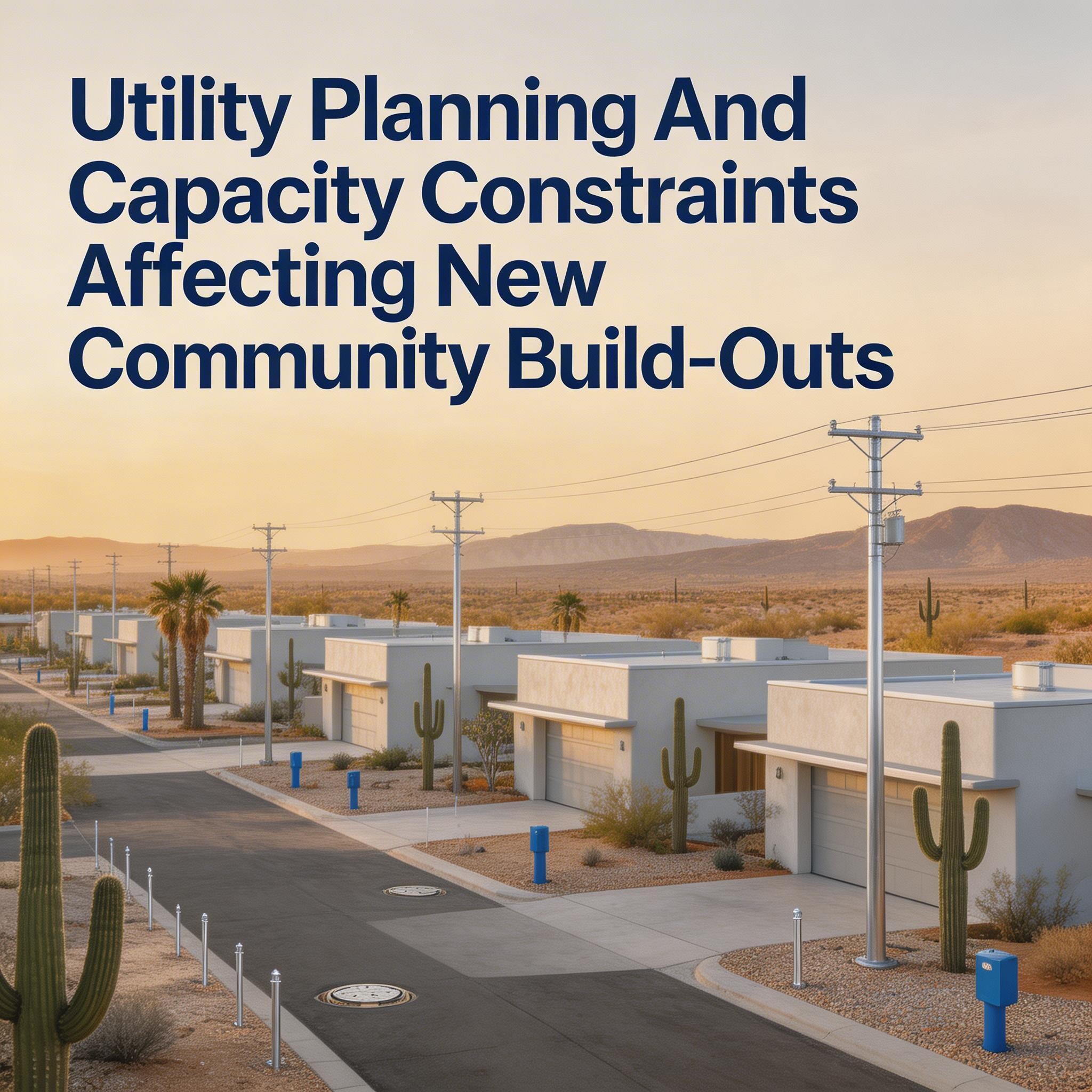
Utility planning and capacity constraints are increasingly deciding which Phoenix growth areas actually build out on schedule—and which ones stall, even when the land is mapped and demand is there.
At this point, it’s not just “Is there dirt?” but “Is there enough power, water, and sewer capacity to support a full community?”
The Three Big Utility Gatekeepers
Across Phoenix growth areas, three systems quietly control new community build‑outs:
- Water supply and delivery
- Wastewater (sewer) capacity
- Electric power (especially in corridors competing with data centers and industrial projects)
When any one of those is constrained—or not yet funded—developers can have platted lots, partial infrastructure, even a bridge built, and still be unable to move forward.
A clear example: in the far West Valley, thousands of planned homes were halted when the state groundwater model showed insufficient long‑term supply to meet Arizona’s 100‑year Assured Water Supply requirements, leaving large master‑planned communities like North Star Ranch in limbo despite roads and some utilities already in place.
Water: Assured Supply and Red Lines
On the water side, Phoenix and the wider metro are now working under a much stricter “prove it before you build it” regime:
- The state’s 100‑year Assured Water Supply rules have put a moratorium on new subdivisions in parts of the West Valley that relied heavily on local groundwater, effectively freezing hundreds of thousands of planned lots until alternative water is secured.
- Developers in affected zones are now pushed to either:
- Find imported or renewable water sources,
- Shift projects to areas with stronger existing supplies, or
- Re‑entitle land for uses that don’t require new assured‑water determinations.
Within Phoenix city limits, water/sewer policies explicitly link development approvals to system capacity, requiring off‑site improvements or infrastructure contributions when existing mains, reservoirs, or pump stations are not sufficient to serve a project.
Bottom line: if the water math doesn’t pencil, build‑out slows or stops, even in high‑demand corridors.
Sewer and Treatment Capacity
Wastewater works the same way, just less visibly:
- Phoenix’s water services department maintains detailed infrastructure plans for interceptors, lift stations, and treatment plants, and new development must tie into this framework.
- In growth areas where downstream lines or plants are near capacity, developers can be required to fund or help fund upsizing—bigger pipes, new lift stations, or plant expansions—before full build‑out is allowed.
That often leads to phased communities:
- Initial phases proceed where existing capacity can support them.
- Later phases wait for scheduled capital projects or cost‑sharing agreements to be completed.
From the street, it looks like a half‑built community sitting still; behind the scenes, it’s a sewer‑capacity and funding issue.
Power Constraints and the Data Center Effect
On the power side, Phoenix is feeling the strain of:
- Rapid growth in data centers and AI/cloud infrastructure, which consume massive amounts of electricity, particularly in corridors like Tonopah and portions of the West Valley.
- Large industrial and advanced manufacturing campuses that lock in high, long‑term loads.
Utilities and planners now face a triage problem:
- New substations and transmission lines are multi‑year projects.
- When data centers and industrial users reserve future capacity, there’s less headroom left for new housing on the same feeders and in the same substation footprints.
That forces some residential developers to:
- Shift to corridors with existing or planned power capacity.
- Accept slower build‑outs while waiting for utility upgrades.
- Re‑scope projects to match available electrical infrastructure.
So even if zoning and demand line up, a constrained substation or overloaded feeder can quietly cap how fast a community can fill in.
How Utility Planning Re-Routes Growth
Because water, sewer, and power projects are capital‑intensive and slow, they effectively steer growth:
- Areas with pre‑planned, funded infrastructure (like established freeway corridors with parallel utility planning) can absorb more housing at a faster pace.
- Peripheral zones lacking clear utility plans or funding often end up as “paper subdivisions”—mapped and marketed, but not built at the scale originally imagined.
Analyses projecting that metro Phoenix must absorb around 1.1 million new residents over the next 15 years already note that infrastructure limits are redirecting development toward corridors with better existing capacity or more realistic upgrade timelines.
This is why you see:
- Stronger, more continuous build‑outs along infrastructure‑ready corridors in parts of the Southeast Valley and selected West Valley pockets.
- Stop‑and‑go patterns—and in some cases long‑term pauses—in fringe areas where water or power constraints are hardest to solve.
What This Means For Buyers and Investors
For people looking at new communities, the utility picture matters even if you never see a pipe or a substation:
- Communities in well‑served corridors are more likely to deliver phases on time, add promised amenities, and support long‑term occupancy and value.
- Projects in constrained zones may face unpredictable timelines, shifting lot releases, or redesigns if the city or utilities change capacity assumptions or funding priorities.
When we zoom in on specific areas, questions worth asking include:
- Is this in a zone with assured water and clear long‑term planning?
- Are there known sewer or plant upgrades tied to later phases?
- What large power users (data centers, industrial) are nearby, and how is the utility planning to serve both them and housing?
You don’t need to become an engineer—but understanding that growth is now utilities‑led rather than just land‑led helps you make calmer, better‑grounded decisions.
If you’d like, next we can pick a specific corridor you’re working in and map out how its utility story might shape build‑out risk and pricing over the next 5–10 years.
Get the full Phoenix Market Insights → [Market Insights]


-
Cost of Living in Rhode Island: Housing, Taxes, Utilities, and Everyday Expenses
-

What If My Commute Becomes Worse Than Expected?
-

How Aging Home Systems Affect Property Value