


This is part of the Ownership Costs & Budget Planning Guide → [Ownership Costs & Budget Planning Guide] & the larger Homeownership 101 Guide→ [Homeownership 101]
Written by: Renee Burke
When you first buy a home in Phoenix, your focus naturally settles on one number: the total monthly payment your lender quotes you. It feels neat and contained—principal, interest, taxes, and insurance all wrapped into a single line item.
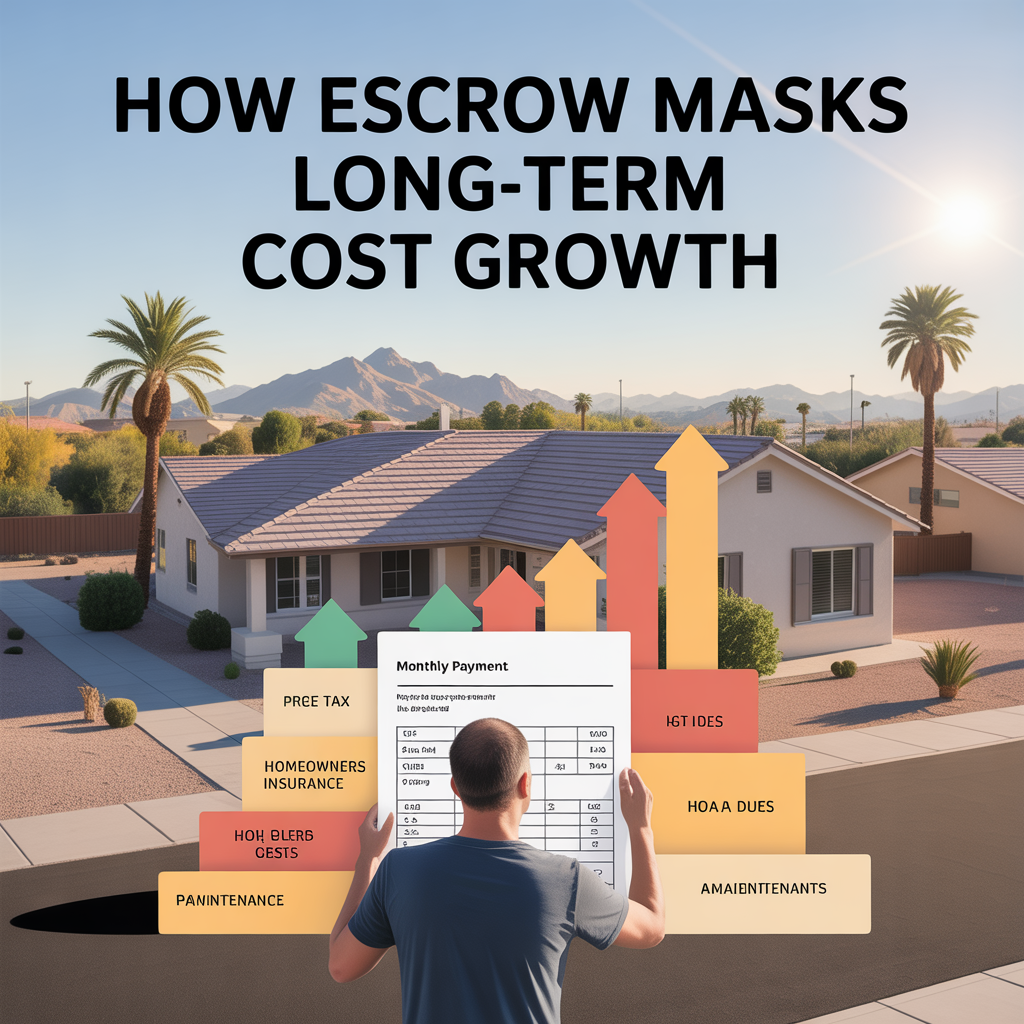
But when those property taxes and insurance are collected through escrow, something subtle happens: the true long-term growth of your housing costs becomes harder to see. Escrow smooths, bundles, and auto-adjusts in ways that can quietly push your payment higher over time, without you realizing where the increase is really coming from.
Let’s unpack this gently, so you can see what’s really going on behind that tidy monthly draft from your bank.
What Escrow Really Does (In Plain English)
When you have a mortgage with escrow, your lender collects extra money each month along with your principal and interest. That escrow portion is used to pay:
- Property taxes
- Homeowners insurance
- Sometimes mortgage insurance or HOA-related items (depending on your setup)
Instead of you writing separate checks once or twice a year, the lender holds those funds and pays the bills for you when they’re due. On the surface, it feels like a convenience feature—and it is. But it also creates distance between you and the true cost of those items as they rise over time.
Because it’s all bundled, you’re less likely to track:
- How fast your property taxes are increasing
- How often your insurance premiums are being adjusted
- How much “cushion” your lender is adding to your escrow to stay compliant
The end result: your payment goes up, and it’s easy to shrug it off as “just the mortgage.”
How Escrow Smooths Out Spikes – and Hides Trends
Here in the Phoenix metro, especially in growing areas like Glendale and the West Valley, property values and insurance costs don’t move in a straight, gentle line. They can jump.
Property taxes
As your home’s assessed value rises, your property taxes often follow. Instead of you seeing a big, once-a-year bill and reacting to it, your lender:
- Recalculates how much they need to collect monthly
- Spreads that higher amount across the next 12 payments
- Adjusts your escrow portion and updates your total payment
So instead of feeling the full impact of a tax spike all at once, you feel it as a “small” monthly increase that’s easy to ignore. Over several years, those little bumps stack up.
Insurance premiums
The same thing happens with homeowners insurance. In Phoenix, insurers pay attention to:
- Rising construction and labor costs
- Weather-related claims (monsoon damage, hail, wind)
- Overall risk in certain zip codes
When your premium goes up, the insurer sends the new bill to your lender. The lender recalculates escrow. Your monthly payment adjusts. Again—no big, obvious moment where you sit down and decide, “Is this still worth it?”
Escrow makes all of this feel softer and more gradual. But that softness can also dull your awareness.
The Annual Escrow Analysis: The Quiet Culprit
Once a year, your lender performs an escrow analysis. They look at:
- What they paid out for taxes and insurance
- What they collected from you
- Whether the escrow account has a shortage, surplus, or is right on target
If there’s a shortage (and there often is, when costs are rising), they usually give you two options:
- Pay the shortage in a lump sum
- Spread it out over the next 12 months, which increases your monthly payment
Many homeowners, especially in busy seasons of life, choose the second option. It feels easier in the moment. But what that means is:
- This year’s tax/insurance increase gets smoothed into next year’s payment
- That higher baseline is then used for the next analysis
- Over time, your “new normal” keeps drifting up
Because the increases are folded into escrow adjustments instead of presented as standalone bills, it’s easy not to connect the dots between local tax changes, insurance trends, and your overall housing cost.
Why This Matters So Much in Phoenix
In a fast-growing market like Phoenix, especially in communities where values have climbed quickly, this masked cost growth can be significant.
In areas of Glendale where demand has strengthened—near major employment centers, good schools, or convenient Loop 101 access—assessed values often rise more quickly. That:
- Pushes property taxes up faster than many owners expect
- Can trigger more frequent or steeper escrow adjustments
At the same time, construction costs in the Valley have climbed in recent years. That affects replacement-cost calculations, which affects insurance premiums.
Escrow doesn’t cause these increases. But it does wrap them in a soft blanket, so you may not realize how much your non-mortgage costs are growing until you suddenly feel “tight” each month and can’t quite figure out why.
The Emotional Side: Why Escrow Feels So Comforting
There’s a reason many lenders and homeowners prefer escrow, and it’s not a bad one:
- It makes budgeting feel simpler. One payment covers “everything.”
- It removes the stress of saving separately for big annual bills.
- It reduces the risk of missed payments on taxes or insurance.
For a lot of people, especially first-time buyers, that structure truly is helpful. But like many comforting systems, it comes with tradeoffs:
- You don’t get as much practice seeing and managing those costs directly.
- You lose some visibility into which part of your housing cost is climbing.
- You’re less likely to shop around for insurance or challenge valuations because the pain is softened.
Think of escrow as a kind, well-meaning friend who pays your bills for you—but doesn’t always tell you that the bills themselves are getting higher every year.
How to See Through the Escrow “Fog”
You don’t have to give up escrow to regain clarity. You just need to peek behind the curtain once or twice a year. Here’s what I encourage Phoenix homeowners to do:
- Read your escrow analysis carefully
- Separate the change in your taxes from the change in your insurance.
- Note how much of your new payment is pure escrow versus principal/interest.
- Pull your property tax notices
- Look at your limited property value and assessed ratios over the last few years.
- If something feels out of line, ask questions or explore your options to appeal.
- Shop your insurance every couple of years
- Rising premiums aren’t always avoidable, but you do have choices.
- Ask about deductibles, coverage levels, and any Phoenix-specific discounts.
- Track your total housing cost on a simple spreadsheet
- Once a year, write down: mortgage principal and interest, taxes, insurance, HOA, and utilities.
- Seeing the pattern in black and white helps you make calm, informed decisions.
This doesn’t have to be complicated. A quiet hour at the kitchen table once a year can give you more control than most people ever feel over their largest expense.
Planning Around Future Escrow Increases
Once you recognize that escrow often drifts upward over time, especially in a maturing market like Phoenix, you can plan around it instead of being surprised by it.
When I work with buyers in Glendale, we don’t just look at “today’s” payment. We talk about:
- What happens if taxes rise steadily over the next 5–10 years
- How insurance might shift as values and construction costs change
- How much cushion feels comfortable to you in your monthly budget
The goal isn’t to scare you away from a home you love. It’s to help you choose a home that still feels comfortable even as these escrow-fed costs grow slowly in the background. That’s how you stay not just a homeowner, but a happy homeowner.
You Don’t Have to Decode This Alone
If you’re already a homeowner and your payment has crept up year after year, it’s okay to admit you’re not entirely sure why. Most people aren’t, and that doesn’t mean you’re not good with money—it just means escrow has done exactly what it’s designed to do: handle things quietly.
And if you’re thinking about buying in Phoenix or Glendale, this is the perfect time to build clarity in from the start. We can walk through sample escrow analyses, look at real tax and insurance histories, and choose a payment that makes sense not only today but in a few years, too.
If you’re thinking about making a move in Phoenix, you don’t have to figure it out alone. Reach out, and let’s sit down together—calmly, patiently—and pull back the curtain on escrow so your long-term housing costs never catch you off guard.
Get the full Phoenix Market Insights → [Market Insights]


-

Real Outdoor Access by Chandler Area
-

Commute Corridors and Directions in Chandler
-

School District Lines in Chandler