


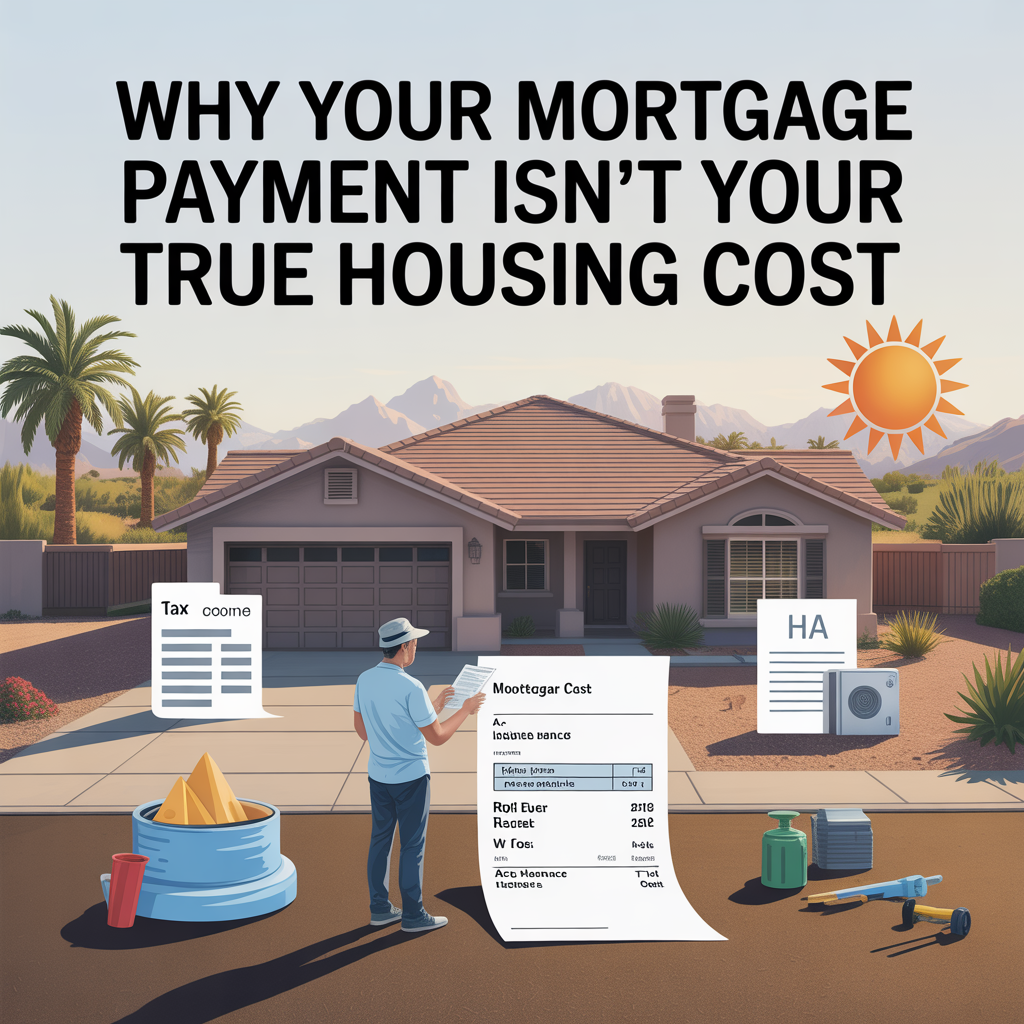
This is part of the Ownership Costs & Budget Planning Guide → [Ownership Costs & Budget Planning Guide] & the larger Homeownership 101 Guide→ [Homeownership 101]
Written by: Renee Burke
When most people picture what they can “afford” in a home, their minds immediately jump to the monthly mortgage payment. It’s the number shown on those eye-catching real estate apps or mortgage calculators—principal, interest, maybe taxes and insurance if you dig a little deeper.
But what I’ve seen again and again with new homeowners across the Phoenix area—from Arrowhead Ranch to North Central, Peoria to Litchfield Park—is that the true cost of owning a home in our desert city goes well beyond that tidy monthly figure. Your real housing cost is layered, nuanced, and, when you understand it clearly, it’s empowering.
Because when you know what really goes into the numbers, you can choose with confidence.
The Mortgage Is Just the Beginning
Let’s start with the part you already know: principal and interest. That’s the base of your monthly payment. But the other pieces—property taxes, homeowners insurance, HOA dues, maintenance, utilities, and long-term upgrades—make just as much impact on your actual budget.
In Maricopa County, for instance, property taxes generally run lower than many big-city areas. But what trips people up is how unevenly those taxes show up across neighborhoods. A home in Glendale’s Arrowhead Lakes with lake privileges and higher assessed value can carry a much steeper tax bill than a similarly sized home in Deer Valley.
So while one buyer might pay around 0.5% of assessed value in annual property tax, another in a master-planned community with added municipal or improvement districts could pay 1% or more. That difference can mean several hundred dollars per month—and most online calculators won’t warn you about it.
Homeowners insurance, too, has a Phoenix-specific rhythm. With our monsoon storms, microbursts, and those rare but memorable hail events, not all policies are alike. Older homes in Central Phoenix or Glendale’s historical core may also require specialized coverage for plumbing, aging roofs, and electrical updates. It’s something I always encourage my clients to price out before they fall in love with a property.
The Hidden Costs of Comfort
Once you’ve moved in, another layer appears—the cost to keep your home comfortable and running smoothly. Living in the Sonoran Desert means energy efficiency isn’t optional; it’s essential.
Think about the air conditioning load. A single-story stucco home built in the 1990s might have average summer energy bills of $250–350 per month, while a newer build with modern insulation and a variable speed HVAC could stay 25–30% lower for the same comfort. That difference adds up fast.
And water costs, while modest compared to many states, can surprise relocating buyers when the lush lawn or backyard pool dream meets reality. Phoenix and Glendale’s tiered water pricing structures reward conservative use—so upgrading irrigation systems, planting desert-adapted landscaping, and investing in pool covers aren’t just environmentally smart; they protect your budget too.
HOA dues follow similar patterns. In parts of Glendale, you might find townhomes with $100 monthly fees that cover common area upkeep and community pools. But in more upscale enclaves like Arrowhead Ranch or Westwing Mountain, dues can climb closer to $200 or more, especially if they include private security or well-maintained lake systems.
The Invisible Line Item: Maintenance
Here’s the truth that even seasoned homeowners sometimes underestimate—homes age constantly, and Phoenix’s desert climate accelerates it. Roofs take a beating from UV exposure; air conditioners work harder than anywhere else; outdoor paint fades quickly under 300+ days of sun.
A good rule of thumb is to set aside roughly 1–2% of your home’s value each year for upkeep. But certain factors can nudge that higher: tile roofs nearing 20 years old, plumbing systems with galvanized piping, extensive landscaping, or high-end appliances that require specialized servicing.
That means on a $500,000 Glendale home, budgeting $5,000–10,000 annually isn’t excessive—it’s realistic. And when those expenses arise, they don’t feel like emergencies; they’re just part of protecting your investment.
It’s not about fear—it’s about foresight.
The Lifestyle Layer
What I love most about helping homeowners in Phoenix, and particularly in Glendale, is that housing cost isn’t just math—it’s lifestyle. How you live in your home changes what you spend and where you find value.
Take commute costs as an example. Living closer to major arteries like the Loop 101 or Grand Avenue can save hundreds per month if it cuts 40 minutes off your daily drive time. Likewise, being within walking distance to schools, parks, or shops in places like the Arrowhead Towne Center corridor can offset transportation and childcare costs in ways that never appear in a mortgage calculator.
Even small things matter—like an older home that’s walking distance to the Glendale Glitters district may require a bit more in maintenance, but it gives back in community experience and cultural connection that no spreadsheet can measure.
So when we talk about housing cost, it’s not only what it takes to own your home but also what you gain from the way you live in it. A lower monthly payment may not mean a better fit if it stretches your time, comfort, or peace of mind too thin.
The Long Game of Stability
The Phoenix market is unique in how quickly conditions can shift. We go through cyclical booms and corrections, often driven by population growth, job migration, and interest rates that directly affect affordability.
Understanding your true housing cost becomes even more critical in that environment. Homeowners who base their decisions solely on a lender’s “approved amount” can end up house-rich but cash-stressed—unable to enjoy the life they moved here for.
By contrast, the clients who thrive long-term in Glendale, Peoria, or Surprise are those who think more holistically. They choose homes not just because the numbers fit on paper, but because the larger lifestyle equation does too. They anticipate energy costs, property taxes, and expected maintenance before closing day. They plan ahead for upgrades—new windows, a more efficient HVAC system, maybe solar panels down the line—that reduce long-term operating costs while boosting resale value.
When you take that broader view, your home becomes far more than an address—it becomes an asset that rewards foresight with stability.
Seeing the Whole Picture Before You Buy
If you’re considering a move in the Phoenix area, it’s important to walk through all these layers early in your home search. Together, we can build a realistic monthly and annual budget that reflects true costs—not just the bank’s version of “affordable.”
For example, I often sit down with clients and outline two versions of their expected expenses:
- Projected Mortgage Payment: principal, interest, taxes, and insurance.
- True Monthly Housing Budget: everything above, plus HOA dues, utilities (based on home age and efficiency), and average maintenance.
We then compare that total to your comfort range—so you can look at listings with clear eyes and steady confidence, not surprises later.
It’s a gentle shift in perspective, but it changes everything about how wisely you buy.
A Home That Works for You
Owning a home should feel like security, not strain. When you understand the whole cost of living in your home, you’re positioned to make decisions from strength—not fear, guesswork, or pressure.
And this understanding is especially vital here in Phoenix, where everything—from HOA structures to energy bills—carries a desert-specific rhythm. The goal isn’t to overwhelm you with details; it’s to equip you with clarity.
Because once you see how the pieces truly fit, your home becomes not just a purchase—but a plan for your future.
Let’s Talk About Your Next Chapter
If you’re starting to think about buying or moving within the Phoenix area, especially here in Glendale, you don’t have to figure it all out alone. There’s a lot more to your true housing cost than a mortgage calculator can show—but that’s exactly where thoughtful guidance makes all the difference.
Let’s walk through your options together, neighborhood by neighborhood, cost by cost, until you feel completely confident in your direction.
If you’re thinking about making a move in Phoenix, you don’t have to figure it out alone.
Get the full Phoenix Market Insights → [Market Insights]


-

Repair vs Replace Decisions for Phoenix HVAC Systems
-
Creating a Long-Term Home Maintenance Plan
-
How Often Phoenix Homes Should Be Professionally Inspected