


Continue your market research using these 3 hubs → [Phoenix Market Insights Guide] → [Phoenix Metro Home Buying Process] → [Phoenix Metro Home Selling Process]
Written by: Renee Burke
If you live in the Phoenix metro area — or even if you’ve just been keeping an eye on it — you know this is a market that never stays quiet for long. There’s always a new headline, a fresh statistic, or a big opinion about what’s going to happen next. But what truly matters isn’t the noise online — it’s how the market feels on the ground, in the conversations between buyers, sellers, lenders, and neighbors who understand what’s really happening across the Valley.
As someone who’s lived and worked in Phoenix real estate for years, I can tell you: this city moves in cycles, but it always moves with purpose. The landscape shifts — interest rates rise, supply tightens, demand softens — yet the fundamentals that make people want to live here don’t fade. They evolve. And in 2026, we’re watching that evolution unfold right before us.
The Market in Early 2026 – A Pause with Underlying Strength
Right now, Phoenix is in what I would call a recalibration period. After a few years of extreme ups and downs — from rapid appreciation in 2020–2022 to the cooling that followed — our housing market has settled into something of a balancing act. Prices aren’t skyrocketing anymore, but they’re holding surprisingly steady given the higher-rate environment. As of March 2026, the median home price across Maricopa County sits just above $450,000, a modest but important 2–3% increase year-over-year.
What’s driving that stability? In large part, it’s our local job market and the continued population inflow — steady, not frantic, but consistent enough to keep the demand pipeline intact. Tech and healthcare remain strong, while construction, hospitality, and manufacturing are regaining momentum. The mix of industries here has matured a great deal from even five years ago, giving the entire metro more resilience.
In short: Phoenix has grown up. We aren’t a boom-and-bust market anymore. We’re a major metro behaving like one — measured, dynamic, and deeply tied to real economic growth.
The Inventory Story: Tight but Turning
The number one question I hear right now is some version of: “Are there even enough homes out there to buy?”
The answer is nuanced. Active inventory has increased slightly over the past year — roughly 8–10% more listings than this time last spring. But that’s still well below our long-term average. Many would-be sellers are staying put because they refinanced during the ultra-low rate years, and they’re reluctant to give up a 3% mortgage for today’s 6.5–7% rates. That decision makes sense on paper — but it’s also keeping the resale market constrained.
We’re seeing builders quietly fill some of the gap. Communities in suburban corridors like Queen Creek, Surprise, and the Loop 303 corridor are gradually adding supply, often with incentives that help offset rate shock for buyers. Still, the pace is intentional, not frantic.
For buyers, this means that while you’ll encounter competition in certain price brackets (especially under $500,000), you’re also much more likely to avoid bidding wars than you were a few years ago. For sellers, it means realistic pricing is everything — homes that show well and are priced correctly continue to move within 30–45 days, often with multiple solid offers. But overpricing, even slightly, can quickly stall momentum.
The Interest Rate Factor and Buyer Psychology
Interest rates have become the emotional barometer of this market. When rates dipped below 6% briefly late last year, activity jumped almost overnight. Now that we’re sitting closer to the mid-6% range again, there’s a wait-and-see energy among some buyers.
Here’s what I gently remind my clients — whether they’re moving up, downsizing, or buying their first home: Phoenix has never been a “cheap” market; it’s been an attainable one. Affordability here is still significantly stronger than in many coastal metros, and homes tend to hold long-term value due to land and zoning constraints across Maricopa County.
Yes, borrowing costs affect monthly payments, but waiting for the “perfect rate” has its risks. We’re in a window where buyers have negotiating leverage and sellers are open to concessions — something we didn’t have much of in 2021. That flexibility often outweighs a few basis points on interest rates, especially when rates are likely to ease slightly over the next 12 months.
What Could Tip Prices Up — or Down
Let’s break it down to the essentials that actually move prices here:
Factors pushing prices upward:
- Continued population growth from California, the Midwest, and the Pacific Northwest
- Limited developable land in key job corridors like Chandler, Tempe, and North Scottsdale
- A stable labor market and rising wages in biotech, semiconductor, and software sectors
- Steady investor and second-home interest in metro neighborhoods near Sky Harbor or downtown
Factors applying downward pressure:
- Elevated mortgage rates keeping move-up buyers on the sidelines
- Rising property insurance premiums in some areas, affecting affordability
- Seasonal slowdowns — summer always brings a bit of hesitation when temps hit triple digits
- An incremental rise in new-construction inventory, especially at entry and mid-price tiers
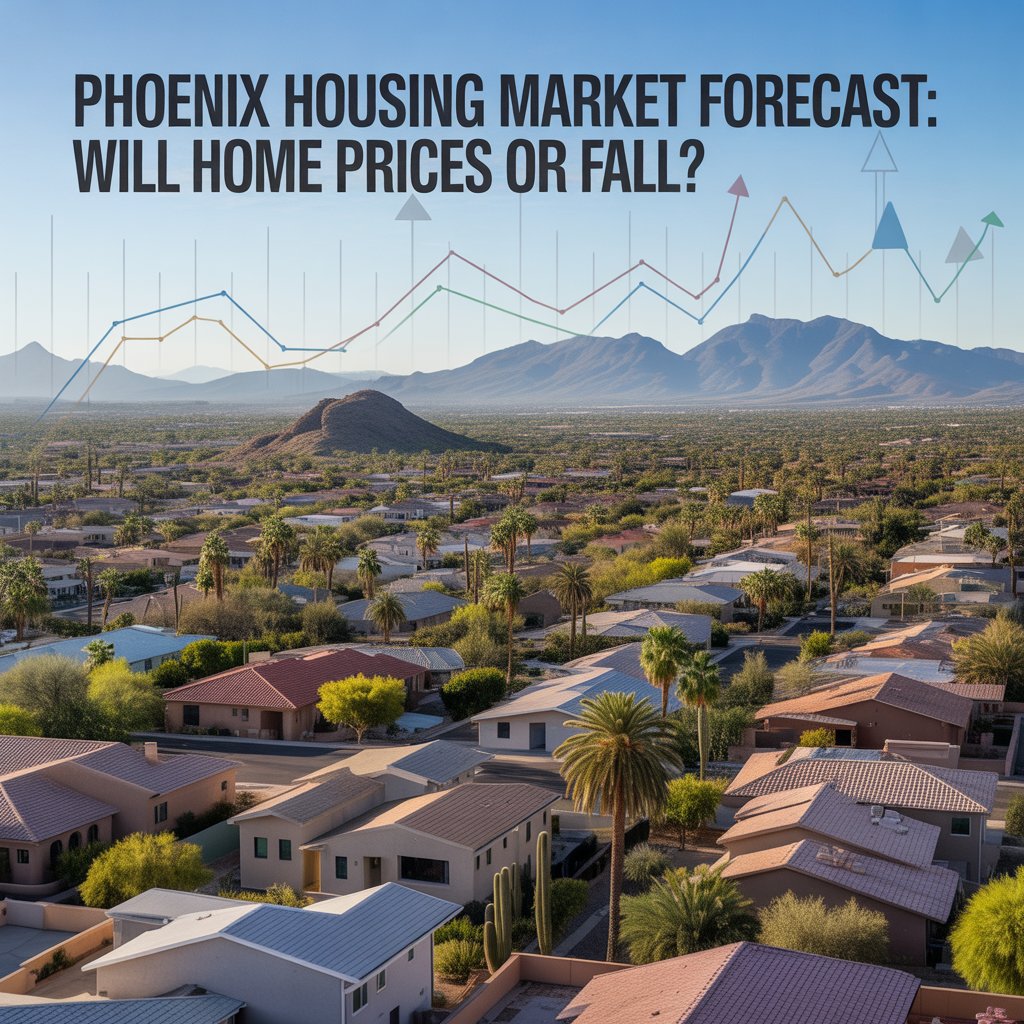
What’s most likely? A gentle slope upward — not a spike. Gradual appreciation, driven by balanced fundamentals. Expect 2–4% nominal growth over the next year, with stronger pockets in East Valley tech corridors and slightly softer conditions in outlying West Valley fringe areas.
The Lifestyle Reality: Why People Keep Choosing Phoenix
Beyond the market data, there’s a reason people keep moving here — and staying here. Phoenix offers something uniquely balanced: big-city opportunity with a quality of life that’s still manageable. The sunshine’s a given, but it’s the culture that’s matured — the mix of urban amenities, food scenes, wellness communities, and outdoor accessibility that makes living here more than a housing decision.
Neighborhoods have grown their own identities. Arcadia’s vibe feels brighter and more relaxed than ever. Central Phoenix, once known for its mid-century charm, is now full of walkable lifestyle hubs and coffee roasters that wouldn’t feel out of place in LA — except you can actually find parking. And suburban enclaves like Gilbert and Peoria combine strong schools, responsive infrastructure, and genuinely connected communities — all while keeping a sense of space and privacy that’s hard to find in other metros of our size.
These aren’t abstract trends; they’re what keep locals rooted and newcomers intrigued. When you blend that with a rising base of jobs, a maturing economy, and still-manageable costs of living, it’s clear why Phoenix remains a healthy housing market even as others around the country wobble.
What This Means for You
If you’re thinking about your next move — whether that’s upgrading, downsizing, or finally stepping into ownership — this is the moment to plan thoughtfully. The Phoenix market isn’t swinging wildly anymore; it rewards intention and preparation. Understanding timing, financing, and neighborhood trajectories can make all the difference between a stressful process and a confident one.
For sellers, it’s about presentation and precision — pricing with real awareness of active competition while highlighting the lifestyle story your home tells. For buyers, it’s about knowing where flexibility exists — not just in price, but in builder incentives, closing timelines, and negotiation windows.
Real estate here has always favored the well-informed. The good news is that with the right perspective, even a complex market becomes navigable.
If You’re Thinking About Your Next Move…
You don’t have to figure it all out alone.
Whether you’re curious about where your home stands in today’s market or wondering how to position your next purchase wisely, I’m here to guide you through it — calmly, clearly, and with your long-term goals in mind.
Phoenix is my home, too. I’ve watched its neighborhoods evolve, its prices shift, and its people grow into this incredible, connected community. And through all of it, one thing has stayed constant: when you make decisions informed by local truth, not headlines, they lead you exactly where you’re meant to be.
Let’s have that conversation — about your neighborhood, your timing, and your next smart move here in the Valley.
Get the full Phoenix Market Insights → [Market Insights]


-
Cost of Living in Rhode Island: Housing, Taxes, Utilities, and Everyday Expenses
-

What If My Commute Becomes Worse Than Expected?
-

How Aging Home Systems Affect Property Value