


This is part of the Ownership Costs & Budget Planning Guide → [Ownership Costs & Budget Planning Guide] & the larger Homeownership 101 Guide→ [Homeownership 101]
Written by: Renee Burke
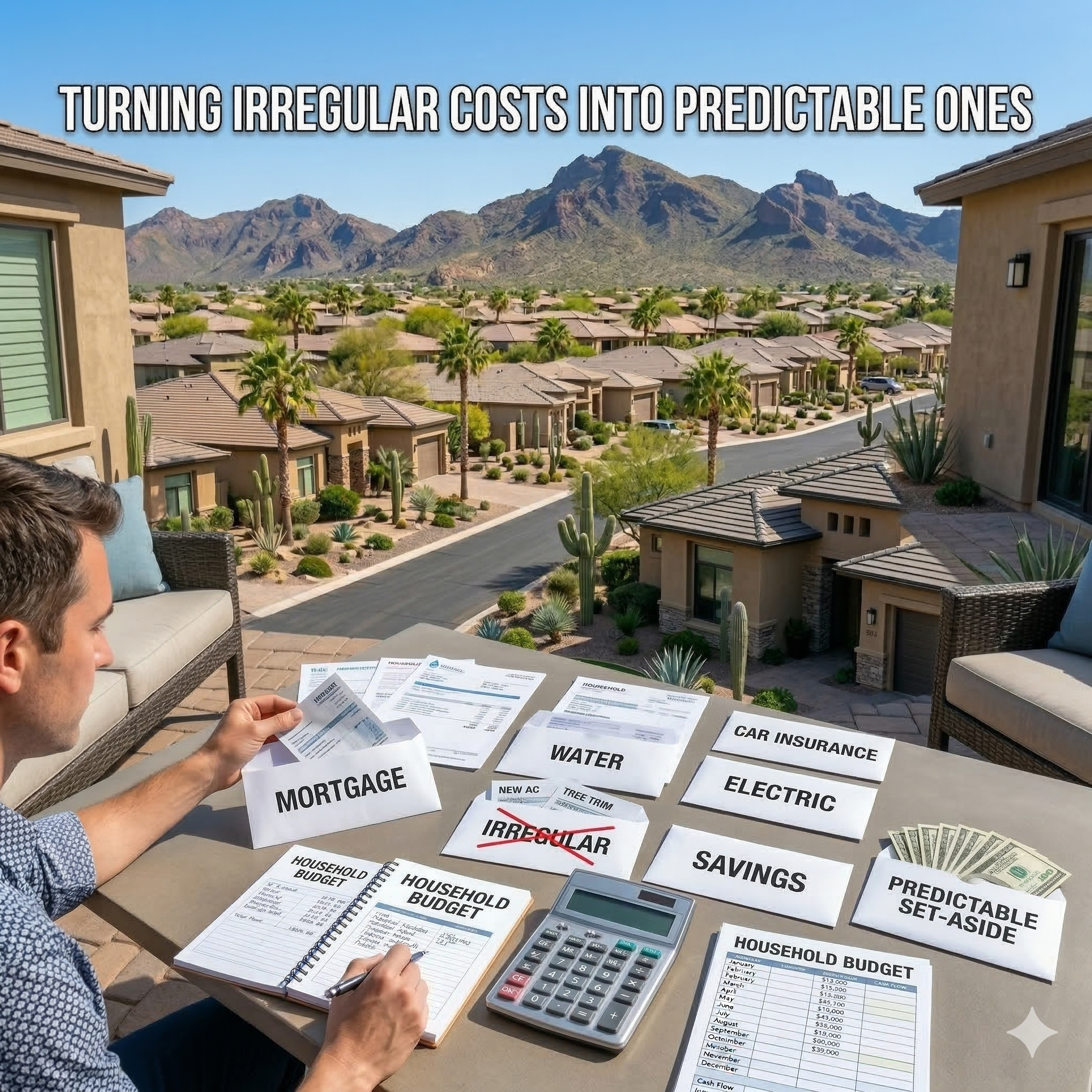
Those surprise home expenses — the $400 AC tune-up in May, the $250 pool pump in July, the $600 stucco patch after monsoon season — can throw even the steadiest Phoenix budget off-kilter. But they don’t have to. By shifting irregular costs into predictable ones, you smooth out cash flow, reduce stress, and protect your equity without cutting corners. I’ve helped countless Valley families do this, turning “uh-oh” moments into quiet confidence.
It’s simpler than it sounds: track patterns, automate reserves, and plan around our local seasons. Here’s how to make it real for your home.
Identify Your Irregular Costs First
Start by listing the one-offs from the past 12-24 months. In Phoenix, they often cluster around climate and lifestyle:
- AC servicing and filters (spring/summer: $150–$400)
- Pool maintenance spikes (chemicals, pumps: $200–$500)
- Irrigation and landscaping fixes (drip lines, trims: $100–$300)
- Monsoon repairs (gutters, minor roof patches: $300–$800)
- Pest control surges (scorpions, ants: $100–$250)
- Appliance tweaks (garbage disposal, dryer vent: $150–$400)
Tally them by category and season. You’ll see patterns — summer ops alone might average $800–$1,200 extra. Average across months to reveal your baseline: say $400–$700 quarterly, or $150–$250 monthly.
Automate the Reserve: Make It Monthly and Painless
The magic is consistency. Treat irregulars like a fixed “Home Ops Fund”:
- Calculate your number: Aim for 1–2% of home value yearly ($400–$800/month on a $500K home), focused on these variables.
- Set it and forget it: Auto-transfer that amount monthly to a high-yield savings account. No thinking required.
- Seasonal boost: In light months (Jan-Mar), let it accumulate; withdraw only for true irregulars.
Example for a Chandler pool home:
| Month/Season | Typical Irregular | Monthly Reserve Contribution | Running Balance |
|---|---|---|---|
| Winter (Jan-Mar) | $100 (pest) | $300 | $900 |
| Spring (Apr-May) | $400 (AC/pool) | $500 | $1,400 |
| Summer (Jun-Aug) | $800 (peak ops) | $600 | $2,200 |
| Fall/Monsoon | $500 (repairs) | $400 | $1,800 (reset) |
This turns $4,800–$9,600 annual surprises into steady $400/month — rivaling a car payment but fully controlled.
Bundle and Schedule Like a Pro
Predictability grows when you dictate timing:
- Batch tasks quarterly: Spring AC + irrigation check ($500 bundled vs. $700 separate). Pros discount 15–25% for combos.
- Annual contracts: Pool service or pest plans spread $1,200–$2,400 into $100–$200/month.
- Pre-pay biggies: Bi-annual HVAC ($300 upfront) beats emergency $800 calls.
In Phoenix, winter (post-holidays) is prime for scheduling — handymen are free, prices soft before summer rush.
Track, Review, and Adjust Annually
Use a simple spreadsheet or app:
- Log every withdrawal with receipts.
- Year-end: Compare actuals vs. projections. Over? Great — buffer grows. Under? Scale up slightly for inflation.
- Life audit: New pool? Add $100/month. Xeriscape installed? Trim $50.
Add a 15–20% contingency for our unpredictable monsoons or heat waves. Review ties to equity: well-funded homes appreciate faster, sell easier.
The Peace It Buys
Irregulars feel chaotic because they’re lumpy. Smoothing them lets you plan vacations, save for kids’ college, or tackle that kitchen refresh without credit card regret. Phoenix ownership shines here — equity compounds quietly while your cash flows evenly.
If your irregulars feel overwhelming or you’d like a custom fund calculator for your home’s specifics, you don’t have to sort it alone. Share your recent bills, and we’ll build your personalized monthly reserve.
If you’re thinking about making a move in Phoenix, you don’t have to figure it out alone. Reach out — I’m here to help turn those surprises into steady steps forward.
Get the full Phoenix Market Insights → [Market Insights]


-

Energy Efficiency Upgrades for Phoenix Homes
-
How to Plan for Major Home System Replacements
-

When Phoenix Homeowners Should Replace Water Heaters