


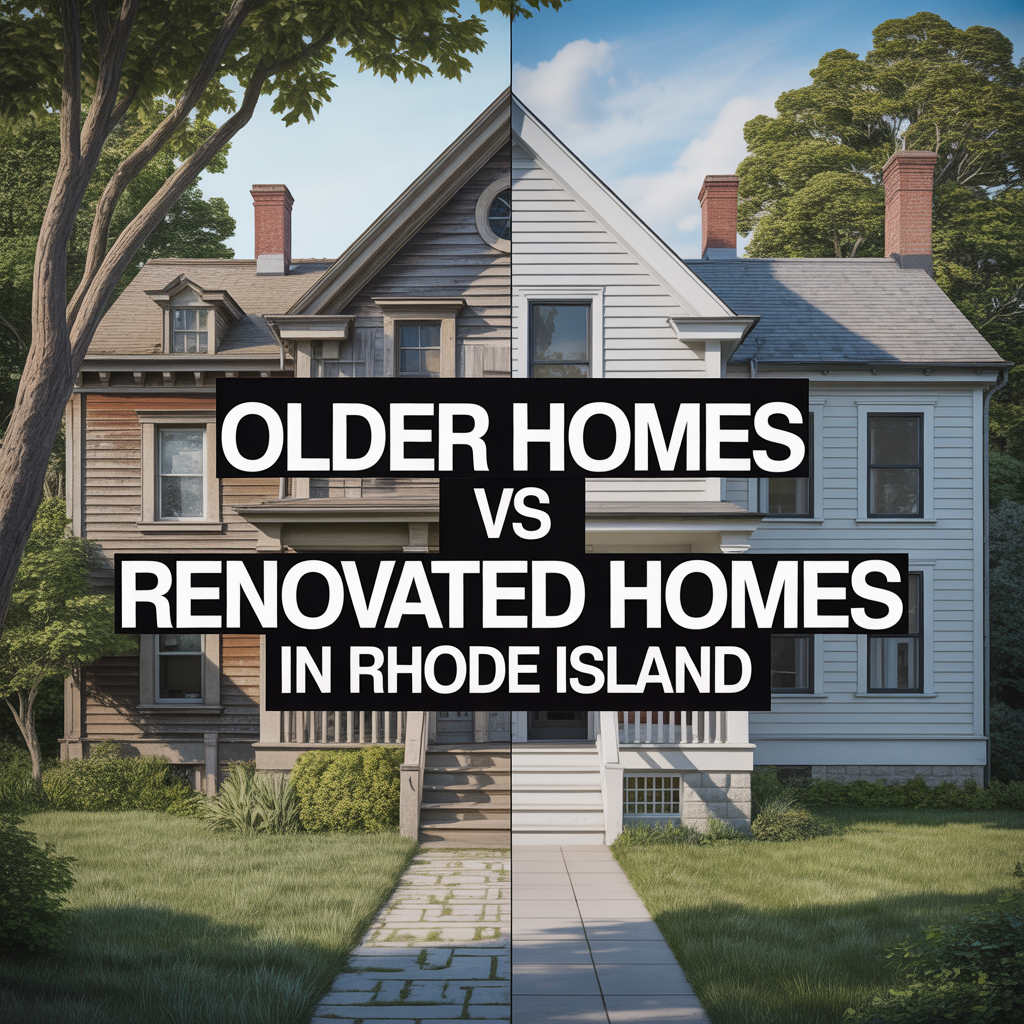
This is part of the RI Home Buying Process→ [RI Home Buying Process] also research the RI Home Selling Process → [RI Home Selling Process]
Written by: Hilary Marshall
Buying a home in Rhode Island often comes down to one defining question: do you want the character and craftsmanship of an older home, or the convenience and efficiency of a renovated one? There’s no blanket answer — but in Rhode Island’s towns from Cranston to Narragansett, the tradeoffs are unusually clear. Most buyers find themselves weighing maintenance, taxes, energy costs, and location more than anything else.
Here’s the reality: Rhode Island’s housing stock skews old. Roughly two‑thirds of homes statewide were built before 1970. That means “older home” doesn’t just mean antique; it might mean a 1930s colonial in East Providence or a postwar cape in Warwick that hasn’t seen updates since the ’90s. Renovated homes, meanwhile, usually reflect investor or homeowner gut work — but not all renovations are equal. Understanding what truly matters in this market can protect you from buying charm that drains your wallet, or shiny finishes that hide deeper issues.
The Real Tradeoffs Between Old and New
In Rhode Island, you’re not just choosing between styles — you’re choosing between eras of building quality, utility systems, and neighborhood dynamics.
Older homes appeal because they offer:
- Solid framing and architectural character, especially in pre‑war colonials, Victorians, and farmhouses.
- Larger lots and mature neighborhoods — think Elmhurst in Providence or Pawtuxet Village in Warwick.
- Tax bases that may be lower than newer coastal builds.
The downsides are predictable but real:
- Aging systems (plumbing, wiring, heating) that need modernization.
- Potential for lead paint, asbestos, or outdated septic systems.
- Higher maintenance and insurance costs, especially in coastal zones prone to moisture.
Renovated homes in Rhode Island, whether flips or owner-upgrades, have their own set of realities:
- Modern mechanicals and insulation that meet current code — a real advantage when heating through long winters.
- Improved resale potential in areas like Cranston or East Greenwich, where move‑in‑ready properties drive competition.
- However, many “renovated” listings in the $500K–$800K range are surface upgrades, not full overhauls. New cabinets and paint might mask original wiring or undersized plumbing.
In practice, buyers often discover that a so‑called “updated” ranch in North Kingstown needs nearly as much long‑term investment as a well‑kept 1950s colonial that hasn’t been fully redone but has good structure.
What Most Buyers (and Sellers) Get Wrong in Rhode Island
The first mistake is assuming older equals cheaper — it often doesn’t. Rhode Island’s historic housing stock includes neighborhoods where restored homes sell at a premium because of architecture and location, especially in Providence’s East Side or Jamestown’s turn‑of‑the‑century streets.
Common misconceptions:
- “Old homes are money pits.” Not all are. A well‑maintained 70‑year‑old home with original hardwood and updated systems can outperform a poorly flipped property with cosmetic changes.
- “Renovated means worry‑free.” Many buyers overpay for flips that cut corners to meet price points. Electrical and insulation shortcuts are common, particularly in investor‑heavy submarkets around Pawtucket and West Warwick.
- “Historic homes can’t be efficient.” With Rhode Island’s state and local efficiency grants, older homes can often be brought up to modern comfort standards with modest investment.
Sellers often err on the opposite side — overpricing renovated homes without understanding that the local appraiser or buyer will still value structure, age, and system condition more than granite countertops.
Cost and Financial Reality in Rhode Island
The financial picture is what truly separates older homes from renovated ones here. Energy, taxes, and updating costs vary dramatically by town.
- Energy and Heating Costs: Rhode Island winters can be expensive for oil‑heated or poorly insulated homes. An older house in Johnston with steam radiators might cost $4,000–$5,000 a year to heat unless converted. A renovated, gas‑converted equivalent could cut that in half.
- Property Taxes: Municipal taxes differ widely. In Providence, a renovated home in the Summit neighborhood could carry the same tax bill as an older Warwick house twice the size. Buyers often misread this tradeoff, especially when calculating monthly affordability.
- Upgrade Costs: Key system updates — roof, boiler, wiring — can add up fast. It’s not unusual to invest $40,000–$60,000 over five years to modernize an older home. But if the price point was $80,000 lower upfront compared to a renovated property, the long-term math may work in your favor.
For investors or move‑up buyers, the critical question isn’t which costs more today — it’s which will hold value and align with your maintenance tolerance.
Risk Factors Unique to Rhode Island Homes
Rhode Island’s geography makes certain risks especially relevant when evaluating home age or condition.
- Coastal Exposure: Salt air accelerates wear on siding, windows, and HVAC systems. An older home in Narragansett that hasn’t had proper exterior updates may need tens of thousands in deferred coastal maintenance. Renovated properties built with composite materials fare better but still require vigilance.
- Stormwater and Flood Zones: Many older homes in Bristol or Barrington sit lower on lots built before modern drainage codes. Renovations may raise systems and grading, but full flood mitigation isn’t always complete.
- Historic District Restrictions: Providence, Bristol, and Wickford have local historic commissions that regulate exterior changes. Renovated homes in these zones must comply with design standards — great for aesthetics, but limiting for owners who want vinyl siding or solar panels.
Buyers should factor these geographic realities more heavily than age alone. An 80-year-old home in an inland neighborhood with zero flood risk can be safer financially than a ten-year-old coastal townhouse with high insurance premiums.
Lifestyle Fit and Practical Living
Beyond financials, the everyday living experience in Rhode Island varies sharply between old and renovated homes.
Why some buyers prefer older homes:
- Larger rooms and taller ceilings found in Providence’s 1920s colonials or Newport’s historic cottages.
- Walkable, established communities where homes sit close to local cafés, schools, and parks.
- Mature trees and traditional architecture that define the Rhode Island aesthetic — not the sterile new‑build look.
Why others lean toward renovated homes:
- Owners with demanding schedules often prefer reduced maintenance.
- Energy efficiency and smart‑home features appeal to younger buyers relocating from Boston tech jobs to places like East Greenwich or Cumberland.
- Families with small children value turnkey safety (no lead paint, modern wiring).
Your personality and lifestyle tolerance shape which fit will feel “right.” An engineer who enjoys home projects may welcome the quirks of a prewar multi‑family in Providence. A busy medical professional in Warwick might want the simplicity of a fully upgraded ranch.
Market Behavior Across Rhode Island
Market data over the past five years show a consistent pattern statewide:
- Older homes dominate inventory. In towns like Warwick, Cranston, and Pawtucket, 70–80% of listings are built before 1975.
- Buyers compete harder for renovated kitchens and modern systems. Appraisal gaps are common when cosmetic updates drive emotional bidding.
- Renovation quality influences days on market. Superficial flips often linger because buyers recognize shortcuts, while structurally sound originals sell faster when priced right.
- Historic and coastal areas appreciate differently. A 1900 Victorian in College Hill may outperform a renovated ranch inland simply due to scarcity and prestige.
Seasoned Rhode Island agents often advise reframing value by lifecycle cost, not list price: compare a 30‑year ownership window, including energy use, maintenance, taxes, and resale potential.
Real-World Example: Two Families, Two Outcomes
Scenario 1: Providence Colonial vs. Renovated Cranston Ranch
A couple buys a 1940s Colonial in Elmhurst for $475K, knowing the boiler is at end‑of‑life but the structure is perfect. Over two years, they spend $20K upgrading systems and insulation. Their effective cost lands around $495K, but the home’s appraised value rises to $520K thanks to location and preservation value. They also accessed a state energy incentive for their conversion to gas heat.
Another couple chooses a “fully renovated” Cranston ranch for $560K. The finishes shine, but six months later they learn the flip didn’t include updated plumbing or attic ventilation. Their first‑year surprise repairs hit $15K, eroding the convenience advantage. Within three years, appreciation evens out between both homes — but the Elmhurst buyers hold a stronger long‑term equity position.
Scenario 2: Coastal Narragansett Cottage vs. Updated Warwick Cape
A retired buyer falls for a weathered 1930s cottage near Point Judith. The charm is real, but frequent salt exposure and an outdated foundation make insurance difficult. Contrast that with a renovated Cape in Warwick Village: fewer ocean views, far fewer maintenance drains, and far more predictable utility costs. Each home fits a lifestyle — coastal nostalgia vs. practical stability — but the long‑term upkeep story diverges significantly.
Intent Capture: Common Buyer Questions Answered
Is buying an older home in Rhode Island a good idea?
Yes — if you value character and are prepared to maintain it. Rhode Island’s older homes were often built with superior craftsmanship and timber. The key is thorough inspection and a realistic budget for upgrades, especially for heating and energy efficiency.
Is it better to buy a renovated home in Rhode Island?
It depends on the quality of the renovation. Some modernized homes (especially owner‑renovated ones) are excellent, but investor flips can hide short‑term fixes. Always confirm permits, insulation levels, and system age — not just visual finishes.
Do Rhode Island towns favor one type over the other?
Yes. Coastal and historic towns like Bristol, Newport, and Wickford lean toward preserved older homes with strict design rules. Suburban markets like Lincoln, Cumberland, and West Warwick see more newly renovated stock from the 1980s‑2000s era. Availability often guides choice more than preference.
Who Each Option Is Right (and Not Right) For
An older home may suit you if:
- You value architectural detail, heavier materials, and long-term neighborhood character.
- You can budget for phased updates instead of full turnkey readiness.
- You want to build equity through sweat equity and thoughtful restoration.
A renovated home may be right if:
- You want predictable operating costs and minimal initial upkeep.
- Your lifestyle doesn’t allow major home projects.
- You’re prioritizing energy efficiency and resale liquidity within 5–10 years.
Neither path is wrong — they reflect different tolerances for complexity and investment. Rhode Island’s mix of prewar and mid‑century housing makes it unusual in that both categories can deliver excellent returns, depending on how you buy.
The Bottom Line: Matching Your Investment to Your Lifestyle
Choosing between an older and a renovated home in Rhode Island isn’t about age — it’s about truth in condition and alignment with how you live. A structurally sound century‑old home can outperform a “modernized” flip if well‑maintained. Likewise, a smartly renovated property with new systems may provide peace of mind that’s hard to price.
The smartest Rhode Island buyers don’t chase trends or curb appeal alone — they weigh building integrity, location stability, and future ownership costs. Whether you’re walking through a Victorian in Bristol or a remodeled ranch in Cranston, the most valuable question remains: Will this home age well with you, not just for you?
Get the full Rhode Island Market Insights → [Market Insights]

Littleton’s Ken Caryl for Lockheed Relocations
This is part of Lockheed Martin Relocation → [Lockheed Martin Relocation Hub] & the larger Denver Relocation Hub → [Denver Relocation Hub] Written by: Chad Cabalka Ken Caryl is one of the best-kept “family first” relocation options for Lockheed Martin employees who want foothills scenery, strong neighborhood appeal, and a real suburban lifestyle that still feels connected…


Centennial & Parker for Lockheed Relocations
This is part of Lockheed Martin Relocation → [Lockheed Martin Relocation Hub] & the larger Denver Relocation Hub → [Denver Relocation Hub] Written by: Chad Cabalka Centennial and Parker are two of the smartest suburban choices for Lockheed Martin employees relocating with families because they give you a strong balance of commute flexibility, good neighborhood variety, and…

Highlands Ranch for Family-Friendly Lockheed Relocations
This is part of Lockheed Martin Relocation → [Lockheed Martin Relocation Hub] & the larger Denver Relocation Hub → [Denver Relocation Hub] Written by: Chad Cabalka Highlands Ranch is one of the strongest choices for Lockheed Martin employees relocating with families because it delivers exactly what most parents want after a big move: stable neighborhoods, strong community…