


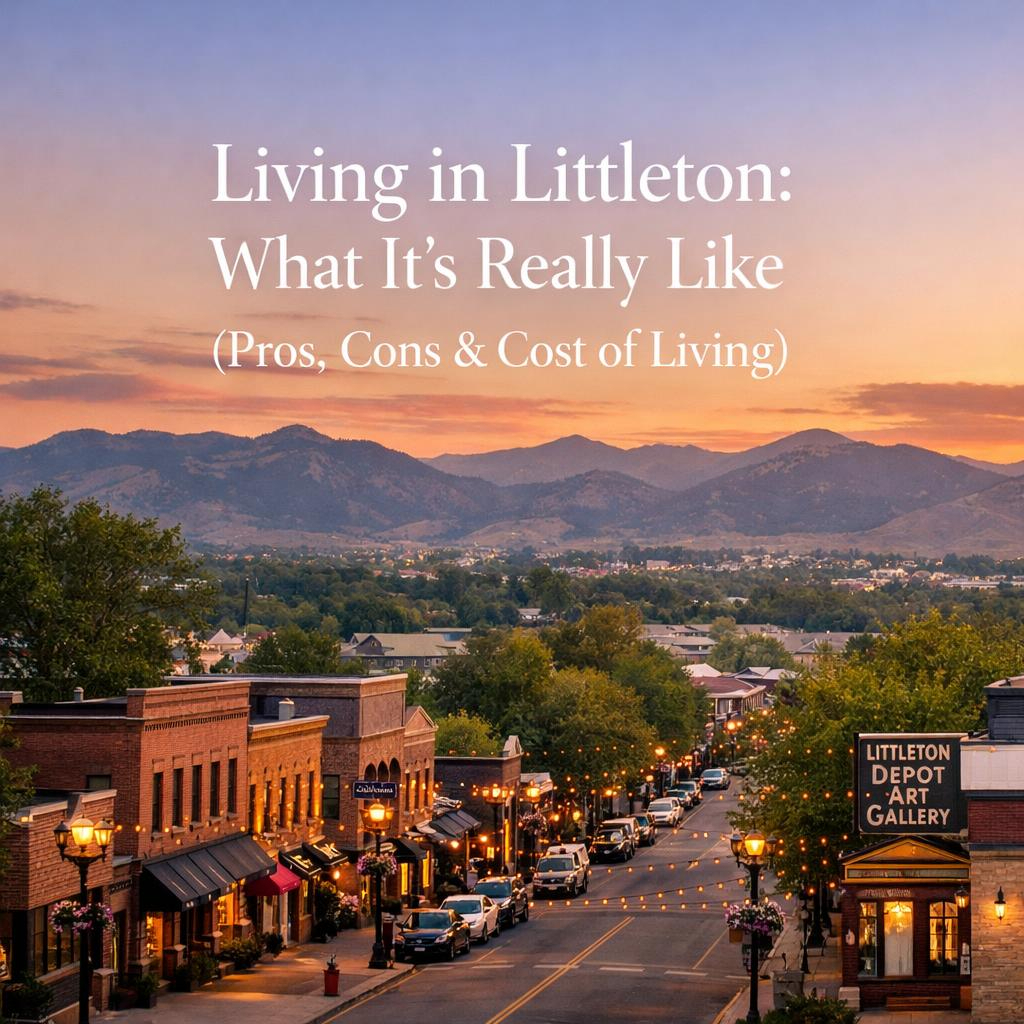
This guide is part of our complete Littleton Estate Guide → [Littleton Real Estate Guide]
Littleton, a southwest Denver metro suburb, draws families and professionals seeking space and stability amid Colorado’s growth pressures. With median home prices around $650,000 and ownership costs reflecting elevation-driven maintenance, it offers a practical alternative to urban density. This analysis details real estate implications for buyers and sellers, weighing commute realities, housing stock resilience, and total expenses against neighborhood benefits.
Littleton’s Housing Market Overview
Stable Inventory and Price Trends
Littleton’s single-family homes dominate sales, with medians holding at $675,000—10% above Denver proper but below Highlands Ranch premiums. Inventory balances at 3-4 months’ supply, allowing negotiation absent in core areas, yet quick sales for updated ranches under $600,000 reward decisive buyers.
This stability matters because Littleton buffers metro corrections; prices dipped only 2% in 2025 versus Denver’s 4%, per local assessor data. Sellers benefit from low turnover, as 75% owner-occupancy fosters equity preservation through hail seasons.
Diverse Stock from Historic to New Builds
Pre-1970 bungalows cluster near downtown Littleton, featuring basements ideal for Colorado’s dry storage needs. Newer subdivisions in Ken Caryl offer 0.25-acre lots with mountain views, suiting remote workers despite C-470 backups.
Housing age influences costs: older brick exteriors withstand freeze-thaw better than 1990s stucco cracking in clay soils common southwest of I-25.
Key Pros of Living in Littleton
Access to Top Schools and Low Crime
Littleton Public Schools rank in Jefferson County’s top tier, with elementary ratings above 8/10 drawing relocators prioritizing education over nightlife. Neighborhoods like Old Littleton report crime rates 40% below Denver averages, enhancing resale appeal as families hold properties 12+ years.
Safety translates to lower insurance—$2,400 annually versus $2,800 metro-wide—since foothills winds spare most homes hail damage.
Commute Advantages and Transit Growth
RTD’s E and F lines reach downtown in 25 minutes, undercutting Littleton-to-DIA drives via Peña at 40 minutes rush hour. Proximity to DTC offices—15 minutes via US-285—suits hybrid tech workers, expanding viable radii post-pandemic.
These patterns matter for equity: transit-adjacent homes appreciate 5% annually, outpacing isolated tracts.
Resilient Ownership Costs
Property taxes average 0.65% of assessed value ($4,400 on $675K homes), below Denver’s 0.85% due to lower mill levies funding suburban services. Utilities run $2,600 yearly, moderated by mature trees shading against 90°F summers.
HOAs in planned areas like Aspen Grove cap at $800, covering snow removal crucial during 60-inch winters.
Notable Cons and Challenges
Traffic Bottlenecks on Major Routes
C-470 and Broadway congestion adds 20 minutes to peak commutes, eroding time value for I-25-dependent sellers. Construction delays from CDOT expansions linger listings in affected pockets like Columbine.
Buyers mitigate by selecting light rail corridors, where values hold firmer amid sprawl.
Elevated Maintenance from Climate Exposure
Southwest exposure amplifies hail risks, with roofs needing replacement every 12-15 years at $15,000. Foothills winds accelerate siding wear on vinyl homes, pushing maintenance to 1.5% of value ($10,000 annually).
Insurance rises 12% yearly here, pressuring fixed-income owners; brick ranches fare better, preserving net equity.
Limited Urban Amenities and Walkability
Outside historic downtown, grocery runs require cars, contrasting walkable cores like Englewood. This car dependency inflates ownership costs via $1,200 annual vehicle wear, overlooked by urban transplants.
| Category | Littleton Avg. | Denver Metro Avg. | Key Factor |
|---|---|---|---|
| Median Home Price | $675K | $599K | School Quality |
| Property Tax (Annual) | $4,400 | $5,100 | Mill Levy |
| Home Insurance | $2,400 | $2,800 | Hail Exposure |
| Utilities (Heating Heavy) | $2,600 | $2,500 | Elevation |
| Total Ownership Cost | $18,500 | $19,500 | Commute Wear |
Cost of Living Breakdown for Homeowners
Housing Dominates at 35-40% of Expenses
For a $675,000 purchase at 6.5% rate, PITI totals $4,200 monthly, consuming 38% of $140,000 household median income. Add 1% reserves for clay soil foundations shifting post-monsoon, vital in this geology.
Relocators from coastal states find relief in no state income tax on Social Security, yet recalibrate for HOA inclusions absent in rentals.
Everyday Expenses Reflect Suburban Scale
Groceries cost 5% above national via King Soopers premiums; gas at $3.50/gallon supports 25-mile commutes. Healthcare via Littleton Adventist runs 10% below Denver hospitals, offsetting premiums.
Childcare averages $1,500 monthly, pressuring dual-income buyers into larger homes for in-home solutions.
Long-Term Ownership Projections
Over 10 years, taxes compound at 3%, hitting $5,500; insurance climbs to $3,200 amid wildfire proximity. Appreciation at 4.5% builds $250,000 equity, netting positive for holders versus renting at $2,800/month escalating 3%.
Sellers time exits post-reassessment to cap hikes, maximizing proceeds.
Neighborhood Variations Within Littleton
Historic Downtown: Walkable Charm with Premiums
Medians at $800,000 offer Victorian updates near brewpubs, with walk scores above 70. Pros include low vacancy for rentals; cons feature parking scarcity during festivals.
Ken Caryl and Foothills: Space at a Commute Cost
$550,000 ranches on 0.5 acres suit horses, but Vail Pass access adds winter travel time. Values rise with open space preservation, buffering development density.
Columbine Knolls: Family Core with School Edge
$700,000 colonials near Heritage High appreciate via low 1% turnover, though Broadway traffic tests patience.
Buyer behavior favors these for basements converting to ADUs, yielding $1,500/month offsets.
Market Trends Shaping Littleton Decisions
Inventory growth grants 10-15% concessions like closing credits, per recent REcolorado reports. Remote work sustains demand, with 20% of sales to out-of-state buyers eyeing affordability over LoDo prestige.
Weather-resilient features—south-facing solar roofs—gain traction, trimming utilities 15% and boosting appraisals.
Conclusion
Littleton balances suburban pros like superior schools and manageable costs against cons of traffic and maintenance, suiting thoughtful buyers prioritizing equity over immediacy. Sellers leverage stability for optimal timing; relocators model total ownership against Denver dynamics. These realities guide sustainable choices in Colorado’s evolving metro.
Ready to evaluate Littleton properties? Contact a local advisor for personalized cost analyses and tours.


Littleton’s Ken Caryl for Lockheed Relocations
This is part of Lockheed Martin Relocation → [Lockheed Martin Relocation Hub] & the larger Denver Relocation Hub → [Denver Relocation Hub] Written by: Chad Cabalka Ken Caryl is one of the best-kept “family first” relocation options for Lockheed Martin employees who want foothills scenery, strong neighborhood appeal, and a real suburban lifestyle that still feels connected…


Centennial & Parker for Lockheed Relocations
This is part of Lockheed Martin Relocation → [Lockheed Martin Relocation Hub] & the larger Denver Relocation Hub → [Denver Relocation Hub] Written by: Chad Cabalka Centennial and Parker are two of the smartest suburban choices for Lockheed Martin employees relocating with families because they give you a strong balance of commute flexibility, good neighborhood variety, and…

Highlands Ranch for Family-Friendly Lockheed Relocations
This is part of Lockheed Martin Relocation → [Lockheed Martin Relocation Hub] & the larger Denver Relocation Hub → [Denver Relocation Hub] Written by: Chad Cabalka Highlands Ranch is one of the strongest choices for Lockheed Martin employees relocating with families because it delivers exactly what most parents want after a big move: stable neighborhoods, strong community…