


This is part of the Denver Metro Relocation Guide → [Relo Guide]
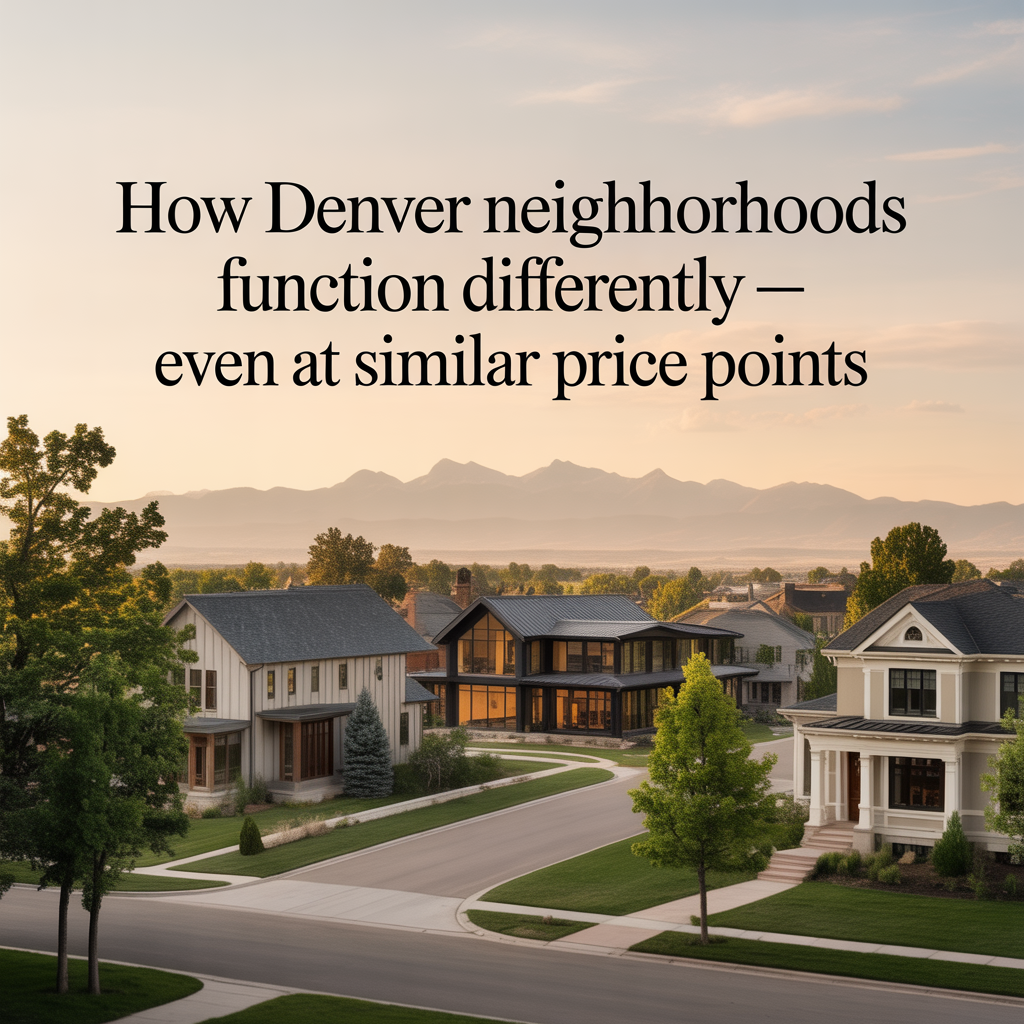
Real estate values only tell part of the story. In Denver, two homes priced around the same level can deliver distinctly different ownership experiences — from commute times and community rhythm to long-term appreciation and maintenance realities. Understanding how and why neighborhoods function differently is critical for buyers, sellers, and relocating homeowners alike.
While price per square foot may suggest parity, the underlying structures of each community — physical, social, and economic — play a major role in shaping how a neighborhood actually performs for its residents over time. The Denver metro area, with its blend of historic grid neighborhoods, master-planned suburbs, and infill redevelopments, provides clear examples of this phenomenon.
The Price Point Illusion
In many parts of Denver, two buyers with the same budget might tour entirely different environments. A $900,000 home in Congress Park might be a century-old bungalow on a narrow lot, while the same figure in Highlands Ranch could buy a newer two-story with modern systems, open floorplans, and direct access to community trails.
On paper, both may seem equivalent — same general value, differing only in aesthetic or location. In practice, they reflect two distinct housing ecosystems.
Older urban neighborhoods often carry higher fixed ownership costs — taxes, insurance, and capital improvements — because properties are individually maintained and infrastructural systems are aging. Suburban homes in managed communities may trade that autonomy for HOA fees, but owners benefit from predictable maintenance standards and uniform building ages.
These trade-offs directly affect how buyers experience their investment. A Denver buyer choosing between established neighborhoods like Platt Park and newer areas near Castle Pines may weigh freedom versus predictability more heavily than price alone.
Local Character and Market Psychology
Each Denver neighborhood carries its own “market psychology” — the interplay of perception, convenience, and community identity that drives both pricing and buyer confidence.
Urban cores such as LoHi, Washington Park, or West Highland tend to attract buyers prioritizing proximity over space. They pay a premium per square foot because neighborhood texture, street life, and access to downtown weigh more heavily than yard size or parking.
In contrast, buyers drawn to suburban areas — Centennial, Erie, or Highlands Ranch — often react more to lifestyle logistics than emotional tone. Commute reliability, school district performance, and functional layouts exert greater sway. Over time, these psychological differences influence which neighborhoods remain in high demand during market slowdowns and which correct more steeply when affordability pressures rise.
An experienced buyer learns to recognize when pricing reflects sentiment more than structure. That distinction is often clearest at mid- to upper-tier price points, where emotional preference outweighs necessity.
Inventory Profiles and Built Environment
Denver’s housing stock is highly segmented by era. This history explains many of the functional differences that appear between neighborhoods with similar prices.
- Pre-war districts such as Congress Park, Park Hill, and West Highland feature compact lots, mature trees, alleys, and walkable main streets. Homes were built for smaller households and pre-car lifestyles, which affects parking, storage, and floorplan flow today.
- Post-war suburban areas like Littleton or Arvada include mixed construction vintages and tend to balance larger lots with proximity to transit corridors. Here, buyers find a middle ground between charm and space — often at prices comparable to smaller city homes.
- 21st-century master-planned communities such as Stapleton (Central Park), Greenfield, or The Meadows in Castle Rock emphasize energy efficiency, HOA-maintained amenities, and predictable architecture. These features appeal to buyers seeking newer infrastructure, even if lot sizes are smaller.
Two homes priced at $800,000 across these patterns may perform differently in daily comfort, maintenance budgeting, and resale resilience, largely because of how the underlying built environment dictates real living experience.
Commute, Accessibility, and Time Value
With Denver’s expanding population and a constrained arterial street network, commute time increasingly dictates neighborhood function.
Neighborhoods along major commuter routes — Parker Road, I‑25, U.S. 36 — tend to price efficiency into their value. A home costing $850,000 in Englewood may command a similar price to one in Erie, but the time cost for downtown professionals differs dramatically. Over a decade, those extra 30 minutes each way equate to hundreds of hours — a lifestyle currency that factors into resale psychology.
Moreover, RTD light rail access (such as from Lakewood or Lone Tree) introduces another layer of differentiation. When gas prices fluctuate or freeway congestion worsens, transit-dependent areas can retain strong buyer interest even if overall demand cools.
Understanding how “time proximity” interacts with price is vital for buyers relocating from other states. Denver’s topography and dispersed job centers make distance alone an unreliable metric; it’s perceived accessibility that drives value persistence.
Microclimates and Ownership Realities
Colorado’s elevation range across the metro area is subtler but still impactful. Low-lying neighborhoods along the South Platte — such as Harvey Park or parts of Commerce City — may warm earlier in spring, while foothill-adjacent communities like Morrison or Evergreen experience longer winters and steeper maintenance demands on vehicles and infrastructure.
These microclimates shift not just daily comfort but long-term durability and upkeep costs. Retaining walls, snow loads, and grading affect roofs, driveways, and landscaping budgets — costs rarely reflected in listing prices but critical to ownership satisfaction.
In Centennial or Highlands Ranch, nearly uniform developments allow predictable upkeep budgeting. In Wash Park or Hilltop, each property requires individualized attention, from water drainage patterns to tree maintenance — expenses that accumulate over time and influence seller motivation later.
School District and Governance Impacts
School districts influence neighborhood value in Colorado differently than in some states because of open enrollment policies. However, practical realities still matter: transportation boundaries, community identity, and social cohesion often follow district lines.
Jefferson County, Denver Public Schools, Littleton, and Douglas County each have distinct governance and resource models, which affect everything from mill levies to local infrastructure improvements. Homeowners in one district may face markedly different long-term tax trajectories than a comparable property across the county line.
These fiscal structures ultimately shape resale appeal. Even among buyers without school-age children, stable districts signal community continuity — a trait closely tied to neighborhood performance during slowdowns.
The Social Operating System
Every neighborhood, at a functional level, operates as its own “social system.” The extent of neighbor involvement, local governance engagement, and shared maintenance expectations determine how smoothly daily life runs.
- In historic districts, residents often self-manage maintenance awareness, with active neighborhood associations rather than formal HOAs. This fosters individuality but can lead to uneven property conditions.
- In planned suburban communities, HOA oversight enhances uniformity and exterior standards but introduces restrictions and dues that directly influence affordability.
- In transitioning urban nodes — parts of Sunnyside, Baker, or South Broadway — evolving demographics can drive rapid appreciation or temporary volatility depending on the pace of redevelopment.
These underlying systems matter for buyers determining how much control, predictability, or community engagement they want tied to their property value. Successful ownership happens when those expectations align with neighborhood norms.
Long-Term Value Behavior
Over time, Denver neighborhoods with limited supply and enduring character — places where redevelopment is constrained but desirability remains high — demonstrate remarkable value stability. Washington Park, Platte Park, and Park Hill illustrate this dynamic. Though prices fluctuate with larger economic cycles, their relative ranking within the metro area remains consistent.
Conversely, newer suburban markets often show more elasticity. In upswings, they appreciate quickly as families seek predictable amenities. In downturns, their values may soften more because supply expands and land remains available.
This volatility is not inherently negative; it simply reflects different trajectories of value creation. For some owners, a newer home purchased during stable conditions may offer better functional value than a smaller older home whose price premium relies on location nostalgia.
Understanding these cycles helps buyers and sellers act objectively rather than reactively. Neighborhood “performance” is multi-dimensional — not just appreciation rate, but depth of demand, ownership satisfaction, and resale resilience.
What This Means for Buyers and Sellers
For buyers, the takeaway is clear: focus less on short-term comparisons and more on structural differences. Ask, “What kind of neighborhood system am I buying into?” rather than “How much house am I getting for the money?”
For sellers, awareness of your neighborhood’s functional identity — not just its average price — allows you to highlight value drivers that resonate with likely buyers. Positioning your home correctly within its neighborhood context often matters more than chasing broader market trends.
For relocating homeowners, pair financial analysis with lifestyle logistics. Commute patterns, community governance, and ongoing maintenance realities will all affect long-term satisfaction and equity growth in ways that price per square foot cannot capture.
Final Perspective
Denver’s real estate market is not monolithic. Even within similar price brackets, neighborhoods function differently because they were built under different assumptions — about transportation, land use, and social structure. Those assumptions still shape ownership today.
Recognizing these differences allows for smarter, calmer decisions — choices grounded in function rather than perception. In an environment where every market cycle resets expectations, understanding how neighborhoods operate is the key to protecting long-term value and personal satisfaction.
If you’re weighing options across the Denver metro area or trying to interpret the deeper patterns behind local pricing, reach out to me directly for detailed neighborhood insights, data-backed comparisons, and practical guidance tailored to your situation.
Get the full Denver Market Insights → [Market Insights]



Littleton’s Ken Caryl for Lockheed Relocations
This is part of Lockheed Martin Relocation → [Lockheed Martin Relocation Hub] & the larger Denver Relocation Hub → [Denver Relocation Hub] Written by: Chad Cabalka Ken Caryl is one of the best-kept “family first” relocation options for Lockheed Martin employees who want foothills scenery, strong neighborhood appeal, and a real suburban lifestyle that still feels connected…


Centennial & Parker for Lockheed Relocations
This is part of Lockheed Martin Relocation → [Lockheed Martin Relocation Hub] & the larger Denver Relocation Hub → [Denver Relocation Hub] Written by: Chad Cabalka Centennial and Parker are two of the smartest suburban choices for Lockheed Martin employees relocating with families because they give you a strong balance of commute flexibility, good neighborhood variety, and…

Highlands Ranch for Family-Friendly Lockheed Relocations
This is part of Lockheed Martin Relocation → [Lockheed Martin Relocation Hub] & the larger Denver Relocation Hub → [Denver Relocation Hub] Written by: Chad Cabalka Highlands Ranch is one of the strongest choices for Lockheed Martin employees relocating with families because it delivers exactly what most parents want after a big move: stable neighborhoods, strong community…