


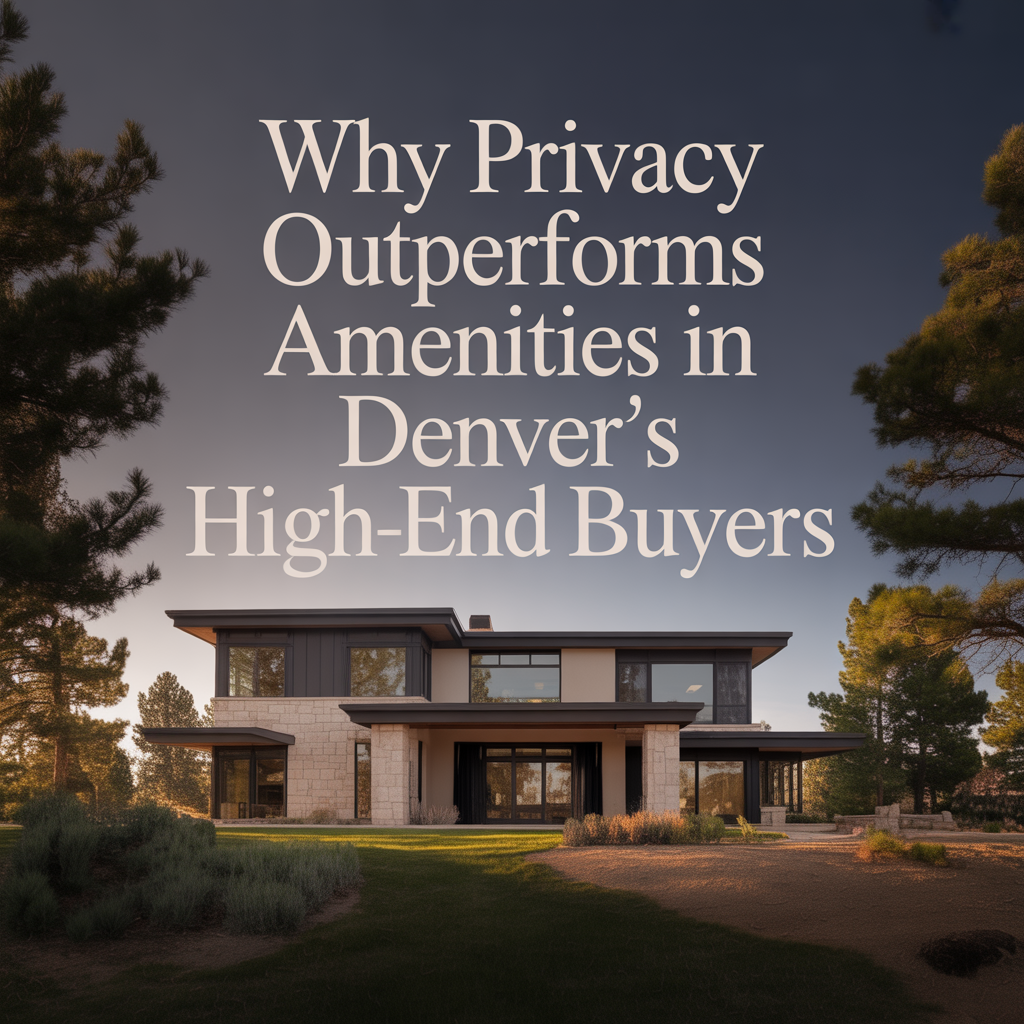
This is part of the Denver Metro Luxury Market Guide → [Luxury Guide]
In Denver’s upper-tier housing market, buyer preferences have evolved in ways that reflect deeper values than square footage or design trends. Features once considered essential—grand entertaining spaces, wine cellars, or resort-style pools—are increasingly secondary to a more fundamental priority: privacy.
For affluent buyers in the Denver metro area, particularly those purchasing in neighborhoods like Cherry Hills Village, Greenwood Village, Boulder, and Castle Pines, privacy now shapes both what defines a luxury home and what drives long-term value. Understanding this shift reveals why homes that offer discretion, quiet, and distance from density consistently outperform even the most amenity-rich listings.
The Recalibration of Luxury in Denver’s Market
Denver’s luxury market has matured dramatically over the last decade. As the metro area attracted national wealth from finance, technology, and professional relocation, demand expanded beyond the traditional enclaves near downtown. Areas once seen as suburban or secondary—like Parker, Lone Tree, and Arvada—now register strong high-end activity.
However, this growth has changed the psychology of Denver’s affluent buyers. Many of today’s luxury purchasers are not first-time high-end homeowners. They have owned or currently own in other markets—San Francisco, Seattle, Dallas, or Boston—and bring learned expectations about noise, congestion, and proximity. For them, privacy is not an indulgence but a precondition for quality of life.
This shift has affected how high-end homes are evaluated. Buyers who once valued proximity to restaurants or cultural amenities increasingly prioritize seclusion, acreage, and sightline protection. The defining question is less “What can I enjoy here?” and more “What can I avoid?”.
Why Privacy Has Become the Defining Currency
Privacy carries both emotional and economic weight in Colorado real estate. On a fundamental level, it signals control, safety, and personal space—three qualities often missing in dense urban environments. But on a financial level, privacy protects value more reliably than visible amenity investments.
1. Scarcity drives resilience
Denver’s population growth has made large, well-sited parcels extremely scarce within commuting range of employment hubs. Land in established areas—especially with mature landscaping and setbacks—cannot be recreated. A buyer seeking true separation in or near the metro area faces finite options.
Because supply is fixed, private properties continue to appreciate even during broader market slowdowns. Data from REcolorado and the Denver MLS consistently show that estate properties with lot sizes over one acre and strategic orientation—shielded from street view or neighboring homes—hold their price per square foot better than high-specification builds on smaller lots.
Privacy, in effect, is a form of built-in inflation protection.
2. Amenities depreciate; privacy endures
High-end amenities age on short cycles. Pools, theater systems, elaborate lighting controls, and designer surfaces all lose relevance as technology and tastes evolve. Replacing or maintaining these features requires capital without guaranteeing a stronger resale.
By contrast, natural privacy—topography, mature trees, thoughtful site planning—does not date. A home positioned to minimize visibility or noise is just as desirable in ten years as it is today. Buyers intuitively grasp this. A property that “feels private” photographs better, shows better, and negotiates from a position of strength.
3. Lifestyle alignment
Colorado attracts residents who value outdoorspace, nature access, and balance. Even affluent professionals relocating from larger coastal cities often move here because they want less friction in their daily lives. Privacy complements this ethos: morning coffee on a quiet patio with foothill views matters more than a media room with surround sound.
For executives, entrepreneurs, and remote professionals, personal space doubles as mental bandwidth. Buyers pay for the ability to disconnect—not just from neighbors, but from constant visibility.
How Denver’s Geography Shapes Privacy Demand
Unlike many Western metros, Denver presents a topographically diverse landscape for luxury housing. Privacy is shaped not just by lot size but by grading, vegetation, and street layout.
Foothill properties
Neighborhoods in Golden, Evergreen, and parts of Boulder use natural elevation and wooded terrain to achieve privacy without complete isolation. Buyers here tend to accept longer commutes for a true sense of retreat.
Inner-metro enclaves
In Cherry Hills Village or Greenwood Village, privacy often depends on strategic architectural design—angled drives, landscaping buffers, and gated perimeters—because parcels remain within close reach of urban amenities.
Acreage on the plains
Douglas County and parts of Parker, Elizabeth, and Sedalia appeal to those seeking open space without losing access to major corridors. These buyers often favor newer builds tailored for security and minimal exposure.
Understanding how each geography defines “privacy” helps sellers identify what makes their property inherently valuable. A Greenwood lot with mature cottonwoods and deep setbacks may offer comparable seclusion to a five-acre ranchette, yet remain minutes from the Denver Tech Center.
The Economics Behind Privacy Premiums
The premium attached to privacy is measurable, though nuanced. In high-end Colorado transactions—typically above $1.5 million—price per square foot fluctuates most dramatically between properties with comparable finishes but differing privacy profiles.
Based on recent MLS data through late 2025, comparable luxury homes in Denver’s southern suburbs demonstrate the following pattern:
- Homes with visible neighboring lot lines or shared driveways sell 3–7% below local averages.
- Properties with mature landscape screening and protected sightlines often exceed average price per square foot by 10–15%.
- Estate lots within twenty minutes of major employment centers draw the strongest resilience through market corrections.
Even during slower quarters, well-screened or secluded homes attract genuine, patient buyers. These buyers are less influenced by short-term mortgage rate movements and more focused on securing long-term satisfaction. In practice, this stabilizes upper-end values even when middle-tier segments show price volatility.
Privacy as an Architectural Principle
Denver architects and builders have increasingly integrated privacy-conscious design into new construction and remodels. The modern luxury buyer wants openness inside but discretion outside. Common architectural strategies include:
- Courtyard orientation: Positioning central living areas around internal courtyards or screened patios.
- Layered facades: Using angled wings or offset volumes to limit direct sightlines from the street.
- Landscaping as architecture: Employing evergreens, sculpted berms, or fencing integrated into the landscape rather than applied atop it.
- Selective transparency: Large windows directed toward view corridors, not neighboring elevations.
These features provide visual privacy without isolation, aligning with Denver’s emphasis on natural light and outdoor connection. Builders who understand this balance achieve broader appeal among high-end buyers seeking subtlety rather than grandeur.
The Buyer’s Perspective: Privacy as Investment Logic
High-net-worth buyers often approach purchases through the lens of opportunity cost. A property that feels exposed—despite luxury amenities—creates future resale risk and reduced enjoyment. Conversely, a private property offers functional and psychological returns.
From an investment standpoint, privacy aligns with liquidity. In a crowded field of comparable listings, quiet and seclusion differentiate. Buyers rarely compromise on these traits once they have experienced them. That persistence of demand reinforces value over decades, not just individual market cycles.
What Sellers Should Understand
For sellers of high-end Denver homes, recognizing privacy’s role in buyer psychology is essential to effective positioning. It influences everything from pricing strategy to marketing language and showing preparation.
A few practical implications:
- Highlight privacy cues early in marketing materials. Instead of emphasizing general terms like “quiet” or “exclusive,” describe tangible attributes—orientation, setbacks, treed perimeters, or limited through-traffic.
- Invest in screening and entry design. Even slight adjustments—extended fencing, controlled gate approach, or strategic plantings—can elevate perception before a buyer reaches the doorstep.
- Document buffer protections. If adjacent land is zoned for open space or low-density residential use, present this up front. Buyers attach concrete value to permanence.
- Stage for discretion, not spectacle. Remove evidence of foot traffic, simplify lines of sight, and consider neutral window treatments to convey calm containment rather than opacity.
The underlying principle is clarity: buyers wish to know what level of separation they’re purchasing. Transparency about this reinforces credibility and accelerates strong offers.
The Long-Term Outlook: Why Privacy Retains Its Edge
Denver continues to expand along both the northern and southern corridors, increasing density in areas once considered suburban. As this intensification progresses, true privacy becomes a rarer and more valuable asset.
Climate considerations—temperature swings, snow management, and vegetation health—affect maintenance, but they don’t diminish the desirability of well-sited private lots. Moreover, hybrid work trends have turned homes into permanent headquarters. Daily exposure to surroundings amplifies the emotional return on peace and separation.
Even as buyer demographics diversify, the preference remains stable. Younger affluent buyers, particularly those moving from coastal metros, rank privacy above extravagance. They prefer thoughtful design, natural buffers, and usable outdoor environments to conspicuous opulence.
As density grows, the distinction between amenity-rich and experience-rich housing will further widen—and privacy squarely defines the latter.
Understanding True Value in Denver’s Evolving Market
In a market as dynamic as Colorado’s, real estate decisions hinge on fundamentals that endure beyond style. Privacy—measured through seclusion, control, and protected space—represents one of those fundamentals. Amenities appeal to the moment; privacy transcends it.
For both buyers and sellers, recognizing this principle clarifies how to allocate capital and where to compromise. Square footage, technology, and materials can be replicated. Authentic privacy cannot. That is why, in Denver’s high-end segment, privacy consistently outperforms every feature that can be marketed, installed, or staged.
For tailored insight into how privacy impacts property value in your specific area—or guidance on identifying opportunities in Denver’s premium neighborhoods—reach out to me directly. I specialize in helping clients interpret the subtleties that drive long-term value in Colorado’s most competitive markets.
Get the full Denver Market Insights → [Market Insights]


Littleton’s Ken Caryl for Lockheed Relocations
This is part of Lockheed Martin Relocation → [Lockheed Martin Relocation Hub] & the larger Denver Relocation Hub → [Denver Relocation Hub] Written by: Chad Cabalka Ken Caryl is one of the best-kept “family first” relocation options for Lockheed Martin employees who want foothills scenery, strong neighborhood appeal, and a real suburban lifestyle that still feels connected…

Centennial & Parker for Lockheed Relocations
This is part of Lockheed Martin Relocation → [Lockheed Martin Relocation Hub] & the larger Denver Relocation Hub → [Denver Relocation Hub] Written by: Chad Cabalka Centennial and Parker are two of the smartest suburban choices for Lockheed Martin employees relocating with families because they give you a strong balance of commute flexibility, good neighborhood variety, and…

Highlands Ranch for Family-Friendly Lockheed Relocations
This is part of Lockheed Martin Relocation → [Lockheed Martin Relocation Hub] & the larger Denver Relocation Hub → [Denver Relocation Hub] Written by: Chad Cabalka Highlands Ranch is one of the strongest choices for Lockheed Martin employees relocating with families because it delivers exactly what most parents want after a big move: stable neighborhoods, strong community…