


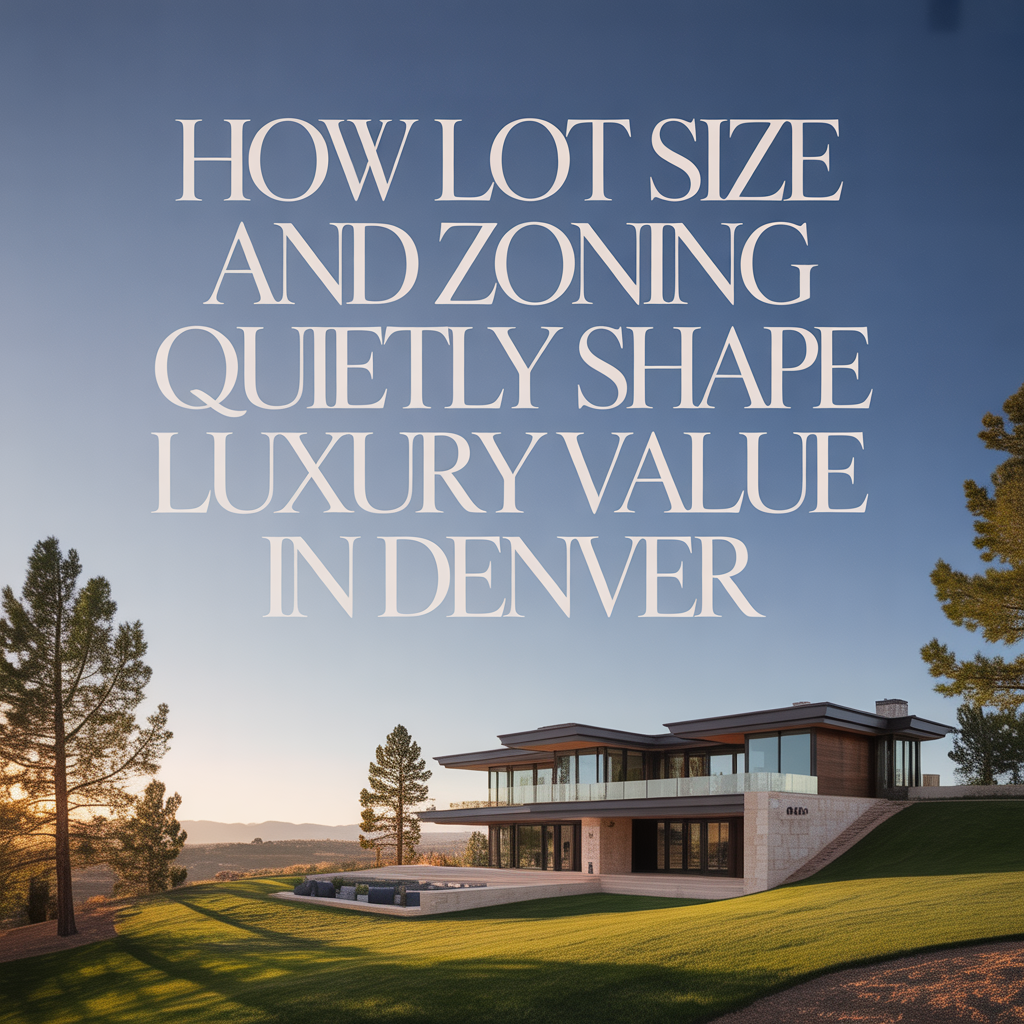
This is part of the Denver Metro Luxury Market Guide → [Luxury Guide]
In Denver’s luxury real estate market, lot size and zoning stand out as overlooked drivers of long-term value. These elements determine not just the physical boundaries of a property but its potential for privacy, expansion, and appreciation amid Colorado’s constrained housing stock. Buyers and sellers who grasp their implications make sharper decisions in a market where subtle factors often separate stable investments from fleeting gains.
Why Lot Size Matters More Than Square Footage
Lot size influences luxury value by controlling usable outdoor space, a premium in Denver’s front range suburbs where yards double as private retreats. Larger lots—typically over half an acre in areas like Cherry Hills Village or Greenwood Village—offer room for custom landscaping, pools, or home offices that enhance daily living and resale appeal. Smaller urban lots near downtown, under a quarter acre, limit these options, often capping value growth as buyers prioritize space amid rising ownership costs like water restrictions tied to Colorado’s semiarid climate.
This distinction matters because Denver metro’s housing stock skews toward mid-sized lots from post-war development, leaving true luxury seekers competing for rare larger parcels. Sellers with oversized lots command premiums, as buyers factor in the scarcity: once subdivided or built out, such opportunities vanish. In practical terms, a half-acre lot can support additions that boost square footage by 20-30% without rezoning hassles, preserving value through flexibility.
Zoning’s Role in Protecting Neighborhood Character
Zoning regulations in Denver quietly enforce exclusivity by dictating density and development rights. Residential zones like R-1 (single-family low density) preserve luxury enclaves such as Broadmoor or The Pinery, where minimum lot sizes prevent infill crowding. This stability reassures buyers that nearby teardowns won’t sprout multifamily units, maintaining views of the Front Range and low traffic volumes critical for family-oriented luxury.
Contrast this with mixed-use zones near LoDo or Aurora, where rezoning allows townhomes or ADUs, eroding privacy and pushing values toward middle-market stability rather than luxury ascent. Zoning matters because it locks in long-term predictability—buyers avoid properties in flux zones prone to upzoning pressures from Denver’s growth management plans. For sellers, zoned protections signal to appraisers and insurers lower risk, supporting higher valuations even in softening markets.
Navigating Denver’s Zoning Districts
Denver divides its 78 neighborhoods into zones from estate (E-SR) to urban infill, each shaping luxury potential differently. Estate zones mandate one-acre minimums, ideal for custom estates in Evergreen or Genesee, where buyers value separation from I-70 commute corridors. Infill zones like those in Washington Park allow smaller lots but permit expansions, appealing to renovators willing to navigate permitting.
Understanding these layers prevents overpaying: a “luxury” home on a zone-limited lot may underperform compared to a modest house on expansive, flexible zoning. Local buyers, familiar with CDOT’s commute data showing 45-minute treks from suburbs to DTC, prioritize zones enabling home-based workspaces over density-driven convenience.
Interplay Between Lot Size and Zoning in Luxury Suburbs
Luxury value amplifies when large lots align with restrictive zoning, creating self-reinforcing scarcity. In Highlands Ranch, where planned developments cluster half-acre lots under PUD zoning, properties hold value through enforced setbacks and height limits that block neighbor encroachments. This setup appeals to executives commuting to Centennial or Parker, as it balances proximity to C-470 with estate-like seclusion.
Suburban examples highlight the dynamic: Cherry Creek North’s R-1 zones pair quarter-acre lots with no-side-neighbor rules, sustaining million-dollar-plus medians. Meanwhile, edge-city zones in Littleton allow lot splits, diluting value unless owners hold firm. Buyers should map this via Denver’s ZMAP tool, revealing how a 0.7-acre lot in an estate zone could appreciate 15-20% more over a decade than an equivalent in flexible zoning, factoring weather-driven maintenance like snow load considerations for roofs.
Case Studies from Denver Metro
Consider a Cherry Hills estate on 1.2 acres zoned estate residential: its value stems from untouchable green space amid urban sprawl, drawing relocators from California seeking Colorado’s lower property taxes relative to size. In contrast, a Washington Park Tudor on 0.2 acres, though charming, faces ADU creep under recent overlays, capping upside as younger buyers densify.
These patterns persist because Denver’s voter-approved initiatives prioritize single-family preservation in 60% of residential land, shielding luxury pockets from multifamily influx. Sellers leveraging this—staging lots to showcase zoning-enabled potential—close faster, as thoughtful buyers weigh total ownership costs including HOA fees common in zoned communities.
Ownership Costs Tied to Lot and Zoning Choices
Larger lots elevate costs through higher property taxes and utilities, but zoning mitigates risks that erode net value. In Jefferson County suburbs, expansive lots incur 1-2% annual taxes on assessed value, yet estate zoning qualifies for ag exemptions on portions, offsetting bills for horse properties. Urban small-lot owners face steeper per-square-foot maintenance, amplified by Colorado’s freeze-thaw cycles demanding robust foundations.
Zoning influences insurance too: low-density districts reduce wildfire adjacency risks in foothill areas like Ken Caryl, lowering premiums 10-20% versus denser zones. Buyers calculating TCO (total cost of ownership) find large-lot, zoned properties yield better ROI, as resale absorbs premiums from buyers valuing low-turnover stability. This edge grows in balanced markets, where precision pricing reflects these fundamentals over comps alone.
Market Psychology and Buyer Behavior in Denver Luxury
Buyers in Denver’s upper bracket—often tech transplants or empty-nesters—gravitate to properties signaling enduring value through lot and zoning. Psychology plays in: a spacious lot evokes control in a state where water rights and growth caps constrain supply, fostering emotional buy-in. Sellers ignoring this list at market rates, watching days-on-market stretch as discerning purchasers filter for future-proof features.
Relocators from coastal markets undervalue this locally, chasing finishes over foundations, only to regret as commute patterns shift with remote work. Savvy agents counsel touring lot edges at dusk to gauge neighbor impacts, underscoring how zoning enforces the quiet luxury buyers crave.
Trends Shaping Future Luxury Value
Denver metro’s inventory, skewed 70% under half-acre, amplifies demand for zoned large-lot outliers as population hits 3 million. Initiatives like Blueprint Denver push infill, pressuring small-lot values while insulating suburbs. Climate realities—drought-driven xeriscaping mandates—favor larger lots with irrigation buffers, positioning them for appreciation as ownership costs stabilize.
Forward-thinking sellers disclose zoning docs early, appealing to investors eyeing appreciation from scarcity. Buyers negotiating concessions tie them to lot surveys, ensuring value aligns with Denver’s evolution from boom to balanced growth.
Conclusion
Lot size and zoning form the bedrock of luxury value in Denver, dictating privacy, flexibility, and resilience against market shifts. Serious buyers and sellers assess them first, as they underpin decisions amid Colorado’s unique constraints on land and lifestyle. Mastering these elements positions properties for sustained appreciation in a thoughtful market.
Reach out to me today for a personalized analysis of how lot size and zoning impact your Denver-area transaction—let’s discuss your specific needs.
Get the full Denver Market Insights → [Market Insights]


Littleton’s Ken Caryl for Lockheed Relocations
This is part of Lockheed Martin Relocation → [Lockheed Martin Relocation Hub] & the larger Denver Relocation Hub → [Denver Relocation Hub] Written by: Chad Cabalka Ken Caryl is one of the best-kept “family first” relocation options for Lockheed Martin employees who want foothills scenery, strong neighborhood appeal, and a real suburban lifestyle that still feels connected…

Centennial & Parker for Lockheed Relocations
This is part of Lockheed Martin Relocation → [Lockheed Martin Relocation Hub] & the larger Denver Relocation Hub → [Denver Relocation Hub] Written by: Chad Cabalka Centennial and Parker are two of the smartest suburban choices for Lockheed Martin employees relocating with families because they give you a strong balance of commute flexibility, good neighborhood variety, and…

Highlands Ranch for Family-Friendly Lockheed Relocations
This is part of Lockheed Martin Relocation → [Lockheed Martin Relocation Hub] & the larger Denver Relocation Hub → [Denver Relocation Hub] Written by: Chad Cabalka Highlands Ranch is one of the strongest choices for Lockheed Martin employees relocating with families because it delivers exactly what most parents want after a big move: stable neighborhoods, strong community…