


This is part of the Denver Metro Luxury Market Guide → [Luxury Guide]
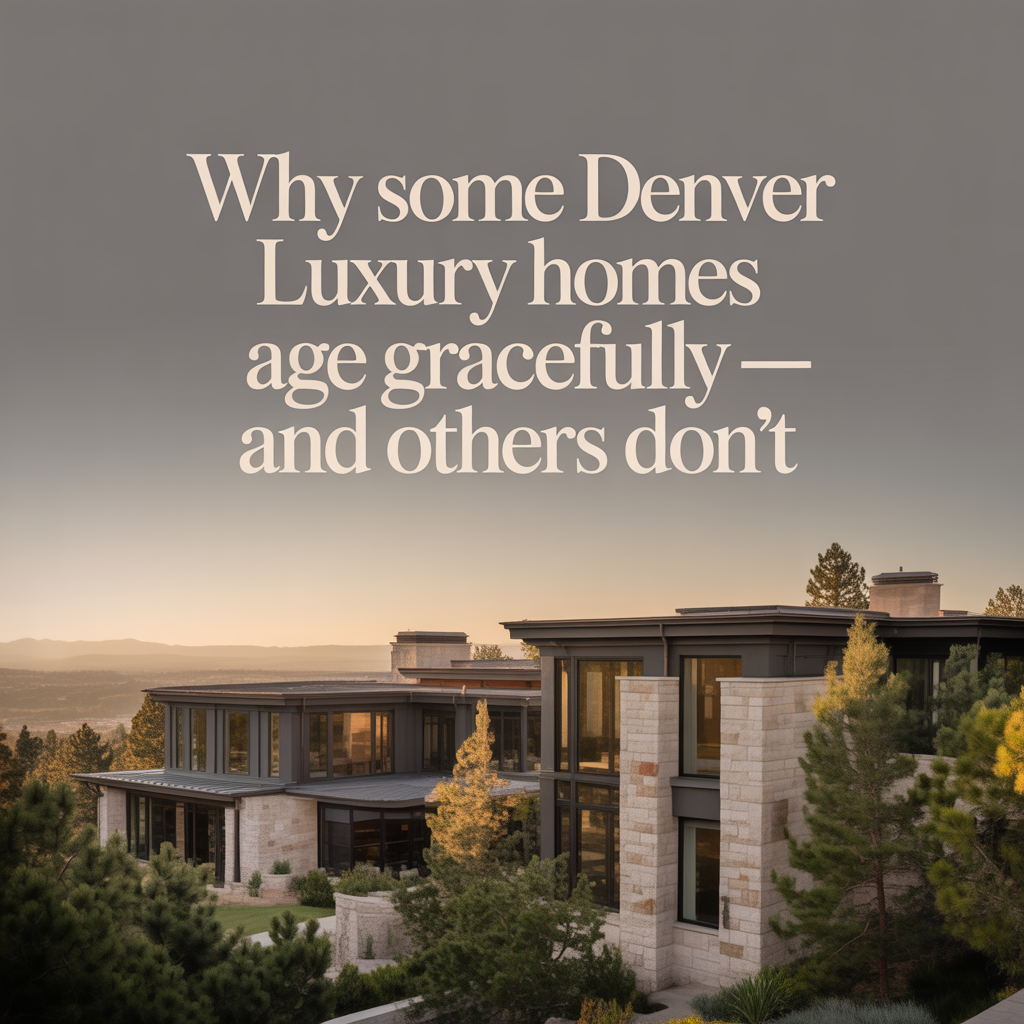
Luxury real estate in the Denver metro area has always reflected more than square footage or finishes. It mirrors how homeowners, architects, and builders interpret longevity — both financial and aesthetic. As Denver’s market matures, a pattern has become clear: some high-end homes retain their value and relevance for decades, while others lose appeal within just a few years. Understanding why certain properties age gracefully provides valuable insight for anyone buying, selling, or building in Colorado’s upper-tier market.
The Meaning of “Aging Gracefully” in Real Estate
A home ages gracefully when its appeal remains stable, even as design trends, buyer preferences, and market conditions shift around it. It resists becoming dated or “tired” and continues to attract interest from discerning buyers. That doesn’t happen by accident.
In a dynamic environment like Denver — where evolving buyer demographics and environmental realities shape housing demand — lasting value stems from three intertwined factors:
- Architectural integrity and proportional design.
- Functional adaptability to modern living.
- Maintenance and material performance suited to Colorado’s environment.
Each determines how a home is perceived ten or twenty years after construction, not just how it photographs when new.
Architectural Integrity: Timeless Design Over Trend
Why Architectural Consistency Matters
Certain design eras age better because they reflect restraint and authenticity. Luxury homes built around clear, regionally appropriate architecture – whether modern farmhouse, mountain contemporary, or classic Tudor – establish their identity with coherence. By contrast, homes that chase hybrid trends or rely heavily on fashionable elements often appear discordant once styles shift.
In the mid-2010s, for example, Denver experienced a surge of what some described as “Franken-style” luxury builds — expansive homes combining rustic stone façades, stucco, metal panels, and a mix of rooflines. These properties looked striking in listing photos, but many now require major exterior rework to remain competitive. By contrast, homes built with disciplined design language — such as clean-lined contemporary architecture in Cherry Hills Village or classic brick colonials in Hilltop — remain visually relevant.
Why It Matters for Value
Buyers in Denver’s luxury segment are highly sensitive to “datedness.” Even small hints of design inconsistency can reduce emotional appeal and negotiation power. A timeless structure gives owners flexibility: it can be lightly renovated rather than completely reimagined. That difference can mean preserving hundreds of thousands of dollars in resale positioning.
Function Over Fashion: How Layouts Endure Market Cycles
The Impact of Everyday Practicality
Luxury homes that age well are not only beautiful — they function intuitively. In markets like Denver, where professionals balance urban access with space and privacy, functional flow greatly influences value over time.
Consider kitchen layouts: open-concept great rooms with walk-in pantries and secondary prep spaces remain enduringly desirable. Conversely, compartmentalized layouts or oversized foyers can feel impractical as lifestyles evolve toward efficiency. The pandemic underscored this point; buyers suddenly prioritized home offices, fitness spaces, and private outdoor areas. Homes with flexible, multi-use floor plans adapted easily. Those designed around one rigid purpose struggled.
Long-Term Adaptability
An adaptable floor plan isn’t a trend — it’s a hedge against obsolescence. Properties in Centennial or Greenwood Village that incorporated multigenerational suites or convertible basements have seen sustained demand as demographics shifted. In contrast, ultra-custom floor plans that reflected a single owner’s personal habits often limit future marketability.
Designing or remodeling for graceful aging means including spaces that can change purpose with minimal structural alteration: a guest suite that can become a home office, a loft that converts to a gym, or a daylight basement easily reconfigured for remote work.
Material Choices That Withstand Colorado’s Climate
Building for Performance, Not Just Appearance
Materials determine not only maintenance costs but also visual longevity. Colorado’s combination of high-altitude sunlight, freeze–thaw cycles, and low humidity means surfaces wear differently than in coastal climates. Stucco, for instance, may perform well when detailed correctly but weathers poorly under improper installation. Natural stone and high-quality fiber cement, while initially more expensive, typically yield a more consistent long-term appearance.
Homes in areas like Castle Pines and Highlands Ranch that used durable exterior materials have generally required fewer aesthetic updates over 15–20 years. Roof materials, window selections, and deck systems also influence perceived quality over time. A home’s first impression often hinges on these exterior surfaces, especially as surrounding neighborhoods mature.
The Role of Maintenance Culture
Even the best materials fail without disciplined upkeep. Luxury buyers in the Denver region expect visible quality, yet they can often spot deferred maintenance from the curb. Regular attention to HVAC systems, exterior paint, landscaping, and driveway surfaces directly supports value retention. A gracefully aging home reflects both its construction quality and the stewardship of its owners.
Location Context: Commuting, Schools, and Lifestyle Durability
Neighborhoods That Hold Their Own
Location remains the foundational factor in how luxury homes endure — but not all locations age equally. In metro Denver, enduring desirability often aligns with three stability markers:
- Proximity to long-term employment centers or major commuter routes.
- Access to high-performing schools.
- Protected neighborhood aesthetics or consistent zoning.
Communities like Cherry Creek, Cory-Merrill, and The Preserve in Greenwood Village maintain attraction because their location advantages persist irrespective of design trends. In contrast, isolated custom enclaves or newer subdivisions farther from established amenities may face longer absorption times once novelty fades.
Why It Matters Now
As hybrid work reshapes commute preferences, some Denver buyers have relaxed their distance-from-downtown expectations but not their desire for cohesive neighborhoods. This subtle shift is influencing which luxury homes sustain demand: those that combine scenic settings with practical access to services and schools tend to hold their advantage best.
The Emotional Component: Market Psychology and Perception
The Buyer’s First Impression
Luxury buyers make deeply emotional decisions, even when they approach the process logically. A home that “feels right” tends to sell faster, commanding stronger offers. Properties that age gracefully evoke confidence — they signal quality without having to prove it.
Buyers entering an established community like Washington Park or Observatory Park often judge homes as much by composure as by cost. Obvious trend-chasing décor or ostentatious remodels can introduce hesitation, while understated design gives reassurance. Subtle cues like neutral millwork, balanced ceiling heights, and harmonious window proportions register subconsciously but powerfully.
Appraisal Meets Emotion
A professional appraisal may capture tangible attributes such as square footage or upgrades, but buyer psychology drives offers beyond that number. A home that feels composed — one that reflects disciplined architecture, precise upkeep, and adaptable function — earns confidence. That confidence translates directly to pricing power during negotiations.
Renovation Strategy: Refresh Without Rewriting
Knowing When to Update
Not every dated feature demands replacement. The goal for aging gracefully is often refinement, not reinvention. Repainting dark interior tones, updating lighting, or simplifying landscaping can rejuvenate visual appeal without erasing original character. In Denver’s mature neighborhoods, buyers often prefer subtle modernization that preserves architectural coherence.
Avoiding Over-Renovation
One of the most common missteps in Denver’s luxury market is over-improvement. Over-customizing kitchens, installing extreme high-tech systems, or incorporating ultra-trendy finishes can narrow future audience appeal. In neighborhoods where resale values naturally plateau, overcapitalization can make it difficult to recover investment. A strategic renovation plan should be guided by surrounding property values, comparable design quality, and the likely resident profile five to ten years into the future.
The Market’s Long View: What Retains Value Over Decades
Stability in Changing Conditions
While real estate cycles ebb and flow, the underlying reasons some homes hold value remain remarkably consistent. Across economic phases, buyers prioritize design integrity, practicality, and authenticity. Denver’s evolving demographics — from relocating professionals to long-time homeowners downsizing into smaller luxury formats — continue to reward those timeless attributes.
The Sustainability Factor
Sustainability has shifted from niche preference to mainstream expectation. Homes built with energy efficiency and durable materials increasingly dominate long-term performance metrics. Properties with modest solar integration, efficient HVAC, and superior insulation often report lower ownership costs, reinforcing their appeal during resale conversations. Given Colorado’s emphasis on sustainability standards and energy-conscious building codes, these attributes now serve as both environmental and financial assets.
A Graceful Legacy: What It Means for Buyers and Sellers
For buyers, recognizing which luxury homes can stand the test of time is key to safeguarding investment and lifestyle balance. Look beyond the finishes on listing photos; instead, evaluate structure, floor plan adaptability, material integrity, and neighborhood trajectory.
For sellers, understanding how to position a home’s enduring strengths can significantly strengthen its market stance. Emphasizing the aspects that communicate permanence — solid architecture, quality upkeep, and coherent upgrades — helps potential buyers visualize security and longevity.
Ultimately, a Denver luxury home that ages gracefully embodies more than high-end appeal. It reflects stewardship — by its designer, builder, and successive owners — and rewards that continuity through stable desirability and value retention.
Get the full Denver Market Insights → [Market Insights]



Littleton’s Ken Caryl for Lockheed Relocations
This is part of Lockheed Martin Relocation → [Lockheed Martin Relocation Hub] & the larger Denver Relocation Hub → [Denver Relocation Hub] Written by: Chad Cabalka Ken Caryl is one of the best-kept “family first” relocation options for Lockheed Martin employees who want foothills scenery, strong neighborhood appeal, and a real suburban lifestyle that still feels connected…


Centennial & Parker for Lockheed Relocations
This is part of Lockheed Martin Relocation → [Lockheed Martin Relocation Hub] & the larger Denver Relocation Hub → [Denver Relocation Hub] Written by: Chad Cabalka Centennial and Parker are two of the smartest suburban choices for Lockheed Martin employees relocating with families because they give you a strong balance of commute flexibility, good neighborhood variety, and…

Highlands Ranch for Family-Friendly Lockheed Relocations
This is part of Lockheed Martin Relocation → [Lockheed Martin Relocation Hub] & the larger Denver Relocation Hub → [Denver Relocation Hub] Written by: Chad Cabalka Highlands Ranch is one of the strongest choices for Lockheed Martin employees relocating with families because it delivers exactly what most parents want after a big move: stable neighborhoods, strong community…