


This is part of the Denver Metro Relocation Guide → [Relo Guide]
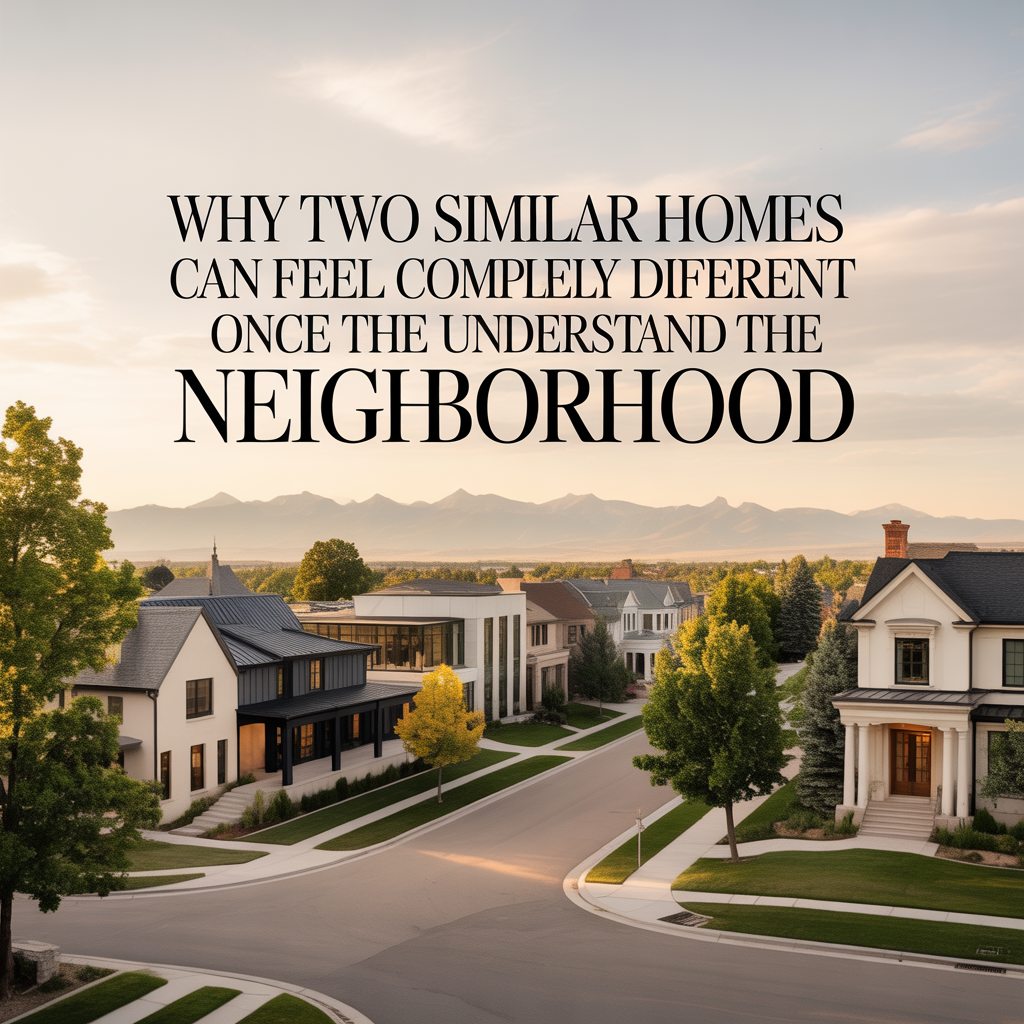
Homebuyers often begin their search by comparing floor plans, square footage, or finishes. Yet even when two houses appear nearly identical on paper, they can feel strikingly different once you step inside — and that difference rarely comes from the house itself. In Colorado, where geography, community character, and daily rhythms vary dramatically from one subdivision to the next, the surrounding neighborhood often determines how a home truly lives day to day.
Understanding this relationship between property and place is one of the most important — and underestimated — parts of making a sound real estate decision.
The Context Behind “Comparable” Homes in Colorado
The concept of “comparable sales” underpins how homes are priced and appraised. In theory, two similar houses with the same square footage and features in nearby areas should command similar values. However, anyone who’s toured across Denver, Littleton, or Castle Rock knows that even within a few miles, identical homes can experience different demand, appreciation rates, and owner satisfaction.
These differences stem from more than just location. They reflect subtle but powerful distinctions in neighborhood design, infrastructure, community culture, and future development potential — all of which influence how a home functions and feels. Buyers who recognize these patterns early tend to make more confident decisions and hold their properties longer.
The Power of Micro-Location
Real estate professionals often speak about location as if it’s a single factor, but in Colorado, it operates on multiple levels.
- Macro-location refers to the city or metro area — such as Denver versus Colorado Springs.
- Meso-location narrows to a specific suburb or corridor, like the south Denver tech belt near Lone Tree or the foothills west of Golden.
- Micro-location drills even further down: the street orientation, lot placement, school catchment zone, or even the commuting route.
In practice, micro-location frequently holds the most sway over day-to-day livability and resale stability. Two homes in Highlands Ranch may share a builder and floor plan, but one tucked beside a greenbelt with mature trees and light traffic may command a 5–10% premium over another backing to a collector road.
These price gaps accumulate over time, often widening faster than the broader market because buyers assign lasting value to comfort and convenience. Understanding where those micro-level advantages exist is essential to making long-term, value-based choices.
Street Design, Sun Exposure, and Everyday Comfort
Many Colorado buyers overlook how physical layout affects perception. In neighborhoods built during rapid growth periods — particularly 1990s and early-2000s suburbs in Parker, Aurora, and Commerce City — the orientation of streets relative to mountain views, sunsets, and afternoon traffic can significantly shape quality of life.
For example:
- South-facing homes in the Denver metro enjoy faster snowmelt and more winter sunlight, which can reduce maintenance in colder months.
- Cul-de-sac or loop streets often create quieter environments with slower traffic and stronger community cohesion.
- Lot elevation can determine whether you see open space or another roofline, influencing both emotion and resale appeal.
These small design factors rarely appear in online listings, yet they are exactly what seasoned local agents assess first when evaluating true market positioning.
Community Planning and the Psychology of Belonging
A house offers structure; a neighborhood offers identity. Sharply contrasting experiences exist within similar price points across the Denver area because of how communities were planned and matured.
Older established neighborhoods like Wash Park or Platt Park in Denver have mature trees, walkable access to amenities, and an ingrained sense of community that newer subdivisions cannot replicate quickly. Conversely, master-planned communities such as Sterling Ranch or The Meadows provide modern layouts, recreational amenities, and consistent architectural design that appeal to long-term stability seekers.
The psychology is straightforward: people gravitate to places that reflect their personal rhythms. Some prefer the quiet predictability of suburban cul-de-sacs; others value the vibrancy and imperfection of historic districts. Neither is inherently “better,” but the mismatch between lifestyle and neighborhood character is one of the most common reasons buyers later feel unsatisfied.
Understanding a neighborhood’s cadence — morning noise levels, evening activity, and community traditions — is just as important as noting lot size or countertop material.
Commute, Connectivity, and the Real Cost of Convenience
In the Denver metro area, drive times remain a defining element of neighborhood desirability. What feels like a short commute on a map can translate into 45 minutes of stop-and-go travel depending on traffic corridors. Buyers relocating from out of state often underestimate how geography interacts with transit infrastructure.
- Along C-470, communities like Highlands Ranch and Littleton offer efficient west-east access and proximity to major employers near the Denver Tech Center.
- Northern suburbs such as Thornton and Broomfield benefit from growing employment centers but occasionally face bottlenecks along I-25.
- Even within the same ZIP code, being on the “right” side of a highway or rail crossing can save fifteen minutes each way.
Why it matters: convenience translates directly into daily satisfaction and time value. Homes that minimize friction in daily routines are less likely to be resold prematurely, and they often retain buyer interest even in slower markets.
Schools, Services, and the Subtle Influence of Public Structure
Quality schools are often cited as a major driver of home value, but their impact extends beyond test scores. In many Colorado suburbs, strong district zoning supports neighborhood identity and parent engagement, which fosters stability and pride that benefit all homeowners — not just those with children.
Similarly, access to reliable municipal services, local recreation centers, and responsive city governance shapes community desirability over time. Buyers who research how local policies influence property taxes, road maintenance, and neighborhood upkeep often make more resilient decisions.
For example, newer developments in Douglas County may offer competitive mill levies for early buyers but adjust rates as infrastructure matures. Understanding these local government trends provides more insight than simply comparing HOA fees.
Construction Materials and Maintenance Culture
Even when homes are built within the same decade and subdivision, their long-term performance can diverge because of neighborhood culture and maintenance norms. Minnesota pine siding or stucco may hold up differently depending on microclimate, elevation, and owner upkeep.
In areas with fluctuating soil conditions — notably throughout Douglas, Jefferson, and Arapahoe Counties — slight variations in ground composition can influence foundation movement and landscaping behavior. Experienced buyers and inspectors know that consistent maintenance culture within a neighborhood often signals collective care — an intangible but powerful indicator of stable property values.
A well-kept street rarely happens by accident; it reflects shared expectations, pride, and established demographics that favor long-term residency. That sense of stewardship contributes directly to how a home “feels,” even when the architecture is common.
Future Development and the Tempo of Change
Colorado’s front range continues to evolve quickly, and future infrastructure or zoning decisions can redefine a neighborhood almost overnight. When two homes feel different to a buyer, that instinct may reflect subconscious awareness of surrounding development patterns.
Infill projects in older Denver areas may elevate property values by introducing mixed-use convenience but also increase density and traffic. Conversely, outer suburbs such as Elizabeth or Erie attract buyers seeking space and affordability but may experience construction noise or temporary visual disruptions as new phases expand.
Seasoned buyers evaluate not just what a neighborhood is today, but what its five- and ten-year trajectory looks like. Municipal master plans, transportation initiatives, and school expansion maps all reveal valuable context for predicting neighborhood stability and long-term return.
Emotional Fit and Long-Term Satisfaction
Real estate decisions often blend logic and emotion. A home that “feels right” usually aligns both comfort and confidence — intuitive signals that the setting matches personal priorities. That’s why two nearly identical homes can register completely differently in a buyer’s mind.
The key is to unpack that emotion: what cues prompted it? Was it natural light, street quietness, or sense of community? Experienced buyers learn to articulate these details and weigh them alongside financial considerations. Doing so avoids regret while clarifying which trade-offs genuinely matter over years of ownership.
In Colorado’s diverse markets, where weather, commuting, and outdoor lifestyle all intersect, emotional alignment with neighborhood culture often predicts lasting satisfaction better than any appraisal spreadsheet.
Balancing Market Strategy with Human Insight
For sellers, understanding these distinctions helps frame more strategic listings. Emphasizing what truly sets a property apart — its micro-location advantages, neighborhood amenities, or consistent upkeep culture — reaches serious buyers more effectively than generic staging alone.
For buyers, the best approach is to evaluate each property through the lens of daily life rather than architectural sameness. Questions worth considering include:
- How does the neighborhood look and sound in the early morning or after dusk?
- Are nearby properties maintained to similar standards?
- How easily can you reach essential destinations during rush hour or snow days?
- What appears likely to change in the next few years?
Answering these questions brings clarity to “value” as more than a price point — it becomes a reflection of enduring livability and confidence in one’s surroundings.
Conclusion: Why Neighborhood Understanding Defines Real Value
In Colorado’s dynamic real estate landscape, the neighborhood is not simply the backdrop to a home; it is the operating system that defines how that home performs and appreciates. Two properties can share the same specifications, yet deliver vastly different experiences — one that quietly endures, another that quickly frustrates.
Buyers who slow down to understand these nuances consistently make stronger long-term investments. Sellers who recognize and communicate their neighborhood’s distinct strengths attract more qualified, confident offers.
The lesson is simple: real estate value is inseparable from context. A home’s comfort, utility, and financial resilience all emerge from the streets, schools, infrastructure, and people that surround it.
If you’re considering buying or selling in the Denver metro or surrounding areas and want a clearer understanding of how neighborhood dynamics affect value, reach out to me directly. I can help you evaluate specific communities, compare micro-locations, and plan for long-term ownership decisions rooted in experience and evidence — not guesswork.
Get the full Denver Market Insights → [Market Insights]



Littleton’s Ken Caryl for Lockheed Relocations
This is part of Lockheed Martin Relocation → [Lockheed Martin Relocation Hub] & the larger Denver Relocation Hub → [Denver Relocation Hub] Written by: Chad Cabalka Ken Caryl is one of the best-kept “family first” relocation options for Lockheed Martin employees who want foothills scenery, strong neighborhood appeal, and a real suburban lifestyle that still feels connected…


Centennial & Parker for Lockheed Relocations
This is part of Lockheed Martin Relocation → [Lockheed Martin Relocation Hub] & the larger Denver Relocation Hub → [Denver Relocation Hub] Written by: Chad Cabalka Centennial and Parker are two of the smartest suburban choices for Lockheed Martin employees relocating with families because they give you a strong balance of commute flexibility, good neighborhood variety, and…

Highlands Ranch for Family-Friendly Lockheed Relocations
This is part of Lockheed Martin Relocation → [Lockheed Martin Relocation Hub] & the larger Denver Relocation Hub → [Denver Relocation Hub] Written by: Chad Cabalka Highlands Ranch is one of the strongest choices for Lockheed Martin employees relocating with families because it delivers exactly what most parents want after a big move: stable neighborhoods, strong community…