


This is part of the Denver Metro Investor Guide → [Investor Guide]
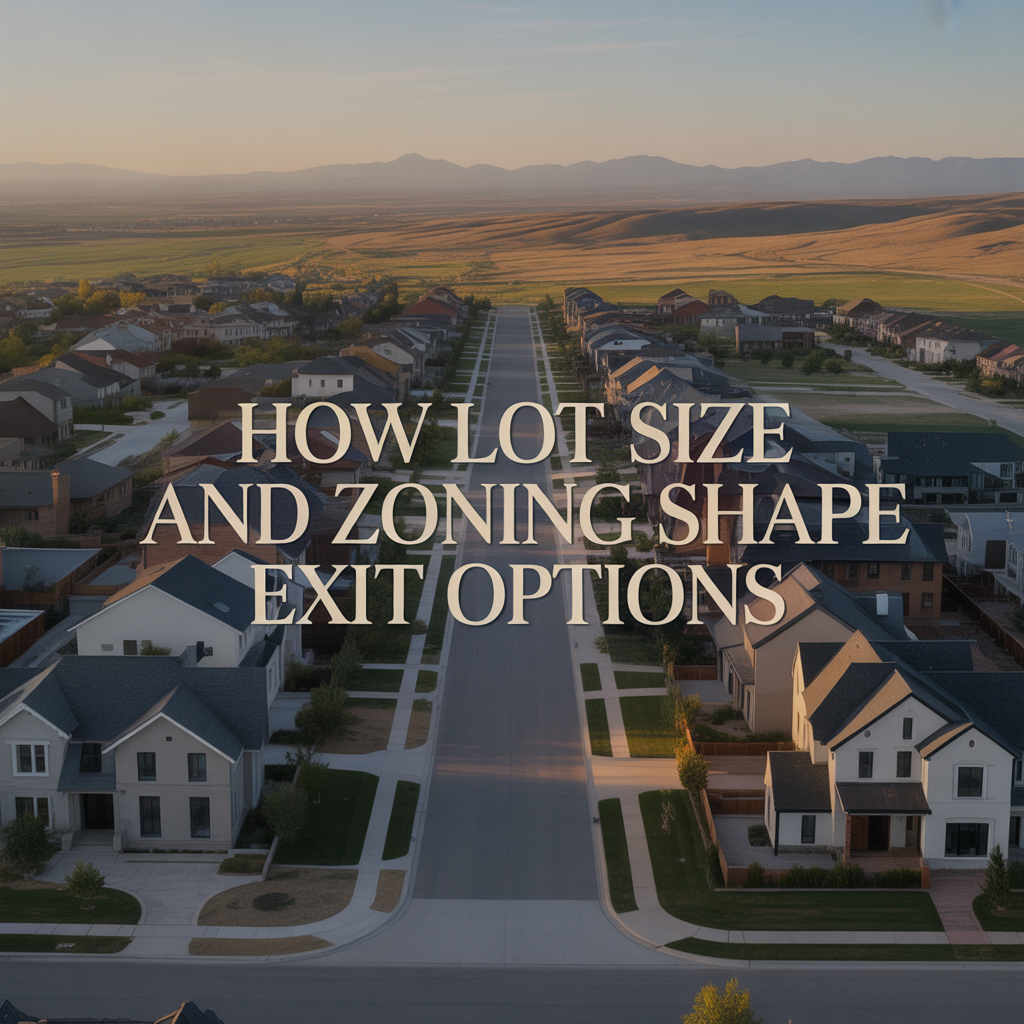
In Colorado’s dynamic real estate market, most investors fixate on price trends, neighborhood demand, or rental yields. Yet one factor consistently drives long-term flexibility and return on investment: how the property’s lot size and zoning designation align with future exit strategies.
Whether your objective is to hold, redevelop, or eventually sell at a premium, understanding these two fundamentals reveals the difference between a property that simply appreciates over time and one that can evolve to meet market shifts.
This isn’t about speculation—it’s about structural potential. Land and entitlement conditions determine what can be built, expanded, split, or converted. In the Denver metro area, these characteristics directly affect your buyer pool, your financing options, and ultimately, your downside protection.
Why Lot Size and Zoning Matter More Than Most Investors Realize
Colorado’s housing market is defined by limited land availability, strict municipal frameworks, and continued population growth across the Front Range. These conditions force investors to think beyond current use.
Zoning dictates permissible land uses—residential density, height limits, setbacks, and other controls—while lot size determines what those entitlements actually allow in practice. A generous lot with restrictive zoning can be less flexible than a modest parcel under an adaptable designation.
When evaluating long-term investment performance, these two factors influence:
- Redevelopment pathways: The ability to add units, expand square footage, or reconfigure use if demand changes.
- Liquidity at resale: Properties allowing multiple pathways to reposition attract a broader class of buyers—builders, owner-occupants, and investors alike.
- Financing leverage: Lenders assign different risk profiles based on zoning and improvement potential, influencing terms and appraised value.
- Resilience to shifts: A property with future-use flexibility tends to better absorb fluctuations in zoning policy, interest rates, or population demand.
In short, the relationship between lot size and zoning defines exit optionality. And in constrained markets like Denver, that optionality often becomes the hidden source of return.
Zoning Realities in the Denver Metro Area
Zoning in the Denver metropolitan region varies dramatically between municipalities, but the broad trends share a clear pattern.
Denver and Inner-Core Neighborhoods
Within Denver city limits, the 2010 zoning code reclassification established form-based zoning, where the character of the structure matters as much as the use. This shift prioritized neighborhood compatibility but often restricted expansion unless the property sits on a larger-than-average lot.
For investors evaluating duplex lots, accessory dwelling unit (ADU) opportunities, or multi-unit infill, Denver’s zoning designations—such as U-SU (urban single-unit) or U-TU (urban two-unit)—set hard boundaries on unit count. Importantly, smaller lots under 6,000 square feet can limit what’s permissible even within the same zoning label. The presence of an “ADU-eligible” suffix, for example, can make hundreds of thousands of dollars in future potential difference.
Suburban Municipalities
Cities like Lakewood, Arvada, and Centennial tend to maintain more conventional zoning systems but have become increasingly deliberate about density. Many older suburban parcels—particularly those developed in the 1960s to 1980s—sit on generous lots but remain locked in single-family-only zones.
Investors viewing these parcels through a 10- or 20-year lens should pay attention to emerging conversations about middle housing, where gentle density options—like duplexes or courtyard clusters—are gradually gaining political backing. Municipal willingness to accommodate such changes often begins with neighborhoods featuring larger existing lots.
Unincorporated and Mountain-Adjoining Areas
Properties in unincorporated Jefferson, Douglas, or El Paso counties operate under different frameworks. Zoning flexibility often increases, but so does infrastructure responsibility. Septic capacity, well permits, and road easements can offset the benefit of looser zoning if redevelopment costs escalate.
In these areas, usable acreage matters as much as raw parcel size. A five-acre property with severe slopes or drainage limitations may not provide the expansion potential its square footage suggests.
How Lot Size Influences Investment Potential
Lot size affects an investment’s functional capacity, not just its visual space. It determines how efficiently improvements can evolve over time, how easily structures can be reconfigured, and what buyers perceive as possible.
Expansion and Building Envelope
The building envelope—the area in which new structures can be placed—depends on required setbacks and coverage ratios. In Denver, for many single-family zones, no more than 37.5% of the lot can be covered by structures. As a result, the same 2,000-square-foot home on an 8,000-square-foot lot carries more latent potential for expansion than one on a 5,000-square-foot lot.
For investors, this built-in margin becomes critical when repositioning properties. Adding a legal apartment, detached garage with living space, or modern addition becomes far more viable when the lot supports it under existing code.
Subdivision and Redevelopment Opportunities
Larger parcels occasionally qualify for lot splits or small subdivision under current zoning, though requirements vary by jurisdiction. With continued regional in-migration and local opposition to new development density, these opportunities are increasingly valuable.
Even when subdivision isn’t immediately possible, assemblage potential—owning a parcel that could combine with a neighbor’s—adds a layer of appreciation distinct from typical market cycles. Local builders and small developers actively seek such parcels when supply tightens.
The Role of Zoning in Determining Exit Options
When analyzing exit options, zoning directly determines who your next buyer can be and what they may envision doing with the property.
1. The Owner-Occupant Exit
For properties that appeal to move-up buyers or downsizers, zoning shapes sense of permanence. A single-family home in a stable low-density zone may command premium resale value because of neighborhood continuity.
However, if an adjacent area begins re-zoning for higher density or mixed-use, long-term resale psychology shifts. Even without changing property use, market perception can adjust in anticipation of redevelopment pressure, affecting who competes to buy your property later.
2. The Builder or Developer Exit
Developers and small builders pay close attention to zoning boundaries, minimum lot sizes, and adjacency. Parcels in transitional zoning corridors—such as Denver’s East Colfax, Federal Boulevard, or South Broadway—carry asymmetric upside if entitlement pathways expand.
For investors holding these properties, maintaining zoning compliance and monitoring proposed code amendments can directly affect future exit timing. Sometimes, the highest-value decision is to sell entitlement-ready land rather than completing redevelopment yourself.
3. The Institutional or Portfolio Exit
For small multifamily or mixed-use holdings, zoning determines expansion rights and adaptive reuse potential. Properties classified under mixed-use districts—MU, C-MX, or Transit-Oriented Development (TOD) overlays—gain strategic value as transit corridors mature.
Institutional buyers increasingly seek this optionality: the ability to intensify use if market fundamentals justify it. Even if your initial investment focus is income stability, aligning with zoning that permits moderate density ensures a wider competitive field at future sale.
Common Oversights Investors Make
Even experienced buyers occasionally underestimate zoning and parcel dynamics. The most frequent missteps include:
- Assuming all large lots allow redevelopment. Setback ratios, easements, and building codes often constrain actual usability.
- Ignoring overlay districts. Denver and nearby cities employ overlay zones for design, environmental, or historic preservation that override general rules.
- Relying on county data alone. Parcel records sometimes reflect legacy zoning. Always verify through current municipal GIS portals or planning staff.
- Focusing solely on improvements. Over-improvement—building far beyond neighborhood norms—can cap exit valuations in zones where density or market demographics lag behind construction cost recovery.
- Buying based on conjectured zoning reform. While trends toward added density are real, local politics determine timing. The state’s 2024 housing reform bill, for instance, advanced debate but left final zoning control to municipalities.
How to Analyze Lot and Zoning Potential Effectively
A structured due diligence approach helps investors integrate zoning and lot analysis without guesswork:
- Confirm the official zoning classification. Use the relevant city or county online map.
- Identify overlays or design districts. These can alter setbacks, roof pitches, parking ratios, or permissible uses.
- Evaluate minimum lot size and width requirements. They determine subdivision potential and future building scale.
- Map setback boundaries. Know your effective buildable footprint before assuming expansion capacity.
- Research comprehensive plans. Long-range planning documents often preview future zoning intent, highlighting corridors likely to evolve.
- Consult building or planning staff early. Preliminary feedback on potential lot splits or accessory units can prevent costly surprises.
These steps transform a property search from reactive to strategic, aligning acquisitions with clear optionality rather than speculative hope.
Long-Term Perspective: Land Behavior in Colorado’s Growth Corridors
Along the Front Range—from Fort Collins through Colorado Springs—land has consistently outperformed improvements over multiple decades. Buildings depreciate, but well-located lots with permissive entitlements appreciate through scarcity.
For investors, this means that understanding land use regulation is not a bureaucratic exercise; it’s portfolio risk management. In Denver’s mature infill neighborhoods, the largest appreciation gaps often occur when zoning evolves faster than investors do.
Suburban communities continue to balance growth pressures with preservation politics. Arvada, Littleton, and Broomfield, for instance, increasingly use mixed-use nodes around transit stops to direct density while shielding interior neighborhoods. Investors who identify parcels on the margin of these nodes—yet still zoned lower density—often hold the most versatile exit cards when rezonings progress.
The Bottom Line: Optionality Equals Durability
For real estate investors in Colorado, market cycles are inevitable; regulatory flexibility is durable. Lot size and zoning may seem static, but they define your range of choices when conditions change.
When you acquire a property, you’re buying not just the structure or current income stream—you’re buying a set of future permissions. Those permissions decide who will want your property next, what they can pay, and how you can methodically improve its value in the meantime.
Study them like you would any financial instrument. Because in Colorado’s land-constrained economy, entitlement literacy isn’t bureaucratic—it’s competitive advantage.
If you’d like guidance identifying properties with strong zoning flexibility or underutilized lot potential in the Denver metro and surrounding suburbs, reach out to me directly. I help investors evaluate land capability, entitlement pathways, and exit positioning with the precision required for durable long-term performance.
Get the full Denver Market Insights → [Market Insights]



Littleton’s Ken Caryl for Lockheed Relocations
This is part of Lockheed Martin Relocation → [Lockheed Martin Relocation Hub] & the larger Denver Relocation Hub → [Denver Relocation Hub] Written by: Chad Cabalka Ken Caryl is one of the best-kept “family first” relocation options for Lockheed Martin employees who want foothills scenery, strong neighborhood appeal, and a real suburban lifestyle that still feels connected…


Centennial & Parker for Lockheed Relocations
This is part of Lockheed Martin Relocation → [Lockheed Martin Relocation Hub] & the larger Denver Relocation Hub → [Denver Relocation Hub] Written by: Chad Cabalka Centennial and Parker are two of the smartest suburban choices for Lockheed Martin employees relocating with families because they give you a strong balance of commute flexibility, good neighborhood variety, and…

Highlands Ranch for Family-Friendly Lockheed Relocations
This is part of Lockheed Martin Relocation → [Lockheed Martin Relocation Hub] & the larger Denver Relocation Hub → [Denver Relocation Hub] Written by: Chad Cabalka Highlands Ranch is one of the strongest choices for Lockheed Martin employees relocating with families because it delivers exactly what most parents want after a big move: stable neighborhoods, strong community…