


This is part of the Denver Metro Investor Guide → [Investor Guide]
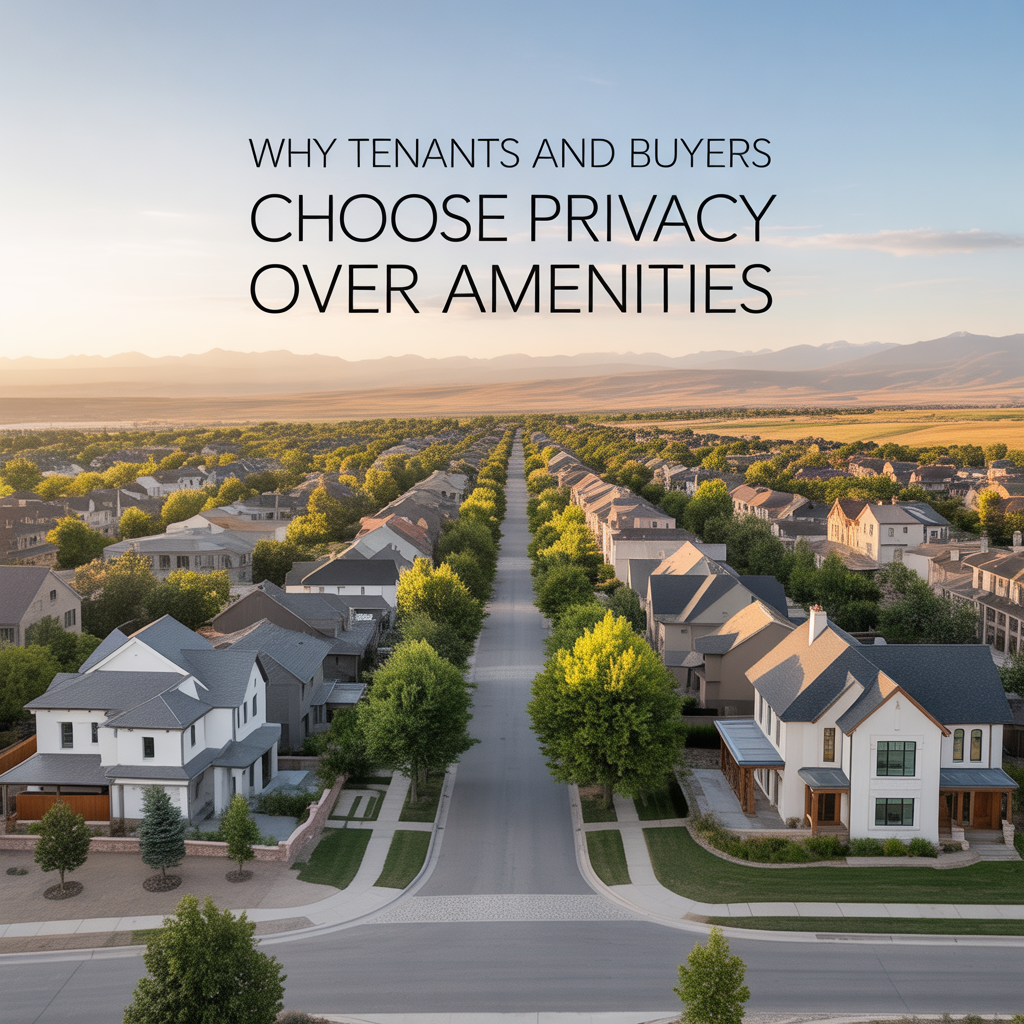
In today’s Colorado real estate market, privacy has quietly become one of the most valuable amenities of all. For years, developers and multifamily operators emphasized shared pools, rooftop lounges, and co-working spaces as the cornerstones of competitive advantage. But in cities like Denver, Centennial, and Lakewood, a different set of priorities is shaping buyer and tenant decisions. More than ever, people are willing to trade shared convenience for personal space, manageable density, and reduced exposure to others’ noise, traffic, and activity.
For investors, this trend is not a passing preference — it reflects structural changes in how Coloradans live, work, and value home environments. Understanding why privacy matters more than amenities in 2026 is critical for building sustainable returns in a market where demand patterns are maturing.
What’s Driving the Shift Toward Privacy
Changing Work Patterns and Remote Adaptation
Colorado’s workforce has restructured in ways that permanently affect housing demand. Even as offices reopen, many professionals in technology, finance, and healthcare maintain hybrid routines. This means that a quiet environment — one that supports video calls, productivity, and mental separation from neighbor activity — now ranks far higher than access to fitness centers or shared lounges.
In neighborhoods across Douglas County, JeffCo, and northern El Paso County, homes that allow separation between workspace and living space see longer tenant retention and fewer turnover costs. From an investor’s standpoint, that translates to steadier income streams and lower carrying expenses.
Urban Density Fatigue
Over the last decade, Colorado’s rapid population growth produced intense construction of high-density apartment communities, particularly near transit corridors. While these developments initially satisfied younger renters seeking convenience, many now feel overexposed — to noise, congestion, and shared surfaces.
In survey data gathered by the Colorado Association of Realtors in late 2025, respondents consistently ranked “personal outdoor space” and “sound insulation” above almost every other feature except overall price. That’s not surprising in urban districts where walls are thinner and leases shorter. People want comfort, not constant exposure. Units with fewer shared walls, private entries, or fenced yards command noticeable premium rent even without pools or game rooms.
Evolving Definition of “Livability”
The concept of livability in Colorado real estate has matured from lifestyle marketing to practical quality. “Easy to live in” now means a home allows for solitude when needed — that you can step outside without stepping into a crowd, or work from home without competing with co-residents for quiet space.
This evolution reflects how the pandemic years reprogrammed expectations. Shared amenities once symbolized community spirit; now, they often signal maintenance fees and unpredictable interactions. For many tenants, fewer shared amenities means simpler management, lower HOA costs, and reduced mechanical failures — a welcome trade for genuine privacy.
How Colorado’s Market Reinforces This Preference
Detached and Semi-Detached Homes Regain Appeal
Throughout 2024 and 2025, detached single-family and paired homes regained market share in the investment category, even as financing costs rose. Buyers and investors paying close attention noticed that demand for townhomes with private garages and small yards stayed strong across South Metro Denver, Arvada, and parts of northern Colorado Springs.
Investors who once focused solely on high-yield multifamily assets are re-balancing portfolios toward small-scale, lower-density rentals. These properties often achieve above-average occupancy and longer lease terms because tenants see them as stable, comfortable, and personal.
The tradeoff — slightly lower per-unit densities — becomes more appealing as replacement cost inflation pressures multifamily cap rates. Privacy, in this sense, is cushioning landlords from volatility.
Weather and Spatial Behavior
Colorado’s climate itself reinforces the desire for private space. With abundant sunshine and dry air for much of the year, outdoor living areas provide extended functional square footage for tenants and owners. Patios, fenced yards, and balconies function as multipurpose extensions of living space, particularly for remote workers who break up their day outside.
Yet when weather turns cold — as it predictably does — the desire for comfort and quiet indoors becomes more acute. Noise transmission and shared ventilation, issues common in densely packed properties, play a larger role in satisfaction surveys and renewal rates. Buyers know this from experience. They remember one loud winter in a high-rise next to I‑25 traffic more vividly than a dozen summer pool days.
Ownership Costs and Hidden Tradeoffs
Buyers increasingly weigh the total cost of privacy alongside taxes, utilities, and maintenance. A townhome with no shared utilities might have marginally higher initial costs but lower long-term risk of assessments tied to communal systems. HOA fees tied to elaborate amenities like gyms, pools, or structured parking often climb faster than inflation, eroding returns and affordability over time.
For investors, this calculus is straightforward: simpler structures with private systems are cheaper to operate and easier to exit or refinance. For owner-occupants, fewer shared amenities mean fewer liabilities when projecting five- or ten-year ownership windows. Privacy isn’t just spatial — it’s financial security through control.
Psychological Drivers Behind the Preference
Autonomy and Control
Human behavior in real estate is rarely rational alone. The desire for privacy reflects the deeper drive for autonomy — to control one’s environment, schedule, and exposure. Properties that provide this autonomy, even modestly, align precisely with the modern homeowner’s priorities.
Tenants accustomed to flexible work and digital independence equate private living with independence itself. The fewer interactions or administrative constraints they face daily, the more valuable the home feels. For investors, this translates to a subtle but consistent advantage: units that respect autonomy foster loyalty and reduce tenant churn.
Emotional Safety and Predictability
Noise, crowding, and unpredictable shared behavior create fatigue. Especially in metro areas like Aurora and downtown Denver, where density has risen sharply, this psychological factor undermines retention. Privacy offers predictability — the assurance that your immediate surroundings will remain under your control.
While tangible amenities depreciate, emotional security compounds. Residents who feel genuinely comfortable renew leases, stay invested in upkeep, and speak positively about management — non‑monetary benefits that strengthen long-term performance metrics.
Implications for Colorado Real Estate Investors
1. Project Design and Acquisition Strategy
Investors developing or acquiring in Colorado should consider designing for functional privacy. This doesn’t necessarily mean larger lots or luxury isolation — it means thoughtful separations: private entries, sound‑dampening construction, and distinct outdoor space even in townhome communities.
Buyers in the Highlands Ranch or Westminster market will often pay a clear premium for end‑unit townhomes or homes that provide visual and acoustic buffering. Investors competing for limited supply might find greater yield in older properties with structural layouts suited to privacy upgrades rather than shared amenity revamps.
2. Marketing and Tenant Retention
Many investors still emphasize amenities in marketing copy — a holdover from the pre‑2020 playbook. In Colorado’s current tenant psychology, however, messaging that highlights seclusion, soundproofing, or low‑density environments aligns better with decision-making patterns.
Maintenance responsiveness and digital convenience (private work orders, keyless entry, self‑guided showings) also strengthen perceived privacy, signaling autonomy rather than communal dependence.
3. Long‑Term Asset Value
Privacy holds surprising staying power as a differentiator in Colorado’s maturing housing market. As new construction pushes efficiency and density, truly private homes — and even moderately private townhomes — will retain rarity value. The same scarcity dynamic that once applied to mountain view lots now increasingly applies to spatial privacy.
For multifamily owners, mitigating density perception through landscaping, staggered layouts, or acoustic improvements can preserve marketability. In turn, investment underwriting should factor not just amenity count but privacy score — an emerging qualitative metric already influencing rent premiums.
The Broader Outlook for Buyers and Developers
Changing Demand in the Denver Metro Area
Suburban infill markets once considered secondary — such as Parker, Erie, or Castle Rock — now benefit from this privacy-driven migration. Residents seek space between homes, shorter commute times than exurban alternatives, and consistent infrastructure. These areas remain close enough for hybrid professionals while providing tangible distance from high-traffic cores.
For developers, the shift invites a recalibration of density targets. Rather than maximizing units per acre, emphasizing balanced spatial design and private-use areas creates sustainable demand profiles less sensitive to minor rate hikes or economic slowdowns.
The Reorientation of “Luxury”
In Colorado’s upper-tier market, luxury increasingly means peace of mind, not amenity count. High-end buyers — particularly relocations from coastal states — prioritize gated entries, reduced shared exposure, and architectural separation. Developers who understand this subtle redefinition are finding success with smaller community footprints offering privacy as the core feature.
This psychological reset distinguishes thoughtful luxury projects from overbuilt amenity packages that add operational cost but little enduring value. It’s a quiet revolution, but one future-proofing high-end real estate against changing cultural norms.
Conclusion: The Quiet Value of Space and Solitude
Privacy is no longer a footnote in buyer preferences; it’s a central theme of housing decisions across Colorado. From Denver’s evolving urban edge to the foothill suburbs, the trend reveals a deeper truth: people increasingly define quality of life by what they can control, exclude, and call truly their own.
For investors, this insight should guide acquisition, renovation, and marketing strategies alike. Properties that protect personal space will outperform those that merely entertain. Amenities may attract initial interest, but privacy sustains value.
If you’re considering your next move — whether acquiring rental units, repositioning a portfolio, or preparing a property for sale — understanding how privacy influences tenant retention and pricing will be crucial to staying ahead of the market.
To discuss specific strategies or market segments where privacy-oriented investments are outperforming, reach out to me directly for a confidential consultation. Thoughtful positioning now can secure stronger, more resilient returns in Colorado’s next market cycle.
Get the full Denver Market Insights → [Market Insights]



Littleton’s Ken Caryl for Lockheed Relocations
This is part of Lockheed Martin Relocation → [Lockheed Martin Relocation Hub] & the larger Denver Relocation Hub → [Denver Relocation Hub] Written by: Chad Cabalka Ken Caryl is one of the best-kept “family first” relocation options for Lockheed Martin employees who want foothills scenery, strong neighborhood appeal, and a real suburban lifestyle that still feels connected…


Centennial & Parker for Lockheed Relocations
This is part of Lockheed Martin Relocation → [Lockheed Martin Relocation Hub] & the larger Denver Relocation Hub → [Denver Relocation Hub] Written by: Chad Cabalka Centennial and Parker are two of the smartest suburban choices for Lockheed Martin employees relocating with families because they give you a strong balance of commute flexibility, good neighborhood variety, and…

Highlands Ranch for Family-Friendly Lockheed Relocations
This is part of Lockheed Martin Relocation → [Lockheed Martin Relocation Hub] & the larger Denver Relocation Hub → [Denver Relocation Hub] Written by: Chad Cabalka Highlands Ranch is one of the strongest choices for Lockheed Martin employees relocating with families because it delivers exactly what most parents want after a big move: stable neighborhoods, strong community…