


This is part of the Denver Metro Relocation Guide → [Relo Guide]
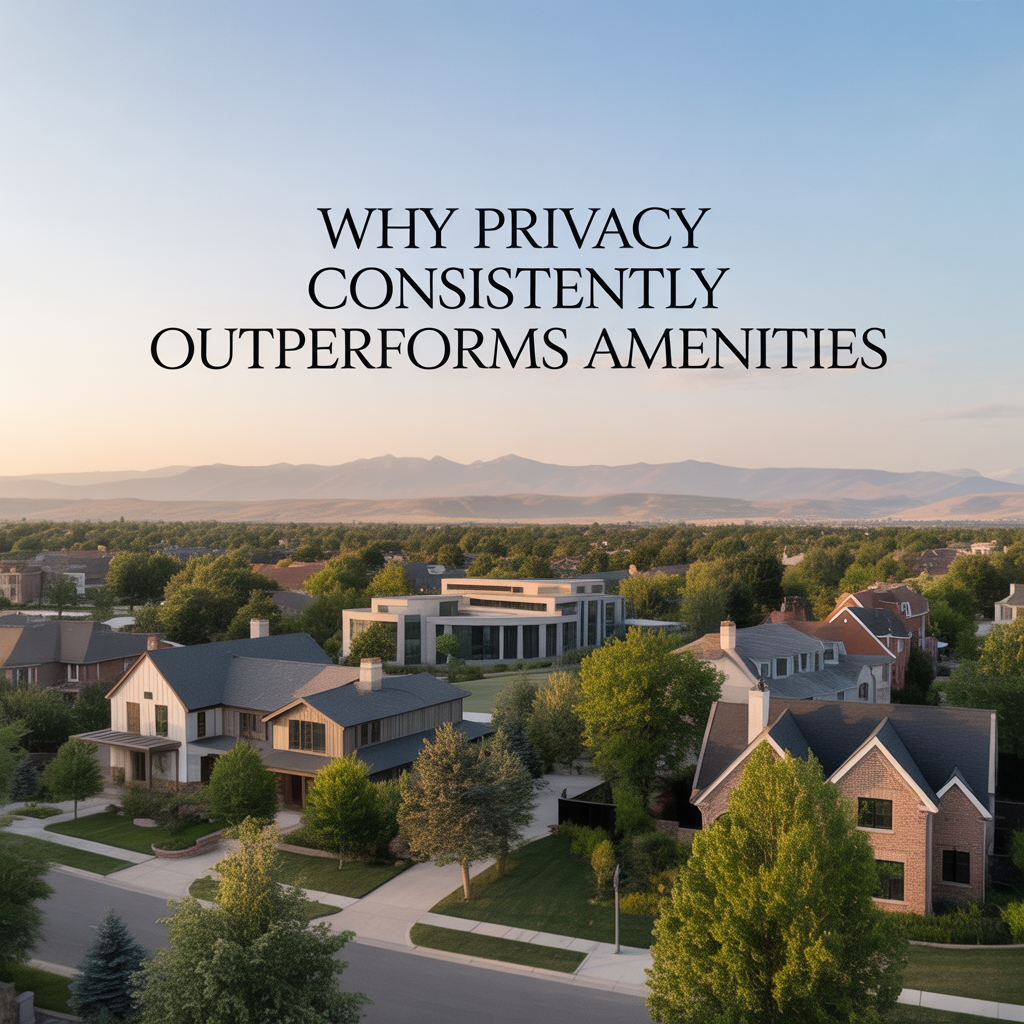
Privacy has become one of the most quietly powerful forces shaping Colorado’s real estate market. In a state known for its mountains, active lifestyles, and open space, buyers continue to show that personal space—both inside and outside the home—ranks higher than nearly any other amenity. Whether it’s a half-acre lot in Highlands Ranch, a treed property in Evergreen, or a carefully landscaped suburban yard in Parker, privacy influences both immediate satisfaction and long-term appreciation in ways most amenities cannot.
This isn’t a passing preference. It’s a structural shift in how people define comfort, security, and value. Understanding why privacy holds this kind of weight can help both buyers and sellers navigate decisions that will endure well beyond the next market cycle.
The Psychology Behind Privacy
Homebuyers are not just shopping for square footage or finishes—they’re seeking a sense of refuge. The best homes in Colorado, regardless of size or price point, create psychological boundaries between life and the outside world.
For many local homeowners, especially those relocating from denser urban areas or higher-cost coastal markets, privacy is not about isolation. It’s about control of environment: the ability to enjoy outdoor space without a neighboring deck in full view, to work from home without street noise, or to open blinds in the morning without feeling exposed.
Unlike a new kitchen or finished basement—features that age and depreciate—privacy retains emotional value because it fulfills a core human need for space and security. Once people live with it, they rarely trade it away. This dynamic explains why private lots consistently achieve stronger appreciation and faster resale times than comparable homes surrounded by close setbacks or shared sightlines.
Privacy in the Colorado Context
Colorado’s geography and development pattern make privacy uniquely valuable. The Denver metro area stretches across open plains bordered by foothills and natural corridors. Expansion over the past two decades—particularly in Douglas, Arapahoe, and Jefferson Counties—has delivered hundreds of new neighborhoods, many built on formerly rural land.
However, as land values rise and densities increase, true privacy has become scarcer. New subdivisions often prioritize amenities such as pools, clubhouses, and walking trails to maximize appeal, but these offerings come with trade-offs in lot size and personal space. For buyers relocating from more congested markets, this can be surprising: the pool or park may look attractive on paper, but daily living can feel closer and noisier than expected.
By contrast, established communities—such as Centennial, Castle Pines, or areas west of I‑25 in Lone Tree—maintain more generous setbacks, mature trees, and lot variation that naturally buffer neighbors. Even within Denver County, certain pockets like Hilltop, Belcaro, and Observatory Park maintain a feeling of separation through landscaping and thoughtful design. For many buyers, this subtle sense of retreat is more meaningful than any shared recreational facility.
Why Privacy Outperforms Amenities Over Time
Amenities may attract initial attention, but privacy sustains value. There are several practical reasons for this consistent outperformance:
- Timeless appeal. Tastes change, but privacy does not go out of style. The home that offers relief from noise and visibility appeals equally to young professionals, families, and retirees.
- Lower operating costs. Community amenities come with HOA fees and maintenance expenses that can rise over time. In contrast, a private yard or secluded patio has minimal shared obligations and remains under the homeowner’s control.
- Market scarcity. As urban infill continues and zoning shifts favor higher densities, properties with natural buffers or larger lots become increasingly rare—and therefore more valuable.
- Lifestyle flexibility. Privacy enables homeowners to use space as they wish: adding outdoor living areas, home offices, or accessory units without neighbor intrusion.
- Quieter resale negotiations. Homes that feel more private tend to sell faster and experience fewer buyer objections during negotiation, because privacy addresses concerns like noise, exposure, and crowding upfront.
While amenities can enhance a neighborhood’s character, they typically favor developers more than individual owners. Once built, amenities may differentiate a subdivision but do little to insulate a single property from market pressures. Privacy, by contrast, becomes a personal asset.
The Shifting Landscape of Buyer Priorities
The rise of remote and hybrid work has intensified Colorado buyers’ preference for privacy. A separate, quiet workspace now ranks among the most sought-after home features—but that is only part of the story. What many buyers actually want is control over their environment: control of sightlines, sound, and personal space.
Surveys from real estate research firms show that “quiet streets,” “mature landscaping,” and “space between homes” consistently outrank communal features like gyms or clubhouses. That aligns with behavior observed across much of the Front Range. Homes that back to open space, greenbelts, or protected land frequently command premiums even when interior finishes are modest.
Seasonal factors reinforce this trend. Colorado’s outdoor culture means homeowners use decks, patios, and yards well into fall and early spring. A sense of seclusion enhances this daily living experience far more than access to a shared pool that operates three months per year.
Design and Landscaping: The New Amenity
Modern buyers often equate privacy with acreage, but thoughtful design can achieve it on almost any lot. This is particularly relevant in neighborhoods where land is limited but demand for privacy is high.
Developers and remodelers across the Denver suburbs increasingly use architectural solutions—angled windows, offset garages, or tiered outdoor spaces—to reduce direct sightlines between homes. Strategic landscaping has become a design priority, not an afterthought. Evergreen trees, fencing combinations, and elevation changes can significantly improve privacy perception without requiring large property footprints.
The result is a quieter form of luxury: homes that feel secluded through intention rather than square footage. Sellers who invest in privacy enhancements often find these updates yield stronger buyer response than interior cosmetic upgrades, because they improve both function and emotional comfort.
Evaluating Privacy When Buying or Selling
Understanding how to quantify privacy helps ensure a sound investment. Consider three primary dimensions:
- Visual privacy: Are windows and outdoor spaces shielded from neighboring views? Homes with natural or built screening—trees, fences, or setbacks—command higher desirability.
- Acoustic privacy: How insulated is the property from street and neighborhood noise? Distance from main roads, elevation changes, and lot positioning can make a measurable difference.
- Spatial privacy: Does the layout of the home and lot create a sense of personal territory? Corner lots, cul-de-sacs, or properties backing to open space typically perform better in this regard.
For sellers, enhancing any of these factors can boost market appeal without major expense. For buyers, evaluating privacy early prevents regrettable trade-offs. A slightly smaller kitchen may be forgotten; the sound of constant traffic or view of a neighbor’s deck rarely is.
How Privacy Affects Long-Term Appreciation
Historical resale data across metro Denver show that homes offering visual or spatial separation maintain more stable appreciation patterns through market fluctuations. The logic is straightforward: scarcity increases as density rises, and privacy cannot be added once adjacent land is developed.
During boom periods, buyers stretch budgets for location or modern upgrades; in slower markets, private settings stand out for their lasting comfort and tranquility. This combination reduces downside risk. Unlike amenity-heavy neighborhoods—where costs continue even when market activity slows—private properties maintain intrinsic value tied to livability rather than shared infrastructure.
Additionally, Colorado’s long-term growth trajectory favors infill and redevelopment. As transit corridors expand and high-demand suburbs reach buildout, secluded settings near employment centers become especially desirable. In this environment, privacy functions as both a lifestyle choice and a structural hedge against overbuilding.
Balancing Privacy and Community
It’s worth stressing that privacy does not mean disengagement. Many of Colorado’s most successful neighborhoods blend personal space with community strength. Developments around Highlands Ranch and Castle Rock, for instance, provide extensive trail systems and recreation options while preserving lot sizes and setbacks that prevent overcrowding.
The healthiest markets balance both dynamics. Communities that protect homeowners’ sense of space foster longer tenure, lower turnover, and fewer disputes—factors that stabilize property values. Ultimately, privacy supports not only individual wellbeing but also neighborhood cohesion, because residents who feel comfortable tend to invest more deeply in their surroundings.
Strategic Takeaways for Buyers and Sellers
For buyers, prioritize privacy early in your search. Once construction density increases, opportunities diminish. Consider the long-term trade-off between shared amenities and daily peace of mind. A slightly older home on a private lot often outperforms a newer home in a dense setting within just a few years of ownership.
For sellers, highlight privacy as a feature, not an accident. Describe sightlines, quietness, and natural buffers in listing materials. If possible, stage outdoor areas to emphasize separation and serenity. Buyers may not consciously use the word “privacy,” but they feel it immediately when they walk through a property.
For relocating homeowners, understand that Colorado’s definition of privacy differs by region. In-town areas value separation through landscaping and design, while foothill and acreage properties emphasize distance and natural screening. Tailoring search criteria to these distinctions avoids wasted effort and ensures value alignment over time.
The Enduring Value of Privacy
Real estate markets evolve, tastes shift, and amenities age—but privacy remains a fixed measure of quality. In Colorado, where outdoor living and personal space are intertwined, that value runs even deeper. Homes that provide both physical and emotional separation continue to outperform those that rely on shared attractions or visual appeal alone.
For serious buyers, privacy is not just a preference—it’s a long-term investment in comfort, flexibility, and resilience. For sellers, it’s a marketing advantage that speaks directly to how people actually live. And for everyone navigating Colorado’s changing market, understanding this dynamic may prove the simplest way to protect both satisfaction and equity.
If you’re considering a move within Colorado—or want to better understand how privacy impacts the value of your home—reach out to me directly. I can provide a detailed analysis of your property or target area, identifying where privacy creates measurable advantages in pricing, demand, and long-term return.
Get the full Denver Market Insights → [Market Insights]



Littleton’s Ken Caryl for Lockheed Relocations
This is part of Lockheed Martin Relocation → [Lockheed Martin Relocation Hub] & the larger Denver Relocation Hub → [Denver Relocation Hub] Written by: Chad Cabalka Ken Caryl is one of the best-kept “family first” relocation options for Lockheed Martin employees who want foothills scenery, strong neighborhood appeal, and a real suburban lifestyle that still feels connected…


Centennial & Parker for Lockheed Relocations
This is part of Lockheed Martin Relocation → [Lockheed Martin Relocation Hub] & the larger Denver Relocation Hub → [Denver Relocation Hub] Written by: Chad Cabalka Centennial and Parker are two of the smartest suburban choices for Lockheed Martin employees relocating with families because they give you a strong balance of commute flexibility, good neighborhood variety, and…

Highlands Ranch for Family-Friendly Lockheed Relocations
This is part of Lockheed Martin Relocation → [Lockheed Martin Relocation Hub] & the larger Denver Relocation Hub → [Denver Relocation Hub] Written by: Chad Cabalka Highlands Ranch is one of the strongest choices for Lockheed Martin employees relocating with families because it delivers exactly what most parents want after a big move: stable neighborhoods, strong community…