


This is part of the Denver Metro Relocation Guide → [Relo Guide]
That’s an excellent and nuanced topic — focusing on the intersections of design decisions, buyer psychology, and Colorado’s particular housing stock. Below is a polished, professional long-form blog post written in the voice of an experienced Colorado real estate advisor.
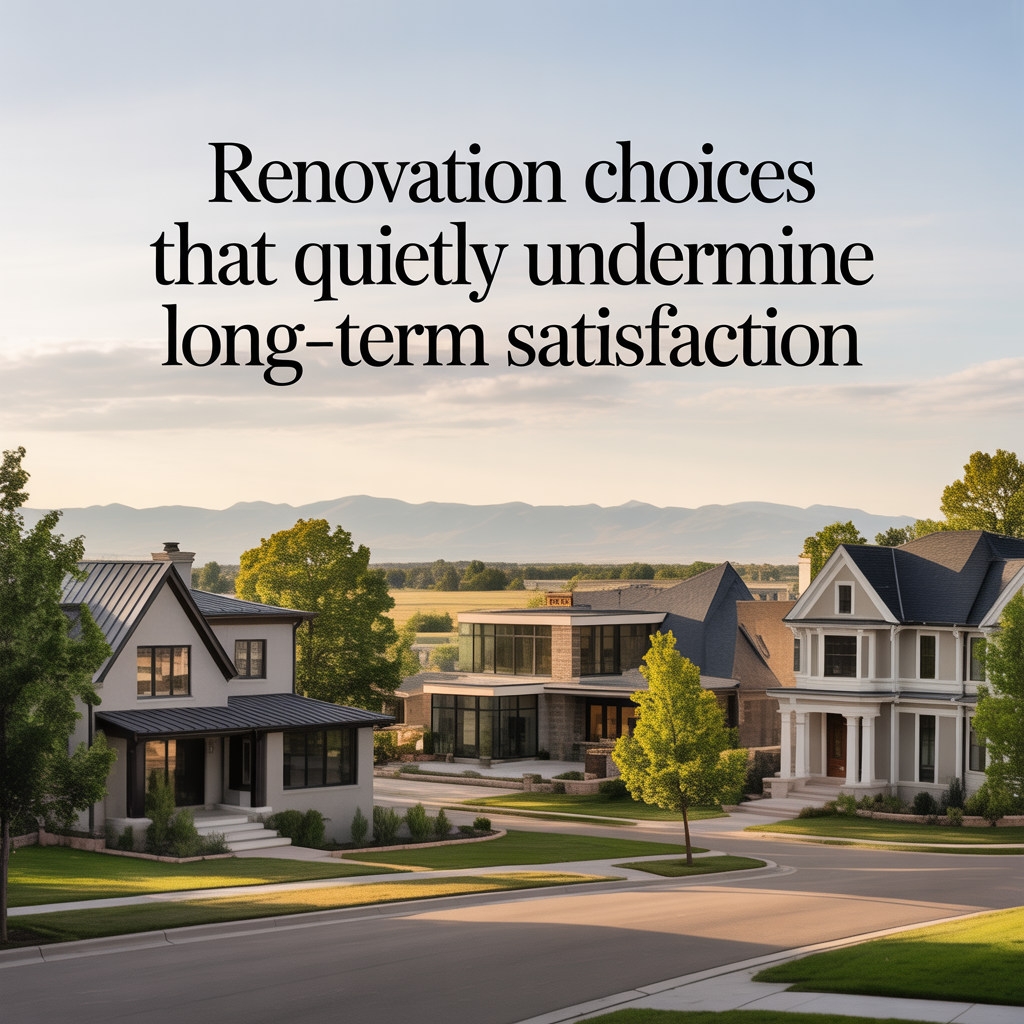
Renovation Choices That Quietly Undermine Long-Term Satisfaction
Homeowners often renovate with the goal of improving comfort, functionality, or resale value. Yet in every market cycle, experienced analysts see the same pattern: some upgrades age gracefully, supporting long-term satisfaction and value, while others start to feel mismatched or burdensome just a few years later.
In Colorado — especially across the Denver metro area, Douglas County, and the Front Range suburbs — housing stock ranges from 1970s ranches and tri-levels to newer infill developments and luxury mountain-view properties. Renovation decisions tend to follow national design trends, but local conditions, climate, and buyer expectations add layers of complexity. What looks appealing in a design magazine may function very differently once it meets our dry climate, high-altitude sunlight, and year-round outdoor-active lifestyle.
This post examines renovation choices that frequently undermine long-term satisfaction — not because they’re “wrong,” but because they often fail to align with how Colorado homeowners actually live or how the local market perceives lasting value.
The Allure — and Limits — of Open-Concept Living
Open floor plans remain popular, especially in suburban remodels where homeowners remove interior walls to create larger shared spaces. The appeal is clear: open sightlines, connection, and light. But in older Colorado homes, especially tri-levels or split-levels, the structural and functional trade-offs can be significant.
Removing walls in homes constructed before the 1990s often means compromising heating efficiency or creating acoustical challenges. At elevations like Highlands Ranch or Castle Rock, heating zones matter — high-ceilinged spaces take more energy to maintain in winter. Families also tend to rediscover, after living with an entirely open layout, that functional separation has value: sound control, privacy, and energy efficiency all suffer when boundaries disappear.
From a resale perspective, buyers with young children or multi-generational households frequently prefer partial openness — an updated kitchen that connects to a casual dining area but still defines living zones. Full wall removal is costly and often irreversible, and its market appeal tends to narrow over time.
Over-Personalized Finishes and Design Statements
Many homeowners understandably want to express individual taste. The problem arises when distinctive style choices dominate a renovation rather than support it. In Denver’s broader market, strongly themed designs — farmhouse white-on-white, ultra-industrial loft conversions, or bold color blocking — can date a home faster than expected.
Real estate data from Front Range MLS reports consistently show that neutral and balanced designs command broader appeal. Buyers’ preferences evolve, but few future owners want large-scale reversal projects. While it’s unrealistic to design only for resale, renovations that preserve flexibility — clean architectural lines, timeless flooring, and understated palettes — sustain satisfaction longer because they adapt with changing lifestyles.
Another quiet trap is the overuse of custom built-ins designed for specific lifestyles: oversized wine rooms, luxury-tier home theaters, or specialized workout spaces. These features may delight in the short term, but they limit room reconfiguration later. If a renovation locks the home into one way of living, its long-term usefulness — and marketability — diminishes.
Choosing Materials Without Local Context
Colorado’s dry weather, wide temperature swings, and high UV exposure uniquely test materials. Finishes that perform beautifully in coastal or humid regions may struggle here. Homeowners sometimes underestimate how climate influences aging and maintenance.
Hardwood, for instance, expands and contracts notably across seasons. Engineered flooring better withstands this variation, while certain exotic woods prone to gapping or cupping can disappoint. Similarly, composite decking materials resist fading far better than standard wood in the strong Colorado sun. Exterior paint longevity, too, varies sharply by formula — what lasts ten years in Oregon may fade or chalk here within five.
Inside, dark-stained cabinetry and glossy finishes show dust and dryness more quickly in our low-humidity environment. Homeowners who make material selections without considering these regional conditions often find themselves frustrated by higher maintenance or premature wear.
Overemphasizing Square Footage at the Expense of Flow
When evaluating resale potential, many homeowners focus on adding square footage — finishing basements, extending kitchens, or enclosing patios. While these additions can increase valuation, they don’t automatically enhance livability. The difference lies in how new space connects to the existing structure.
In areas like Littleton, Centennial, and Parker, finished basements are common. Yet too many feel like separate worlds — isolated, poorly lit, or inconsistent in finish quality. Appraisers may give partial credit for finished areas, but buyers instantly register when an addition feels tacked on. Long-term satisfaction correlates far more strongly with flow, daylight, and proportional layout than with raw footprint.
A thoughtfully reconfigured main level often improves daily life more than an extra 400 square feet downstairs. Strategic design — aligning circulation, opening sightlines selectively, and improving transitions between outdoor and indoor living — tends to hold value better than one-dimensional expansion.
The Hidden Costs of Over-Improvement
Another frequent pitfall is over-improvement relative to the surrounding neighborhood. In Denver suburbs where home price parity influences appraisal comparisons, owners sometimes renovate beyond what the local market supports. This usually happens in stages — a luxury kitchen here, a high-end bath remodel there — until the property exceeds the ceiling of nearby comparable sales.
This doesn’t make the renovation unwise, but it changes the return calculus. In areas like Highlands Ranch’s early phases or Centennial’s older subdivisions, adding ultra-premium finishes can outpace neighborhood benchmarks by 15–20%. The longer the ownership horizon, the less problematic this becomes, but those planning to sell within five years often realize that their investment returns less than planned.
A disciplined approach considers both personal enjoyment and resale alignment. For example, upgrading to semi-custom cabinetry and durable quartz counters offers better long-term satisfaction than luxury marble that may be too fragile for family use and too costly for future buyers to appreciate proportionally.
Ignoring Maintenance Implications
Every renovation has a maintenance tail. Homeowners often focus on upfront aesthetics without accounting for how new systems or materials behave over 10–15 years.
In our dry, high-altitude environment, sealants, finishes, and exterior elements degrade differently. Frameless glass showers require constant upkeep to prevent mineral buildup from hard water. Intricate landscaping designs depend on irrigation systems that must adapt to water restrictions or drought cycles. Complex smart home systems, though convenient, often outpace software or device compatibility within a decade.
Renovations should balance ambition with manageability. The most quietly satisfying homes — those aging gracefully and maintaining functionality — typically share one trait: simplicity. They rely on robust materials, intuitive systems, and layouts that don’t demand continuous upkeep or technical troubleshooting.
Overlooking Energy Efficiency in Older Homes
Energy performance is another common blind spot. Many remodels focus heavily on finishes and layout while ignoring the underlying systems driving monthly costs. Yet heating efficiency, insulation, and window quality have an outsized impact on comfort in Colorado’s climate.
Older homes around Denver often have uneven performance between upstairs and downstairs. Renovating without evaluating attic insulation, window seals, or HVAC zoning can freeze the problem in place. Buyers are increasingly savvy about utility bills and energy audits — a home that “feels drafty” loses appeal faster than one that simply needs aesthetic updates.
Upgrading insulation, windows, and mechanical systems may not carry the visible glamour of a designer kitchen, but it delivers consistent, real-world satisfaction. The first winter’s utility statement tells the story more compellingly than any remodel photo gallery.
Landscaping That Ages Poorly
Exterior upgrades matter deeply in Colorado, where outdoor space is a functional extension of the home. However, certain landscaping approaches create long-term frustration. Choices that ignore soil conditions, drainage, or water availability can quickly become costly.
For instance, non-native lawns requiring heavy irrigation rarely justify their upkeep, especially under regional water restrictions. Extensive rock landscaping may seem low-maintenance initially but can raise heat around the home and complicate future planting. Overly complex retaining wall designs, popular in sloped neighborhoods, sometimes fail when not engineered to handle freeze-thaw cycles.
The most durable approaches favor adaptability: native or xeric plantings, patios oriented for seasonal use, and materials suited to both heat and snow. These landscapes not only mature well but align with how Coloradans use outdoor areas — as year-round extensions of daily living, not decorative afterthoughts.
The Psychology of Satisfaction
Renovation satisfaction is as much psychological as functional. Projects grounded in real lifestyle needs — space to work, gather, rest, and connect — remain fulfilling. Those driven by aesthetics alone often fade.
In Colorado’s stable but evolving housing market, buyers’ long-term preferences reflect a balance of practicality and experience. They value homes that feel authentic, manageable, and well-built more than those showcasing fleeting style. A renovation guided by thoughtful restraint seldom disappoints because it allows daily living, rather than design, to take center stage.
Homeowners who think about the “quiet moments” of daily routine — the walk from kitchen to patio, the comfort of evenly heated rooms, the adaptability of shared spaces — tend to make decisions that sustain contentment far beyond resale calculations.
Building Renovations Around Long-Term Lifestyle Value
Home improvements achieve their highest return when they complement both the home’s architectural integrity and the owner’s foreseeable needs. The strongest framework for decision-making includes:
- Evaluating whether a renovation enhances daily efficiency and comfort.
- Considering material and design durability within Colorado’s climate.
- Matching investment scale to neighborhood value and ownership horizon.
- Recognizing that quality of use — light, flow, maintenance simplicity — outweighs visible complexity.
This mindset encourages balance between personal enjoyment and practical foresight. It respects the difference between spending on a trend and investing in enduring livability.
Conclusion: Designing for Lasting Comfort and Value
Truly successful renovations are rarely the flashiest; they’re the ones that continue to make sense as circumstances change. They preserve a home’s adaptability, control maintenance costs, and sustain comfort through Colorado’s distinct seasonal rhythms.
For homeowners navigating which improvements will stand the test of time, context matters — not just the national trends but the way local buyers think, live, and measure value. Renovations that harmonize design with regional realities consistently yield the highest long-term satisfaction, whether the goal is to stay put or to sell strategically in the years ahead.
If you’re considering a renovation or preparing to position your Colorado home for sale, reach out to me for tailored insight. Together, we can identify the choices that truly reinforce your home’s comfort, efficiency, and lasting appeal.
Get the full Denver Market Insights → [Market Insights]



Littleton’s Ken Caryl for Lockheed Relocations
This is part of Lockheed Martin Relocation → [Lockheed Martin Relocation Hub] & the larger Denver Relocation Hub → [Denver Relocation Hub] Written by: Chad Cabalka Ken Caryl is one of the best-kept “family first” relocation options for Lockheed Martin employees who want foothills scenery, strong neighborhood appeal, and a real suburban lifestyle that still feels connected…


Centennial & Parker for Lockheed Relocations
This is part of Lockheed Martin Relocation → [Lockheed Martin Relocation Hub] & the larger Denver Relocation Hub → [Denver Relocation Hub] Written by: Chad Cabalka Centennial and Parker are two of the smartest suburban choices for Lockheed Martin employees relocating with families because they give you a strong balance of commute flexibility, good neighborhood variety, and…

Highlands Ranch for Family-Friendly Lockheed Relocations
This is part of Lockheed Martin Relocation → [Lockheed Martin Relocation Hub] & the larger Denver Relocation Hub → [Denver Relocation Hub] Written by: Chad Cabalka Highlands Ranch is one of the strongest choices for Lockheed Martin employees relocating with families because it delivers exactly what most parents want after a big move: stable neighborhoods, strong community…