


This is part of the Long Term Rentals in Denver→ [Long Term Rentals in Denver] a hub of Denver Investing Guide → [Denver Investing Guide]
Written by: Chad Cabalka
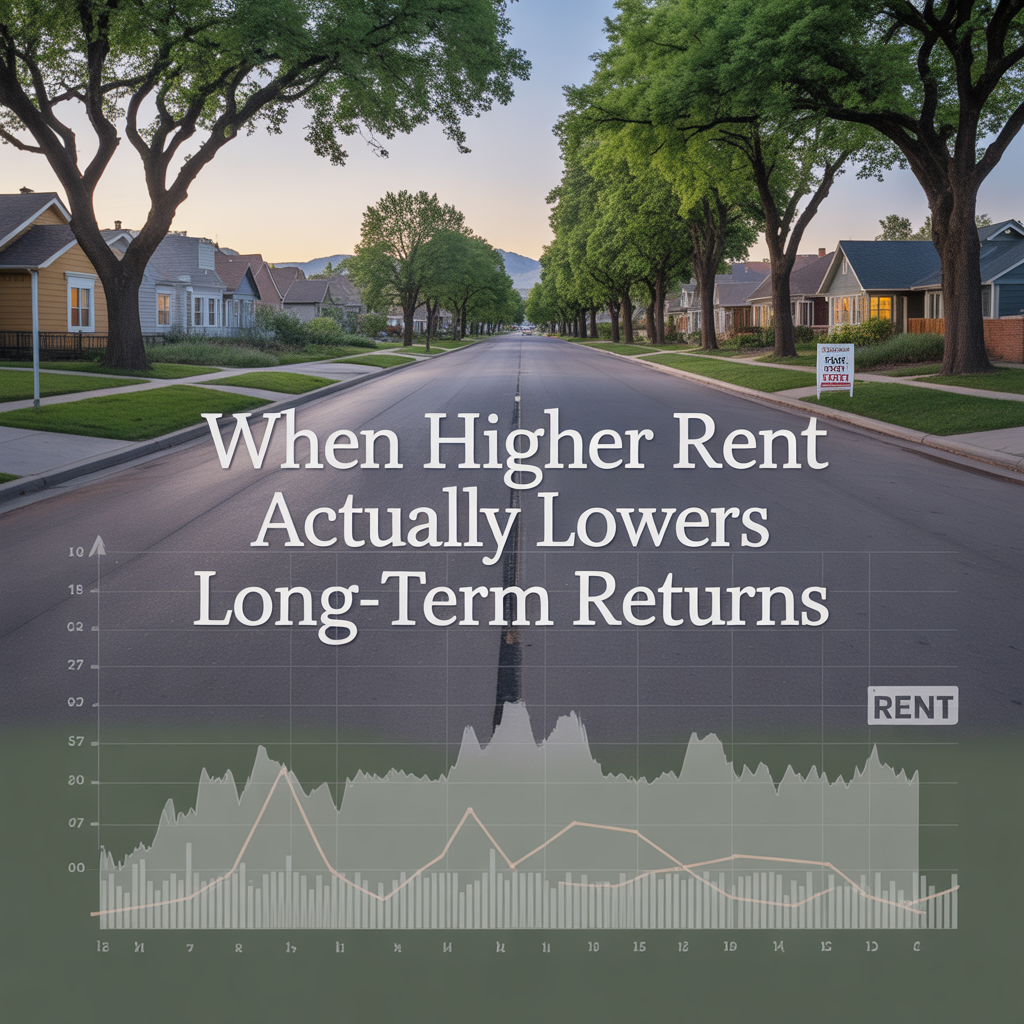
Pushing rents to market maximums delivers short-term revenue spikes but often undermines total returns through extended vacancies, accelerated turnover, and tenant quality erosion. In Denver’s maturing rental landscape, optimal pricing prioritizes sustained occupancy over headline income, as retention compounds value faster than aggressive hikes. Higher rents reduce net operating income over cycles by 15-25% in metro submarkets.
This dynamic prevails when lease-up times lengthen and concessions become standard, turning apparent gains into hidden losses.
Vacancy Extension Outweighs Rent Premiums
Higher rents extend lease-ups 20-40 days in competitive areas like Arvada and Littleton, where families comparison-shop across platforms. A $3,000 rent versus $2,800 yields $2,400 extra annually from a 12-month tenant—but 30 extra vacant days erase two months’ income, netting negative.
Denver’s 7-10% vacancy environment amplifies this: top-of-market units linger while moderately priced homes lease in 14-21 days. Single-family rentals in Highlands Ranch see 55-65% renewals at fair pricing; 10% hikes drop that to 45%, doubling turnover costs at $4,000 per cycle.
Tenant Quality Drives Asymmetric Costs
Premium rents attract price-sensitive occupants who stretch budgets, leading to late payments, maintenance disputes, and early exits. Stable DTC professionals tolerate modest increases; overpricing draws transients who neglect properties, inflating repairs 25-35%.
In Aurora’s military-heavy zones, $2,600 rents secure reliable payers; $2,900 prompts 18-month stays versus 24+, with higher utility pass-throughs and compliance issues under habitability laws. Credit losses and accelerated wear compound, slashing five-year yields.
Concession Cycles Erode Effective Rent
Denver landlords counter slow lease-ups with incentives—free months, waived fees—reducing effective rents below lower asks. A $3,100 Wash Park listing nets $2,850 after concessions; a $2,900 competitor achieves $2,850 outright with faster fills and renewals.
Market data shows 40-50% tenant retention metro-wide; high-rent strategies halve that, perpetuating concession reliance. New multifamily supply in Thornton forces similar dynamics on nearby single-family, where $140 monthly drops compound over quarters.
Submarket Pricing Sweet Spots vs. Max Rents
| Submarket | Max Rent Risk | Optimal Range | Annual Return Gap |
|---|---|---|---|
| Highlands Ranch | $3,200+ | $2,700-$3,000 | -18% |
| Aurora | $2,600+ | $2,100-$2,400 | -22% |
| Littleton | $3,100+ | $2,500-$2,900 | -15% |
| Arvada | $2,900+ | $2,300-$2,700 | -20% |
| Wash Park | $3,900+ | $3,200-$3,600 | -12% |
Optimal pricing yields 92% occupancy; max chases 85-88%.
Expense Leverage Amplifies the Penalty
Higher rents coincide with top-quartile properties demanding premium upkeep—landscaping, snow removal, minor updates—to justify pricing. These add 8-12% to operating costs, while lower tiers run leaner.
Tax and insurance escalations hit uniformly, but high-rent owners lack cash flow buffers during gaps. Management firms charge percentage fees, consuming more absolute dollars on elevated rents without proportional service gains.
Renewal Dynamics Favor Moderation
Denver tenants renew at 3-5% hikes, not 10%; pushing beyond triggers 35-45% non-renewals. Each cycle restarts vacancy clocks, while steady payers cover fixed costs predictably. Over five years, moderate pricing compounds 10-15% higher net income through avoided turnovers.
Policy overlays—licensing, inspections—extend transitions, penalizing slow fillers disproportionately.
Strategic Pricing for Maximum Yield
Target 60-70% renewals via:
- 3-4% annual adjustments against verified comps.
- Screening for long-term fits pre-concessions.
- Quarterly audits balancing occupancy and growth.
- Incentives for proven tenants over new chases.
- 8-10% vacancy buffers in pro formas.
These secure 11-13% returns versus 7-9% from max-rent volatility.
Conclusion: Yield Through Balance
Higher rents lower long-term returns in Denver by disrupting occupancy stability and inflating operational drag. Sustainable pricing—slightly below peak—maximizes net income through retention velocity, outperforming aggressive strategies across metro cycles.
For rent optimization models, submarket yield forecasts, or portfolio pricing audits, contact Long-Term Rentals in Denver. Precise guidance elevates your returns.
Get the full Denver Market Insights → [Market Insights]



Littleton’s Ken Caryl for Lockheed Relocations
This is part of Lockheed Martin Relocation → [Lockheed Martin Relocation Hub] & the larger Denver Relocation Hub → [Denver Relocation Hub] Written by: Chad Cabalka Ken Caryl is one of the best-kept “family first” relocation options for Lockheed Martin employees who want foothills scenery, strong neighborhood appeal, and a real suburban lifestyle that still feels connected…


Centennial & Parker for Lockheed Relocations
This is part of Lockheed Martin Relocation → [Lockheed Martin Relocation Hub] & the larger Denver Relocation Hub → [Denver Relocation Hub] Written by: Chad Cabalka Centennial and Parker are two of the smartest suburban choices for Lockheed Martin employees relocating with families because they give you a strong balance of commute flexibility, good neighborhood variety, and…

Highlands Ranch for Family-Friendly Lockheed Relocations
This is part of Lockheed Martin Relocation → [Lockheed Martin Relocation Hub] & the larger Denver Relocation Hub → [Denver Relocation Hub] Written by: Chad Cabalka Highlands Ranch is one of the strongest choices for Lockheed Martin employees relocating with families because it delivers exactly what most parents want after a big move: stable neighborhoods, strong community…