


This is part of Homeownership 101→ [Homeownership 101]
Written by: Chad Cabalka
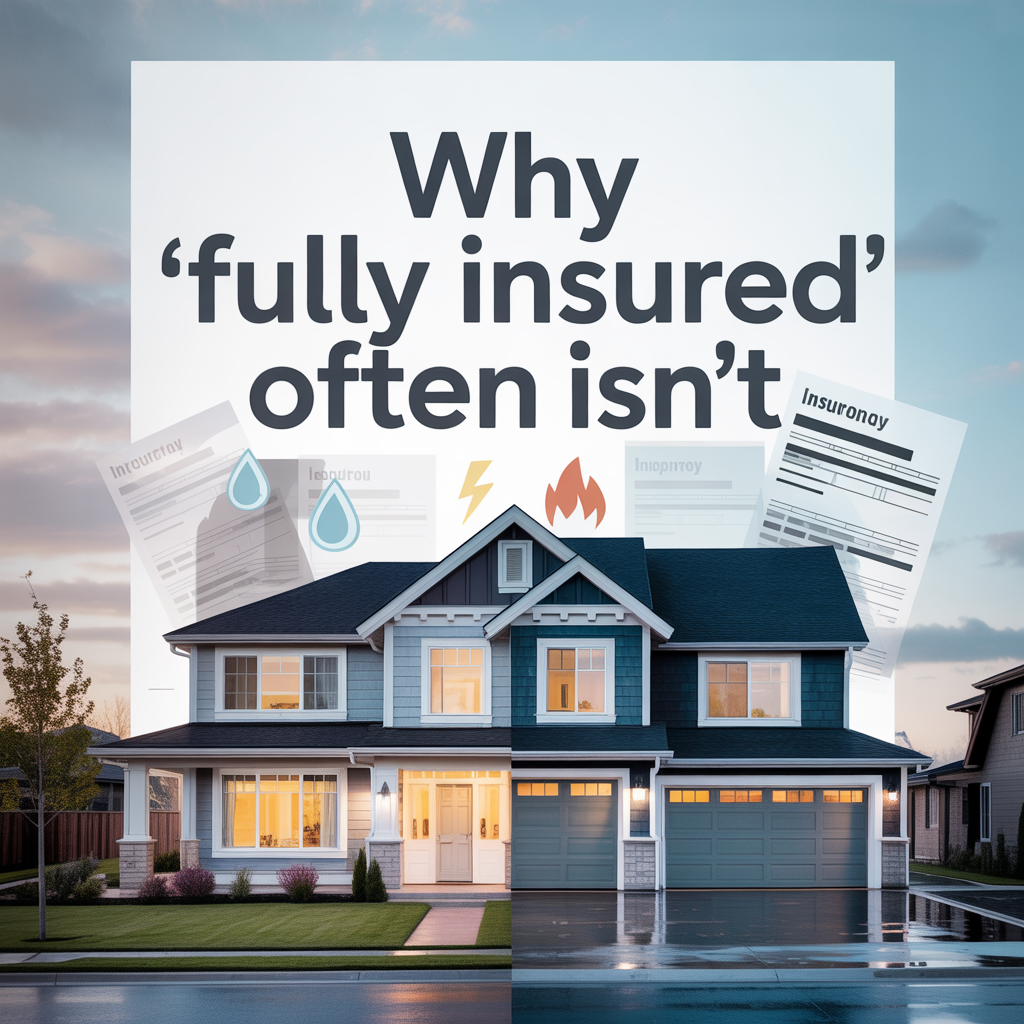
“Fully insured” sounds reassuring, but in practice it rarely means “everything that might go wrong in this house is covered.” Standard homeowners policies are designed to pay for sudden, accidental events—not slow deterioration, wear and tear, or problems that could reasonably have been prevented with basic maintenance. That gap between what owners assume and what policies actually cover is where many painful surprises happen. A roof that leaks gradually, a pipe that has been weeping for months, or mold that builds up over time often falls outside coverage, even when the marketing made things sound comprehensive.
The phrase “fully insured” usually reflects that you have a policy in force at the limits your lender or agent recommended, not that every type of damage or loss will be paid for. Policies come with exclusions, conditions, deductibles, sub-limits, and “duty to maintain” language that puts some responsibility squarely back on the homeowner. Understanding that distinction helps you avoid leaning on insurance as a safety net for issues that, from the insurer’s point of view, were supposed to be handled through routine care.
How This Shows Up in Real Homes
A homeowner with a “full coverage” policy discovers a slow kitchen sink leak has rotted out the cabinet base and subfloor. Because the damage developed over weeks or months and could have been caught and repaired, the adjuster cites the wear-and-tear and neglect exclusions and denies the claim. From the owner’s perspective it feels like a sudden discovery; from the insurer’s side it is gradual damage they explicitly do not cover. The result is a full out-of-pocket repair despite feeling “fully insured.”
Another common example is a roof that has been allowed to age past its prime. When a storm finally comes through and causes visible damage, the insurer inspects and notes long‑term deterioration, missing shingles, and prior granule loss that were never addressed. They may reduce or deny payment on the grounds that the damage is mostly due to wear and tear and lack of upkeep, not just the storm. The homeowner expected a new roof from insurance; instead, they receive a partial payout, or none at all.
Similar patterns appear with mold and moisture. A musty basement or bathroom mold that has built up over time is often excluded if it stems from “persistent humidity” or poor ventilation rather than a sudden covered event. Even when mold coverage is added, it tends to be capped at low sub‑limits, leaving the homeowner to cover the bulk of remediation costs. The owner feels blindsided because they assumed “full” meant comprehensive.
Common Misunderstandings Homeowners Have
Many homeowners assume that as long as they pay premiums on time, insurance will step in for almost any major repair. In reality, policies routinely exclude normal aging, deterioration, and maintenance‑related issues, treating those as the owner’s responsibility. The job of the policy is to handle unpredictable losses like fires, certain storms, or theft—not to replace systems simply because they are old or poorly maintained. That is a fundamental mismatch between expectation and contract language.
Another frequent misunderstanding is around “all‑risk” or “open‑peril” wording. These phrases sound like blanket protection, but even all‑risk policies come with a list of exclusions, including wear and tear, rust, corrosion, settling, and mechanical breakdown. Homeowners see “all‑risk” and mentally translate it to “everything,” but insurers use it to mean “any cause of loss except what we specifically exclude.” The exclusions list is often long and easy to skim past.
People also tend to underestimate how much documentation matters. If a claim is denied due to alleged neglect, the insurer may lean heavily on the absence of maintenance records as evidence that routine care did not happen. From the homeowner’s side, it feels like an unfair technicality; from the insurer’s perspective, they are distinguishing between sudden loss and preventable deterioration. Without receipts, service reports, or photos, it can be difficult to prove that you did your part.
Why These Assumptions Create Problems Over Time
When homeowners believe they are “fully insured,” they may unconsciously give themselves permission to delay certain maintenance tasks, assuming the policy will backstop them if something fails. Over years, that can lead to roofs kept beyond their useful life, plumbing not checked for slow leaks, and drainage problems left unresolved. When these issues eventually surface as significant damage, claims are often reduced or denied on the basis of wear, neglect, or the “duty to maintain” clauses. At that point, the costs land entirely on the owner, often at the worst possible time.
These assumptions can also shape financial planning. If you believe insurance will cover most major problems, you are less likely to build a robust maintenance and repair reserve. In practice, standard guidance still recommends setting aside 1–4% of your home’s value annually for upkeep precisely because so many scenarios fall outside insurance coverage. When a large uncovered expense arrives—a mold remediation, a sewer backup without the right endorsement, or a failing foundation from poor drainage—it can force the use of high‑interest debt or deplete savings meant for other goals.
Over the long term, deferred maintenance driven by false security affects resale. Visible deterioration and inspection findings are red flags for buyers and appraisers, leading to price reductions and repair credits that can easily dwarf what timely maintenance would have cost. Insurance does not make up that difference. The assumption of being “fully insured” can therefore undermine both day‑to‑day financial stability and the eventual return when you sell.
How Thoughtful Homeowners Handle This Differently
Thoughtful homeowners treat insurance as protection for truly unexpected events, and maintenance as a separate, non‑negotiable obligation. They read and periodically review their policy’s exclusions, especially sections on wear and tear, mold, water backup, and “gradual damage,” so they know which risks they are carrying themselves. When needed, they add specific endorsements—for example, limited coverage for sewer or sump pump backup, or a rider for high‑value items—to close the most important gaps.
They also keep basic records of routine care: roof inspections, HVAC tune‑ups, plumbing repairs, and moisture mitigation. These records serve two purposes. First, they help manage the home proactively. Second, if a claim is questioned, they provide evidence that the homeowner met the “duty to maintain” and that the loss truly was sudden and accidental. That can be the difference between a paid claim and a denial.
Financially, they maintain a separate home maintenance fund alongside their insurance coverage, recognizing that many big‑ticket items—from replacing an old roof to addressing long‑standing drainage issues—will never be fully covered by a claim. They see insurance as one tool in a larger risk‑management strategy, not a complete shield. This perspective keeps expectations realistic and decisions calm, even when something unexpected does happen.
What to Keep in Mind Moving Forward
“Fully insured” is more of a marketing shorthand than a technical guarantee. Standard homeowners policies are designed to cover sudden, accidental losses and come with clear exclusions for wear and tear, neglect, and gradual damage. Relying on insurance to fill maintenance gaps sets up frustrating claim experiences and out‑of‑pocket surprises.
A more reliable approach is to understand your policy’s limits, close critical gaps with endorsements where it makes sense, and pair that coverage with consistent maintenance and a dedicated repair reserve. That combination—insurance plus stewardship—offers far more real protection than any label.
Get the full Denver Market Insights → [Market Insights]



Littleton’s Ken Caryl for Lockheed Relocations
This is part of Lockheed Martin Relocation → [Lockheed Martin Relocation Hub] & the larger Denver Relocation Hub → [Denver Relocation Hub] Written by: Chad Cabalka Ken Caryl is one of the best-kept “family first” relocation options for Lockheed Martin employees who want foothills scenery, strong neighborhood appeal, and a real suburban lifestyle that still feels connected…


Centennial & Parker for Lockheed Relocations
This is part of Lockheed Martin Relocation → [Lockheed Martin Relocation Hub] & the larger Denver Relocation Hub → [Denver Relocation Hub] Written by: Chad Cabalka Centennial and Parker are two of the smartest suburban choices for Lockheed Martin employees relocating with families because they give you a strong balance of commute flexibility, good neighborhood variety, and…

Highlands Ranch for Family-Friendly Lockheed Relocations
This is part of Lockheed Martin Relocation → [Lockheed Martin Relocation Hub] & the larger Denver Relocation Hub → [Denver Relocation Hub] Written by: Chad Cabalka Highlands Ranch is one of the strongest choices for Lockheed Martin employees relocating with families because it delivers exactly what most parents want after a big move: stable neighborhoods, strong community…