


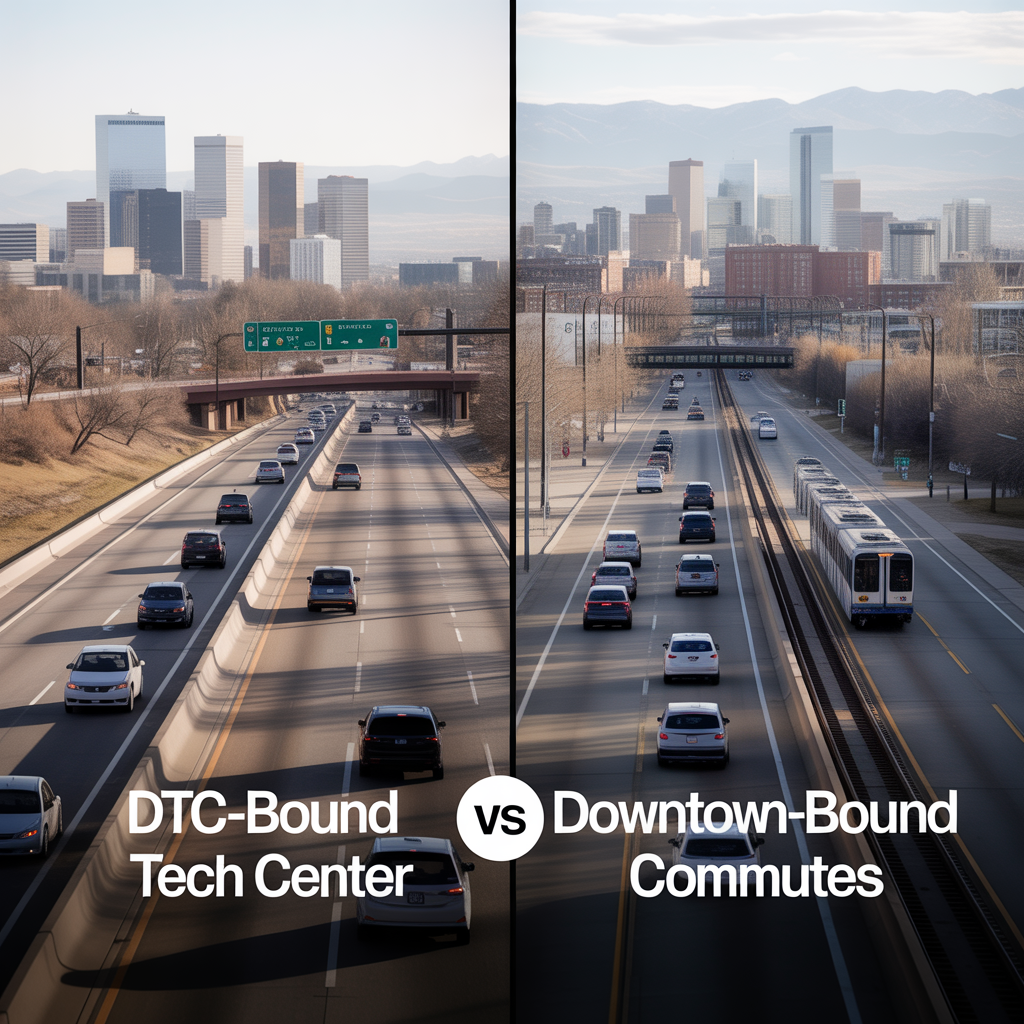
This is part of Littleton Lifestyle Hub → [Littleton Lifestyle Hub] & Littleton Real Estate Guide → [Littleton Real Estate Guide]
Written by: Chad Cabalka
The difference between a DTC-bound commute and a downtown-bound commute from Littleton isn’t just “a different exit” — it’s a totally different daily rhythm, cost structure, and stress level, and once buyers understand that, it changes how they pick a neighborhood and how they experience Littleton long‑term. After 15+ years in Denver-area real estate, I’ve seen a lot of families move into Littleton thinking “I’m close to downtown,” then realize that rushing into downtown every day is a lot more expensive and stressful than they expected. Here’s how a DTC-bound commute and a downtown-bound commute actually play out in real life, how they compare on time and cost, and how to decide which one makes sense for your family.
Typical DTC‑Bound Commute from Littleton
Most DTC‑bound jobs come from the southeast Littleton, Highlands Ranch, and Ken Caryl areas, and they’re usually for people working in healthcare, biotech, tech, finance, and related corporate offices around the I‑25/CO‑470 corridor.
Common neighborhoods
- Southeast Littleton (80126–80127)
- Highlands Ranch (80129–80130)
- Ken Caryl (80127–80130)
- The 80120–80124 areas near Santa Fe and C‑470
Primary routes
- I‑25 N / CO‑470 E to I‑25 N / DTC (Plum Creek, Lincoln, University)
- Santa Fe Dr N to I‑25 N / CO‑470 E
- Perry Park Rd / Ridgeline Blvd / Ken Caryl Ave to CO‑470 E / I‑25 N
Typical drive times (without traffic)
- 10–15 miles, 20–25 minutes
- During rush hour, 30–45+ minutes, especially if starting later in the morning or leaving at 5–6 p.m.
Reality checks
- DTC traffic is “predictable chaos” — slower, but fewer full gridlocks compared to downtown.
- Parking is usually structured (parking garages or lots) with a monthly fee, often subsidized or shared with the employer.
- Light rail is viable for some DTC destinations, but it often requires a bus transfer or a short Uber/Lyft ride from the station to the office, especially if working in the newer office parks.
Daily life impact
- Commute feels more like a “zone of comfort” for many families: it’s the same stretch of highway, same exit, same parking lot, which people can mentally tune into and tune out.
- Easier to run errands before or after work at problems like stores, pharmacies, or restaurants in the DTC corridor without adding much time to the travel day.
- Less psychological stress than downtown because there’s less stop‑and‑go, fewer one‑way streets, and more parking availability.
Biggest pros and cons
- Pros: reliable timing, good infrastructure, lots of housing options nearby, and often a shorter actual drive than downtown.
- Cons: can feel like a “corporate commute,” and it doesn’t offer the walkable downtown lifestyle if you want to live closer in.
Typical Downtown‑Bound Commute from Littleton
A downtown-bound commute from Littleton is usually for people working in downtown Denver, civic roles, law, finance, hospitality, or jobs that are deeply tied to downtown offices, Union Station, or the 16th Street Mall area.
Common neighborhoods
- Littleton core (80120–80126) near downtown Littleton, the South Platte River Trail, and the light rail station
- Neighborhoods with easy access to Santa Fe / I‑25 (80124–80125)
- Homes near the South Platte Park trail system that connect toward downtown
Primary routes
- I‑25 N directly into downtown (Santa Fe Dr, Broadway, or domestic access)
- Via Santa Fe Dr to I‑25 N
- Via the South Platte River Trail and light rail from Littleton / Downtown Station to downtown
Typical drive times (without traffic)
- 10–13 miles, 15–20 minutes
- During rush hour, 30–50 minutes, and it can easily stretch to 60+ minutes in bad weather, accidents, or events in downtown.
Reality checks
- Downtown traffic is stop‑and‑go, with lots of merging, lights, and congestion, especially on I‑25 approaching downtown and on surface streets like Colfax, Speer, and 16th Street.
- Parking is a major cost and headache: downtown garages often run $150–$300+/month, and street parking is limited, heavily enforced, and not guaranteed.
- Light rail is a solid option for many downtown jobs, especially if the office is near Union Station, 18th & California, or the 16th Street corridor, but it requires being on a schedule, dealing with transfers, and walking to and from the station.
Daily life impact
- The commute feels more “urban” and intense: more traffic stress, more unpredictability, and more need to leave early or work late to avoid traffic.
- Living in Littleton gives a suburban feel (yard, schools, parks) while still offering a commute to a major job center, which is a big draw for many families.
- The trade‑off is the “disconnect” between a quiet neighborhood and a high‑density downtown workplace, which some people love and others find exhausting over time.
Biggest pros and cons
- Pros: access to a wider range of jobs, networking, downtown events, restaurants, and cultural amenities; light rail can be a big lifesaver for avoiding traffic and parking.
- Cons: higher stress, less predictability, and a big chunk of the budget often eaten by parking and car wear from downtown driving.
How They Compare: Time, Cost, and Stress
From a real estate and lifestyle perspective, it helps families compare the two options side by side on the three things that matter most: time, money, and daily stress.
Time
- DTC‑bound: Shorter drive overall, more consistent travel times, and fewer “disaster days” when traffic grinds to a halt.
- Downtown‑bound: Can be just as short on paper, but it’s less predictable, and delays are more common, especially around events, construction, or bad weather.
Cost
- DTC‑bound: Car wear, gas, and a monthly parking pass or garage fee, but it’s usually a more manageable total cost.
- Downtown‑bound: Higher gas cost, higher wear from stop‑and‑go traffic, and a much steeper parking cost, which can add up to thousands per year, not just hundreds.
Stress and comfort
- DTC‑bound: Feels more like a “corporate suburb” commute — it’s routine, but not as exciting, and it’s very focused on getting from house to office and back.
- Downtown‑bound: More exciting access to downtown, but it’s a lot more mentally taxing if you’re dealing with parking, traffic, and the energy of downtown every day.
A lot of families in Littleton eventually land on a hybrid pattern: they live in Littleton for the schools, parks, and lifestyle, and they tolerate the commute to downtown, but they look for neighborhoods that are on the light rail line or have a reliable route to I‑25 so they can avoid the worst of the stress, especially if they’re still working in an office.
How This Should Shape Your Home Choice
After 15+ years in Denver real estate, what I see is that the right commute question is less about “Can I get there?” and more about “What does it feel like every day, and how much of my life and budget does it take?”
If you’re DTC‑bound, look for:
- Neighborhoods with easy access to I‑25 and CO‑470, especially off Santa Fe, Perry Park, or Ken Caryl.
- Homes that minimize “local traffic” before you even get on the highway (so you’re not stuck on domestic streets every morning).
- Good light rail access if you want to be able to leave the car at home on some days, especially if traffic is a real issue for you.
If you’re downtown‑bound, look for:
- Neighborhoods near the Littleton / Downtown light rail station so you can realistically use transit instead of driving into downtown.
- A very straightforward route to downtown that avoids the worst local traffic bottlenecks before you even hit I‑25.
- A neighborhood that feels like a true “home base” where you can really unwind, because the commute will be more draining over the long term.
If you’re choosing a home in Littleton or south Jeffco and want to know which neighborhoods are actually structured for a DTC‑bound commute versus a downtown‑bound commute, which ones line up with light rail, and how the real drive times and parking costs work for your family, I can help you build a simple, no‑jargon plan that matches your actual commute pattern, not just a listing description.
Get the full Denver Market Insights → [Market Insights]


Littleton’s Ken Caryl for Lockheed Relocations
This is part of Lockheed Martin Relocation → [Lockheed Martin Relocation Hub] & the larger Denver Relocation Hub → [Denver Relocation Hub] Written by: Chad Cabalka Ken Caryl is one of the best-kept “family first” relocation options for Lockheed Martin employees who want foothills scenery, strong neighborhood appeal, and a real suburban lifestyle that still feels connected…

Centennial & Parker for Lockheed Relocations
This is part of Lockheed Martin Relocation → [Lockheed Martin Relocation Hub] & the larger Denver Relocation Hub → [Denver Relocation Hub] Written by: Chad Cabalka Centennial and Parker are two of the smartest suburban choices for Lockheed Martin employees relocating with families because they give you a strong balance of commute flexibility, good neighborhood variety, and…

Highlands Ranch for Family-Friendly Lockheed Relocations
This is part of Lockheed Martin Relocation → [Lockheed Martin Relocation Hub] & the larger Denver Relocation Hub → [Denver Relocation Hub] Written by: Chad Cabalka Highlands Ranch is one of the strongest choices for Lockheed Martin employees relocating with families because it delivers exactly what most parents want after a big move: stable neighborhoods, strong community…