


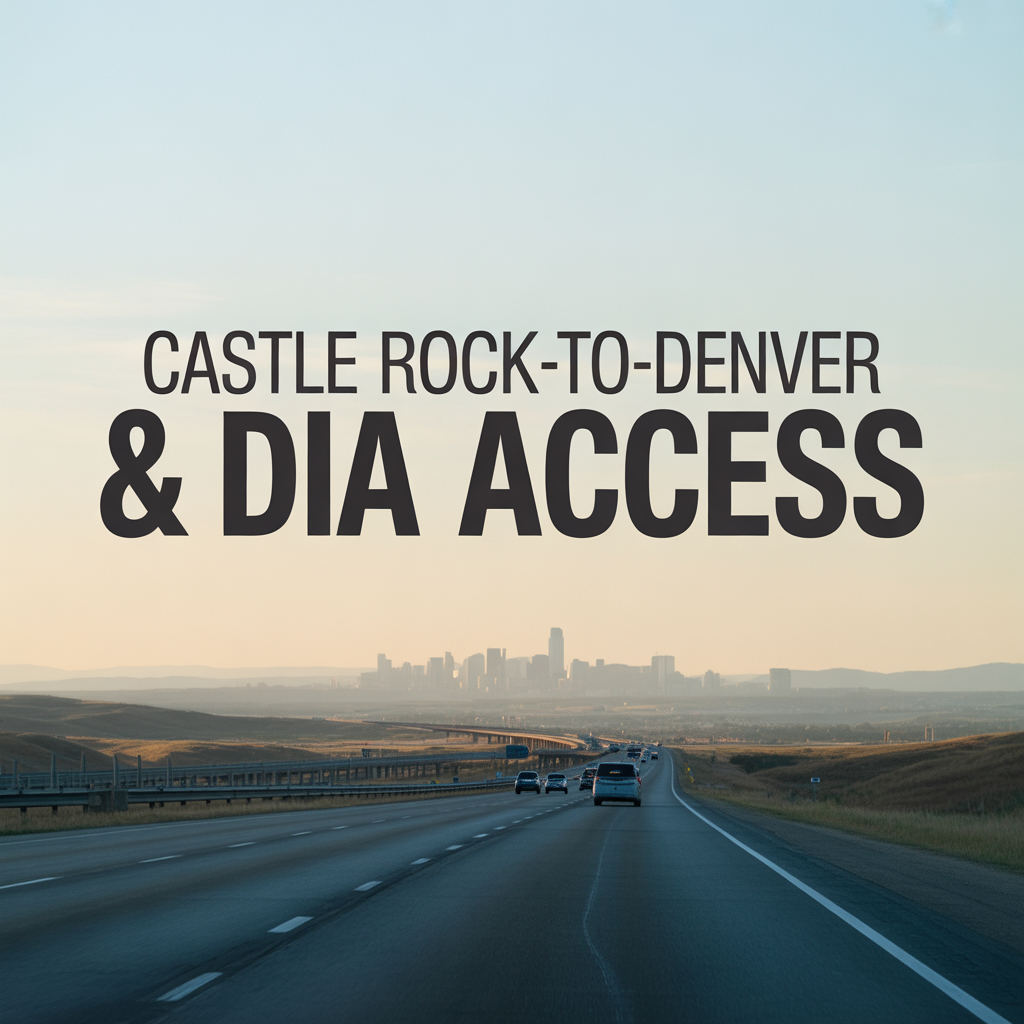
This is part of Castle Rock Lifestyle Guide → [Castle Rock Lifestyle Hub] & Castle Rock Real Estate Guide → [Castle Rock Real Estate Guide]
Written by: Chad Cabalka
Castle Rock sits in a sweet spot: close enough to Denver and DIA to be workable, far enough that you feel like you’ve stepped out of the city at the end of the day. How you access each one depends a lot on whether you’re prioritizing speed, predictability, or stress reduction.
Castle Rock-to-Denver: Core Options
By car, Castle Rock is roughly 28–30 road miles from central Denver or Union Station, and in ideal conditions that translates to about 32–35 minutes of drive time. In reality, most locals mentally budget closer to 40 minutes to downtown on a typical non‑peak run and up to an hour during heavier rush windows.
Key points:
- Direct drive:
- Drive + rail from RidgeGate:
- Many Castle Rock residents drive north to RidgeGate Parkway Station, then take light rail into Denver.
- The tram from RidgeGate to 10th & Osage or Union Station takes about 40–49 minutes and runs roughly every 20 minutes, with a typical adult fare around 3 dollars.
- With the initial drive and transfer, you’re usually looking at 50–70 minutes door‑to‑door, but you trade driving stress and downtown parking for a predictable train ride.
- Drive + bus from Sky Ridge / Pinery PnR:
- Another option is to drive to a park‑and‑ride like Sky Ridge or Pinery and take an express bus to Civic Center or Union Station.
- These buses take about 49–55 minutes from the PnR into downtown, with adult fares typically in the 3–7 dollar range, depending on the service.
- Total Castle Rock‑to‑downtown time ends up similar to the train combo, but you’re on a coach‑style bus rather than light rail.
For many professionals, the drive is still the default, but rail or bus become appealing if you work right downtown, dislike city parking, or want to use commute time to work or decompress instead of white‑knuckling I‑25.
Castle Rock-to-DIA: Typical Patterns
There isn’t a single direct rail line from Castle Rock to DIA, so most people use a combination of driving and existing regional transit.
The most common patterns:
- Drive all the way to DIA:
- Castle Rock to DIA is roughly 55–60 miles depending on your exact route, usually 55–70 minutes in light to moderate traffic.
- Most people run I‑25 north, then connect via E‑470, Peña Boulevard, or the I‑225/I‑70 combo.
- The upside is full control over timing and luggage; the downside is tolls if you use E‑470 and the stress of airport parking.
- Drive to a rail or bus hub, then go to DIA:
- One option is to drive to a light‑rail station on the southeast or A‑Line side (for example, RidgeGate Parkway, then up to Union Station by rail, then the A‑Line to DIA).
- Another option is to drive to a SkyRide/Bus hub or coach service departure point in the south metro, then ride directly to the airport.
- Door‑to‑door, those combinations often land in the 75–100 minute range, but you eliminate airport parking and get a more relaxed ride for most of the distance.
Because there’s no single, direct Castle Rock–DIA transit line, your best choice depends on how often you fly and what you value: time, cost, or stress reduction.
How This Feels Day to Day
Over time, the difference between Castle Rock‑to‑Denver and Castle Rock‑to‑DIA access isn’t just minutes; it’s how often you’re doing each trip and how much margin you need:
- If you commute to Denver daily:
- Driving is usually the default, especially if you work in the DTC or just south of downtown, and most people budget a 40–60 minute band depending on time and weather.
- Combining a short drive with light rail or bus becomes more attractive if you’re deep in downtown and want to avoid parking or if your employer is near a rail stop.
- If you fly a few times a year:
- Driving directly to DIA is often simplest; the one‑hour run is manageable occasionally, and long‑term parking or drop‑offs are straightforward.
- If you fly frequently, building a routine around a rail/bus hub or an airport shuttle service can reclaim a lot of mental energy, even if it adds a bit of time.
- If you’re hybrid or remote:
- The occasional Denver run (once or twice a week) and periodic DIA trip feel very doable from most parts of Castle Rock, especially if you can time them outside the worst I‑25 windows.
- In that scenario, the quality of life you get in Castle Rock tends to outweigh the extra planning you do for big city or airport days.
When I’m helping people think this through, I always come back to three questions:
How often are you going north? At what times? And how much “buffer” are you willing to build into every trip? Answer those honestly, and it becomes clear whether Castle Rock’s mix of direct driving and park‑and‑ride options feels like a comfortable part of your lifestyle or something you’ll want to design around very intentionally.
Get the full Denver Market Insights → [Market Insights]


Littleton’s Ken Caryl for Lockheed Relocations
This is part of Lockheed Martin Relocation → [Lockheed Martin Relocation Hub] & the larger Denver Relocation Hub → [Denver Relocation Hub] Written by: Chad Cabalka Ken Caryl is one of the best-kept “family first” relocation options for Lockheed Martin employees who want foothills scenery, strong neighborhood appeal, and a real suburban lifestyle that still feels connected…

Centennial & Parker for Lockheed Relocations
This is part of Lockheed Martin Relocation → [Lockheed Martin Relocation Hub] & the larger Denver Relocation Hub → [Denver Relocation Hub] Written by: Chad Cabalka Centennial and Parker are two of the smartest suburban choices for Lockheed Martin employees relocating with families because they give you a strong balance of commute flexibility, good neighborhood variety, and…

Highlands Ranch for Family-Friendly Lockheed Relocations
This is part of Lockheed Martin Relocation → [Lockheed Martin Relocation Hub] & the larger Denver Relocation Hub → [Denver Relocation Hub] Written by: Chad Cabalka Highlands Ranch is one of the strongest choices for Lockheed Martin employees relocating with families because it delivers exactly what most parents want after a big move: stable neighborhoods, strong community…