


This is part of Castle Rock Lifestyle Guide → [Castle Rock Lifestyle Hub] & Castle Rock Real Estate Guide → [Castle Rock Real Estate Guide]
Written by: Chad Cabalka
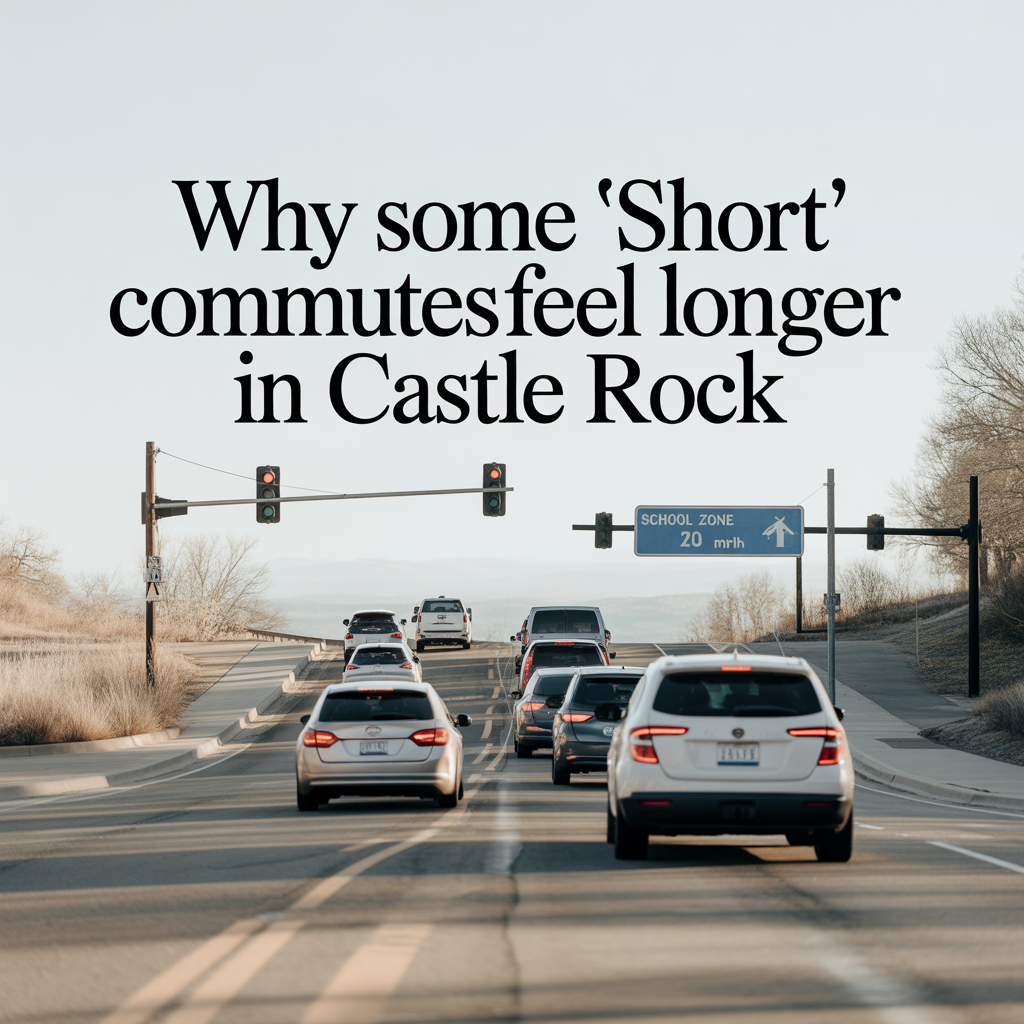
A “short” commute in Castle Rock can feel long for three big reasons: variability, friction, and mental load. Even if the miles and Google-estimated time look reasonable, the way the drive behaves day to day is what you actually live with.
Distance vs experience
On paper, Castle Rock’s commutes look fine. The average one-way commute here is about 29 minutes, only a few minutes above the U.S. average. You can technically get from Castle Rock to the Denver Tech Center or downtown Denver in roughly 30–45 minutes in light traffic, and to either Denver or Colorado Springs in about 45 minutes depending on where you’re headed.
But “average” hides the spread. Residents report that a run to the DTC might be 25–35 minutes most days, while a trip all the way to downtown can swing from 40 minutes to 90 depending on time of day, weather, and incidents. So what looks short on a map turns into “anything from pretty quick to pretty rough” in real life.
Two rush hours in one
If you work in central Denver, your northbound morning drive from Castle Rock hits two separate congestion zones:
- The DTC stretch (RidgeGate to around I‑225), where south‑metro commuters merge and slow.
- The inner‑city zone approaching downtown, where older freeway geometry and more ramps create another wave of braking and lane changing.
Locals describe it as going through “two rush hours” in one drive: once when you join the big flow near the Tech Center, and again as you enter the city. Even if your total mileage isn’t huge, spending most of it in high-density, stop‑and‑go traffic makes the commute feel longer than the number on paper.
Variability and “bad day” risk
Short commutes feel longer when the worst‑case scenario happens often enough that you have to plan around it.
Castle Rock sits between Denver and Colorado Springs on the only main north–south freeway in that corridor, so:
- Any crash, lane closure, or weather issue between Monument and the south metro can affect your drive.
- There are stretches of I‑25 with limited alternate routes, so if you don’t bail out early (for example, onto Highway 105 toward the Springs), you’re stuck riding it out.
Residents routinely report ranges like “25 minutes on a good day, 40–90 minutes on a bad one” for downtown Denver. That spread forces you to leave earlier “just in case,” which means you’re budgeting for the bad days even when conditions are perfect.
Weather and construction friction
Even when the distance is short, two chronic factors add friction to Castle Rock commutes:
- Weather
Storms rolling through the Palmer Divide can turn a normal run into a slow, high‑focus drive; locals note that if a storm is building and you work in Denver or the DTC, you often try to leave early, because conditions can deteriorate over a few hours to the point where closures or big backups happen. - Construction
Long-term work on I‑25 and frontage roads between Castle Rock and Monument, and periodic projects near Castle Pines and the south metro, add lane shifts, narrowed shoulders, and lower speed limits. Even if posted times don’t change much, constant lane changes and heavy truck traffic make the drive feel more tiring.
Put together, that friction means a “29-minute” commute is rarely a 29‑minute, cruise‑control, low‑stress ride.
Mental load and lifestyle fit
The last layer is psychological. A local YouTube creator who commuted daily from downtown Denver to Castle Rock described it this way: even when it was “consistently around 37–41 minutes,” doing that run every day was still a grind. Compared to big‑city horror stories, 40 minutes sounds fine; compared to the lived reality of doing it in both directions, five days a week, through two rush zones, it starts to feel big.
Residents on local forums echo the same pattern:
- Commuting only to the DTC from Castle Rock is “not bad at all” at 25–35 minutes most days.
- Doing downtown Denver daily from Castle Rock is something people “wouldn’t wish on anyone” long‑term, because of the double‑rush‑hour effect and bad‑day spikes.
So a “short” commute feels long when:
- The time swings a lot from day to day.
- You’re spending much of it in high‑concentration driving rather than steady flow.
- You have to plan your whole schedule around worst‑case delays, storms, and construction.
- You’re doing it often enough that the mental load never really fades into the background.
When I’m talking with Castle Rock buyers, that’s exactly why I push them to think beyond the map: not just “How many miles is it?” but “How many days a week? At what times? Through which segments? And how will that feel in year three, not month three?”
Get the full Denver Market Insights → [Market Insights]



Littleton’s Ken Caryl for Lockheed Relocations
This is part of Lockheed Martin Relocation → [Lockheed Martin Relocation Hub] & the larger Denver Relocation Hub → [Denver Relocation Hub] Written by: Chad Cabalka Ken Caryl is one of the best-kept “family first” relocation options for Lockheed Martin employees who want foothills scenery, strong neighborhood appeal, and a real suburban lifestyle that still feels connected…


Centennial & Parker for Lockheed Relocations
This is part of Lockheed Martin Relocation → [Lockheed Martin Relocation Hub] & the larger Denver Relocation Hub → [Denver Relocation Hub] Written by: Chad Cabalka Centennial and Parker are two of the smartest suburban choices for Lockheed Martin employees relocating with families because they give you a strong balance of commute flexibility, good neighborhood variety, and…

Highlands Ranch for Family-Friendly Lockheed Relocations
This is part of Lockheed Martin Relocation → [Lockheed Martin Relocation Hub] & the larger Denver Relocation Hub → [Denver Relocation Hub] Written by: Chad Cabalka Highlands Ranch is one of the strongest choices for Lockheed Martin employees relocating with families because it delivers exactly what most parents want after a big move: stable neighborhoods, strong community…