


This is part of Highlands Ranch Lifestyle Guide → [Highlands Ranch Lifestyle Hub] & Highlands Ranch Real Estate Guide → [Highlands Ranch Real Estate Guide]
Written by: Chad Cabalka
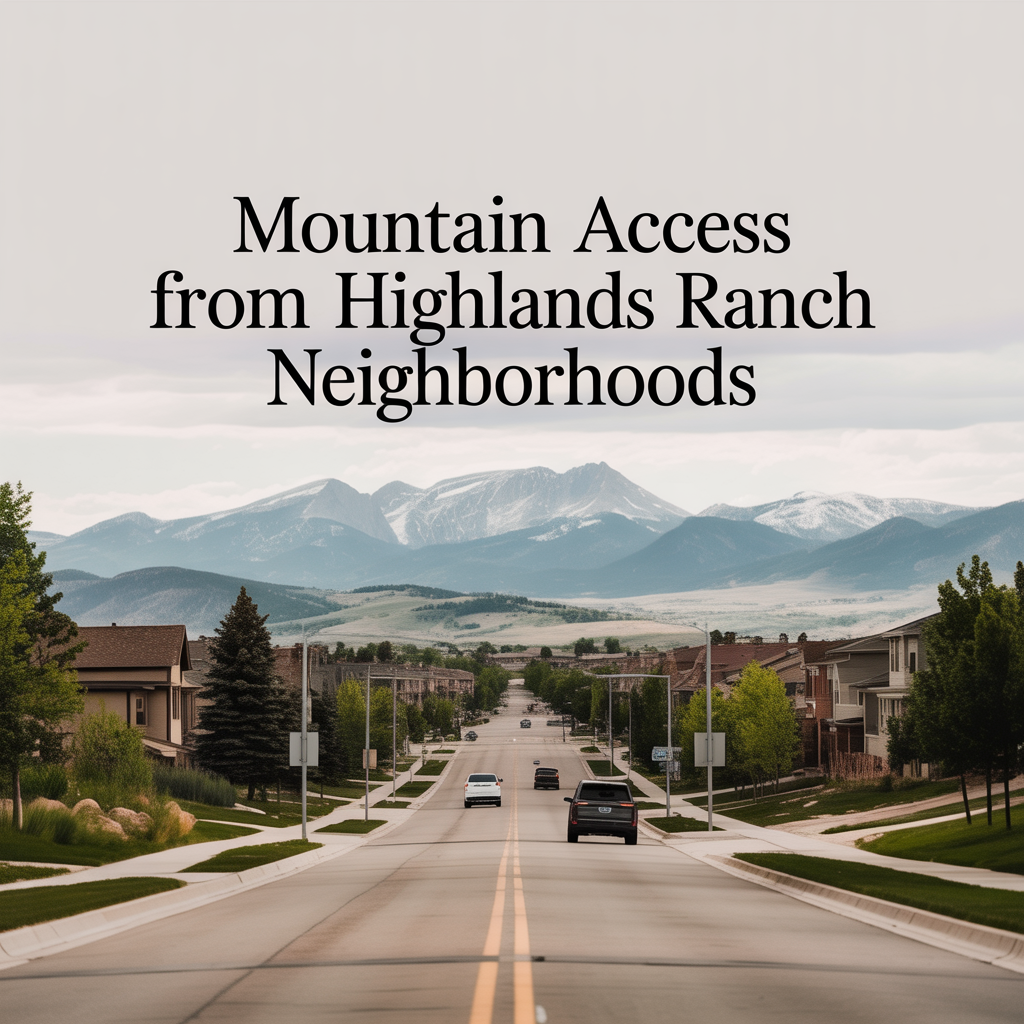
For families in Highlands Ranch, having a good shot at the mountains matters more than people often say aloud. It’s not just about ski weekends; it’s about the mental reset of a long drive into the foothills, a fall hike with peak views, or a casual weekend where the whole family is outside without the city noise.
As a longtime resident and someone who’s advised families in this area for decades, I’ve learned that mountain access is one of those quiet, long-term quality-of-life factors. It doesn’t override schools, safety, or the daily commute, but it does shape which neighborhoods feel like a true fit, especially for families who expect to spend a significant part of their lives in the foothills and mountains.
How Highlands Ranch Connects to the Mountains
Highlands Ranch is not a mountain town, but it’s positioned in a useful corridor between the south metro and the Front Range foothills. That means:
- The main access to the mountains runs northwest along I-25 and I-70, with a few side routes (US 285, CO 105, and 120/285) serving different parts of the mountain range and canyon areas.
- Most Highlands Ranch mountain trips involve a drive of 45–60 minutes to the canyon or trailhead, plus whatever time it takes to climb up to the destination.
The neighborhood you’re in changes how that access feels on a day-to-day basis.
- On the west side of town (South Ridge, Westridge, BackCountry), you’re much closer to the 470/University corridor, so you can get on I-25 or I-70 quickly and with fewer stoplights.
- On the east and central sides (Eastridge, Indigo Hill, Falcon Hills, and areas near the Village Center), the route is more surface-heavy, which can add congestion and a few extra minutes, especially when school traffic is thick.
For many families, that difference isn’t about whether they can get to the mountains; it’s about how much of a “negotiation” the commute feels like. The west-side neighborhoods feel more like a “turn onto the highway and go;” the east-side neighborhoods feel more like a “weave through the neighborhood, then hit the highway.”
Weekday and Weekend Patterns
Most families in Highlands Ranch use the mountains and foothills on a mix of short trips, weekend getaways, and longer ski outings. That changes how access feels depending on the season.
Weekday use (after school, short hikes, training)
For families with teens on ski teams, soccer travel, or mountain bike teams, “mountain access” includes weekday trips to foothills practices and games:
- Fields and facilities around the foothills (Red Rocks, City of Westminster, Lakewood, and some of the southern foothills parks) are a solid 35–50 minutes away.
- Route choice matters: the 470/I-25 route is usually faster and more predictable, but it can still be slow during rush hour, so families often build in extra time or leave right after school.
For families in the western ridge neighborhoods, that kind of trip feels more like a normal commute, because it’s mostly on freeway and connector roads. For families in the eastern neighborhoods, it feels more like a dedicated “out-of-town” trip, but it’s still manageable with planning.
Weekend and holiday patterns
In the winter, the rhythms shift dramatically:
- Families trying to “beat the morning rush” out of the metro tend to leave between 6:30–8:30 a.m. to get to the major I-70 and 285 resorts.
- The 470/I-25 connection is critical for that: it’s the main route to I-70, so being close to the ramps makes a big difference in how early and how stressed the morning feels.
- On big holiday weekends, the 470/I-25 corridor is simply more predictable than trying to use a longer, more stoplight-dependent route from the far east of the community.
In the non-ski seasons (spring, summer, fall), families tend to spread their mountain trips more evenly, but:
- Popular weekend destinations (Red Rocks, the mountain foothills, Chatfield, and some of the more popular mountain towns and parks) can still feel like a mini-rush, especially on long weekends.
- Families in the west-side neighborhoods often feel like they have a slight edge, not because they’re closer to the trailhead, but because they can more easily jump on the 470/I-25 shuttle and reach the foothills and canyon more reliably.
How Neighborhoods Match Different Mountain Lifestyles
After years of matching families with homes, I’ve seen that different parts of Highlands Ranch support different kinds of mountain lifestyles.
Families with a strong ski/snowboard culture
These families tend to:
- Park in the 470 corridor neighborhoods (South Ridge, Westridge, BackCountry, and the western parts of Firelight and Wildcat Reserves) so they can get on the 470/University/I-25 route quickly and efficiently.
- Value a garage that can handle skis, boards, boots, and bags, and a home that’s oriented toward the highway for easy departures.
- Care less about a super-central rec center spot and more about a neighborhood that doesn’t add 15–20 minutes of stoplights to the already-long drive to the resorts.
For them, being “close to the mountain route” is a big piece of the equation, not a nice-to-have.
Families with a mixed recreation pattern (hiking, trail running, casual mountain trips)
These families tend to:
- Split their time between the mountains, the rec center, and the neighborhood parks and trails.
- Value a neighborhood that is well-connected to the East/West Trail and the BackCountry Wilderness, so they can do a long, quality trail run, hike, or bike ride very close to home.
- Are more comfortable with a slightly longer drive to the 470 entrance, as long as the neighborhood supports a balanced, active lifestyle.
For them, “mountain access” is more about having a fulfilling outdoor life in the community (trails, rec centers, parks) than about shaving 10 minutes off the ski trip.
Families where the mountains are a secondary priority
These families tend to:
- Work locally, travel infrequently, and spend most of their weekends on errands, rec center time, and local restaurants and events.
- Are completely fine with a 50–60 minute drive to the mountains, as long as it’s not a daily grind.
- Often prioritize schools, rec center access, and neighborhood friendliness over rapid highway access, and they’re comfortable with a slightly more surface-driven route.
For them, mountain access is a “nice bonus,” not a deciding factor, and they tend to stay happy in the central and eastern neighborhoods, where the focus is on the community and schools.
Local “Mountain-Type” Outdoor Life in Highlands Ranch
One of the quiet strengths of Highlands Ranch is that it supports a very mountain-adjacent lifestyle, even if it’s not in the mountains proper.
- The BackCountry Wilderness Area and the East/West Regional Trail give many families a daily or weekly experience that feels like a foothills escape: single-track trails, ridgeline views, and the ability to see the Front Range peaks on clear days.
- The Wildcat Ridge and Bluffs Regional trail systems give more casual hikers and families with tweens and teens a solid, walkable option that still feels like a true “outdoor” experience.
- The rec centers, pools, and parks are designed to support a very active, outdoor-oriented lifestyle, which is the kind of rhythm that translates well to mountain living on weekends.
For many families, this local “mountain-flavored” outdoor life is what makes the community feel like a good fit, even if the neighborhood isn’t right on the 470 ramp. It’s not about being in the canyon; it’s about living in a community where the rhythm of outdoor activity is already built in.
How Mountain Access Shapes Home Choices and Long-Term Fit
The neighborhoods where families tend to stay the longest are often the ones where the mountain access lines up with their actual rhythm:
- Families with a major ski and mountain commitment often do best in the 470-adjacent neighborhoods, where the route to the lifts is straightforward and predictable.
- Families with a more mixed, community-focused lifestyle often do best in the central and east-side neighborhoods, where the neighborhood, schools, and rec centers are the true anchors.
The “best” access isn’t about which neighborhood is closest to the interstate; it’s about which neighborhood matches the kind of mountain life the family actually expects to live.
A Local Conversation About Your Mountain Lifestyle
If you’re thinking about how mountain access actually fits into your family’s life in Highlands Ranch, I’d be glad to talk through the different neighborhoods and micro-areas to show how the routes, drive times, and neighborhood dynamics line up with your work, school, and long-term plans.
The right home isn’t just about square footage and price; it’s about finding a place where the mountain access feels realistic, not exhausting, and where the neighborhood supports a balanced, outdoor-friendly life for years to come.
Reach out when you’re ready to talk about more than just the checklist — about the kind of neighborhood and lifestyle that will truly support your family in Highlands Ranch.
Get the full Denver Market Insights → [Market Insights]



Littleton’s Ken Caryl for Lockheed Relocations
This is part of Lockheed Martin Relocation → [Lockheed Martin Relocation Hub] & the larger Denver Relocation Hub → [Denver Relocation Hub] Written by: Chad Cabalka Ken Caryl is one of the best-kept “family first” relocation options for Lockheed Martin employees who want foothills scenery, strong neighborhood appeal, and a real suburban lifestyle that still feels connected…


Centennial & Parker for Lockheed Relocations
This is part of Lockheed Martin Relocation → [Lockheed Martin Relocation Hub] & the larger Denver Relocation Hub → [Denver Relocation Hub] Written by: Chad Cabalka Centennial and Parker are two of the smartest suburban choices for Lockheed Martin employees relocating with families because they give you a strong balance of commute flexibility, good neighborhood variety, and…

Highlands Ranch for Family-Friendly Lockheed Relocations
This is part of Lockheed Martin Relocation → [Lockheed Martin Relocation Hub] & the larger Denver Relocation Hub → [Denver Relocation Hub] Written by: Chad Cabalka Highlands Ranch is one of the strongest choices for Lockheed Martin employees relocating with families because it delivers exactly what most parents want after a big move: stable neighborhoods, strong community…