


This is part of Centennial Lifestyle Guide → [Centennial Lifestyle Hub] & Centennial Real Estate Guide → [Centennial Real Estate Guide]
Written by: Chad Cabalka
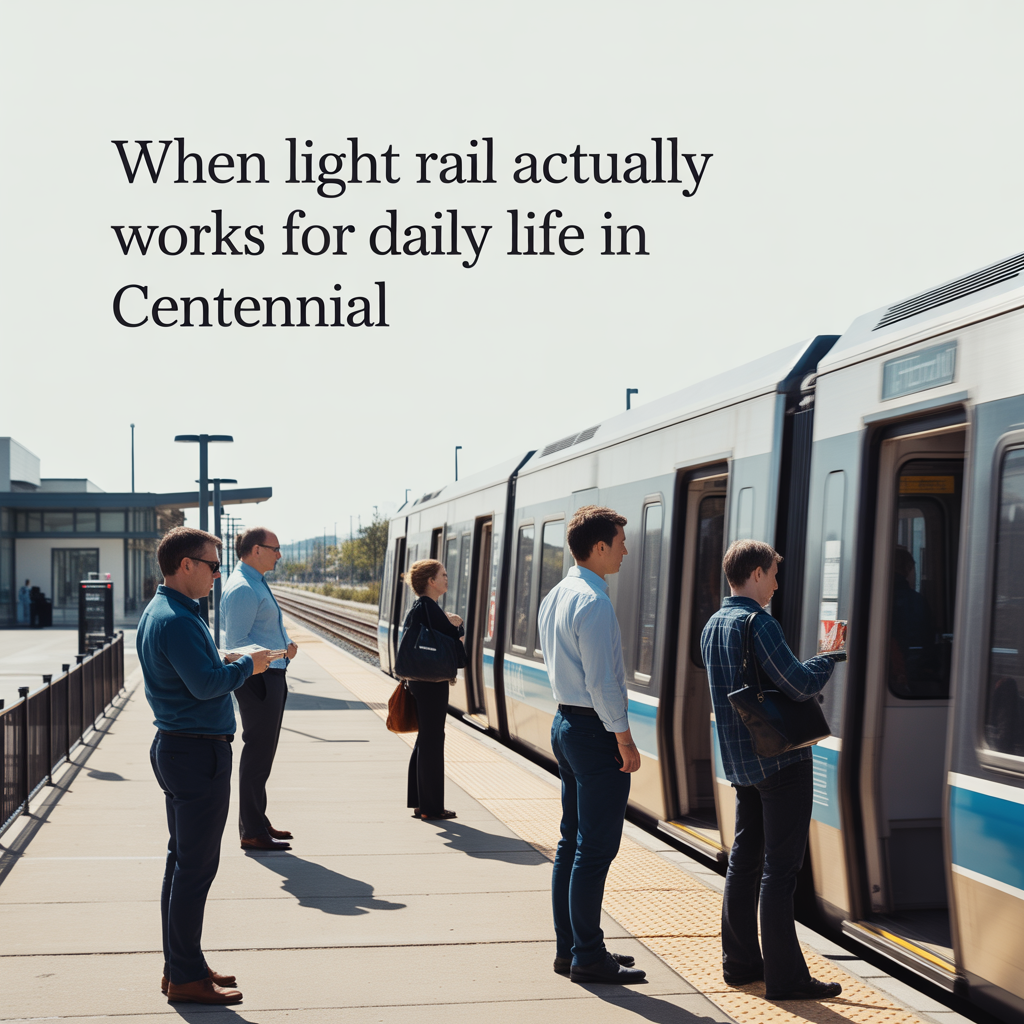
Light rail can work very well for some Centennial residents, but only in specific situations where your home, station, and destination line up cleanly. It’s not a one‑size‑fits‑all solution; it’s a tool that works when the geometry of your life matches the rail map.
Where Light Rail Actually Reaches Centennial
Centennial itself doesn’t have a station with “Centennial” in the name, but it sits right on top of the southeast rail corridor, and multiple nearby stations function as “home base” for residents. The stations that really matter for daily life here are:
- Dry Creek (in Centennial, just west of I‑25)
- County Line and Lincoln (in Lone Tree, but essentially south‑Centennial’s stations)
- Arapahoe at Village Center, Orchard, and Belleview (just over the line in Greenwood Village/Denver but heavily used by Centennial commuters)
These stations sit on the E, F, and R lines, which run the southeast corridor along I‑25 and I‑225, connecting you to the DTC, downtown Denver, central Aurora, and (via transfers) the airport. From a pure map standpoint, light rail works best if:
- You live within a short drive, bike, or reasonably safe walk of one of those stations.
- Your regular destination is somewhere on the same corridor (DTC) or directly reachable with one train into downtown.
If neither of those is true, light rail is more of a “sometimes” option than a daily one.
When Light Rail Beats Driving for Centennial Residents
There are a few clear patterns where rail genuinely improves daily life for people in Centennial:
1. Downtown‑bound nine‑to‑five
If you regularly work near Union Station, the central business district, or the Civic Center side of downtown, light rail can turn a volatile 30–50 minute drive on I‑25 into a predictable train ride. In that case, rail works well when:
- You can park at Dry Creek, County Line, Lincoln, Orchard, or Arapahoe at Village Center without a miserable last‑mile slog.
- Your work hours line up with peak train frequencies, so you’re not waiting long on either end.
- You value predictability and the ability to read, work, or decompress instead of managing traffic.
For many south‑metro professionals, the “park, ride downtown, walk to the office” pattern feels longer on paper but lighter emotionally than fighting northbound I‑25 every morning and night.
2. DTC‑adjacent jobs but painful parking
If you work in the heart of the DTC near Belleview, Orchard, or Arapahoe, and your office is within a short walk of those stations, light rail can be competitive with driving in heavier traffic windows. This is especially true if:
- Your building charges for parking or has limited structured parking.
- You’re close enough to walk from home to a station like Dry Creek or can bike in via trail connections.
- You prefer a routine where you don’t move your car all day and can go out for lunch or errands on foot along the DTC grid.
You’ll still use the car plenty for non‑work trips, but rail can de‑stress the A.M./P.M. peak.
3. Occasional downtown or event trips
For Centennial residents who rarely go downtown but hate driving and parking when they do, light rail works beautifully for:
- Sports games and concerts (changing at I‑25/Broadway or going straight in on an E/F line).
- Union Station‑area outings.
- Avoiding late‑night or bad‑weather drives.
In those cases, the calculation isn’t just time; it’s risk, parking cost, and hassle. Parking at a south‑metro station and riding in is often the least stressful way to “visit” Denver from Centennial.
4. Multi‑adult households with only one car
In some Centennial households, one partner drives and the other uses rail when schedules don’t align, or a teen/young adult lives at home and uses light rail to access downtown, DTC jobs, or college campuses. When a family structures around “one primary car plus rail,” the stations at Dry Creek, County Line, Lincoln, and Arapahoe at Village Center become important pressure valves.
When Light Rail Usually Doesn’t Work as a Daily Solution
There are just as many patterns where rail sounds nice in theory but rarely wins in practice for Centennial residents:
1. East‑west or “diagonal” commutes
If your job, campus, or daily destination isn’t near the I‑25/I‑225 spine, light rail often adds transfers and walking that wipe out any benefit. For example, Centennial to jobs in Lakewood, Broomfield, or far‑north Denver is rarely smoother by train than by car; you end up stringing together long rides and transfers.
2. Childcare‑heavy routines
If your day involves dropping kids at multiple schools or daycares, then going to work, then circling back for sports or activities, rail is tough unless everything happens along the same corridor. The moment you’re zig‑zagging across Centennial for drop‑offs, having the car with you often becomes non‑negotiable.
3. Odd shift work or late‑night hours
RTD rail runs 365 days a year, but frequencies thin out, especially early morning and late night. If you start before dawn, finish very late, or have highly irregular hours, you may find service gaps or long headways that make the system unreliable as your primary commute. In that case, light rail becomes an occasional back‑up, not the backbone.
4. “Last‑mile” problems that never go away
If you’re a 15‑minute drive from a station with no practical bike or bus option, and your destination is still a long walk from the other end, the rail trip can easily exceed your door‑to‑door drive time by 20–30 minutes each way. That added time may be worth it once in a while for special events, but most people won’t tolerate it daily.
How to Tell If Light Rail Fits Your Actual Life
Instead of asking, “Does light rail serve Centennial?” it’s better to ask, “Does any station–destination pair match my real schedule?” A practical way to think it through:
- Map your anchors
Put pins on where you live (or might live), where you work, and any regular destinations (school, partner’s office, main client, campus). Then overlay the southeast rail stations: Dry Creek, County Line, Lincoln, Arapahoe at Village Center, Orchard, Belleview, and the downtown terminals. - Estimate door‑to‑door time both ways
Include:- Drive/bike/walk to the station.
- Time to park and reach the platform.
- Train ride itself.
- Walk from the destination station to your actual door.
Then compare that to your realistic drive in normal traffic, not just your best or worst day.
- Test a real weekday
If it looks close on paper, actually do your commute by train once or twice at your real start/finish times. Notice stress level, predictability, and how you feel walking into the office or back home. A slightly longer commute that feels calm and predictable may be worth adopting; a theoretically faster drive that leaves you tense and late half the time may not. - Factor in frequency and backups
Check how often trains actually run at your times and what your Plan B is if you miss one or a run is delayed. If missing a train derails your whole morning, that’s a different risk profile than having another one in 10 minutes.
How This Plays into Neighborhood Choice
For many of my south‑metro clients, light rail is a “tie‑breaker” factor between similar neighborhoods, not the first filter. Where it really tilts the scales is when:
- One neighborhood gives you a 5–7 minute drive or a bikeable route to a station like Dry Creek or Arapahoe at Village Center, and your work is downtown or in core DTC.
- You know you’ll be downtown several days a week for the foreseeable future and want to avoid betting your sanity on I‑25.
- You’re planning for a teen or young adult in the household who will rely on transit for work or school.
In those cases, building light‑rail access into your home search is smart. In other cases, it’s enough to know that rail is there for occasional use, while you let drive times, schools, trails, and daily routine do most of the decision‑making.
If you’d like to walk through how specific Centennial neighborhoods line up with particular stations and your real schedule — hybrid work, travel, kids’ logistics and all — I’m always glad to talk it through. The goal isn’t to force rail into your life, but to see honestly where it can take pressure off your week and where the car will still be king.
Get the full Denver Market Insights → [Market Insights]



Aurora Southlands Living For Aerospace And Defense Families
This is part of Lockheed Martin Relocation → [Lockheed Martin Relocation Hub] & the larger Denver Relocation Hub → [Denver Relocation Hub] Written by: Chad Cabalka Relocating to Denver for Lockheed Martin changes the home search fast, because Waterton Canyon is not the kind of campus you casually “figure out later.” The southwest metro drives the whole…


Best Neighborhoods For Buckley Space Force Base Commuters
This is part of Lockheed Martin Relocation → [Lockheed Martin Relocation Hub] & the larger Denver Relocation Hub → [Denver Relocation Hub] Written by: Chad Cabalka If Buckley Space Force Base is the anchor of your move, the best neighborhoods are usually in east and southeast Aurora, with the strongest practical options around Southlands, Murphy Creek, East…
C-470 Commuting Strategy For South Denver Aerospace Workers
This is part of Lockheed Martin Relocation → [Lockheed Martin Relocation Hub] & the larger Denver Relocation Hub → [Denver Relocation Hub] Written by: Chad Cabalka If you work at Waterton, split time between Waterton and the DTC, or live anywhere in the south metro with a Lockheed Martin paycheck attached to it, C-470 is the corridor…