


This is part of Castle Rock Lifestyle Guide → [Castle Rock Lifestyle Hub] & Castle Rock Real Estate Guide → [Castle Rock Real Estate Guide]
Written by: Chad Cabalka
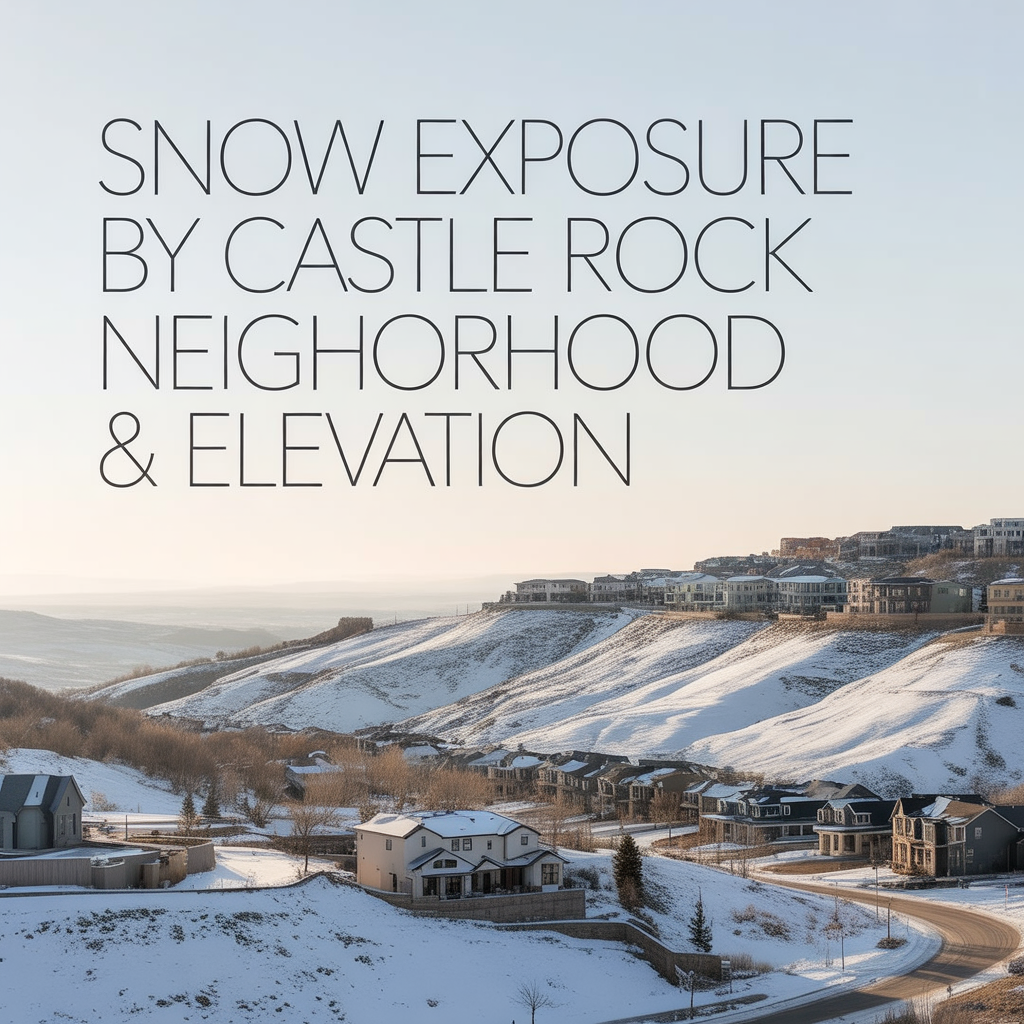
Castle Rock’s winter personality is basically “low sun + ridges + quirky street grids,” which is why one block can feel bone‑dry while the next is still an ice rink. The key pieces are winter sun angle, elevation, slope/aspect, and how the streets are laid into that terrain.
Winter sun at this latitude
Castle Rock sits a bit above 39° N, so in mid‑winter the midday sun only climbs to roughly the high‑20s degrees above the horizon (about 27–30° around noon in December). That low angle means:
- South‑facing walls, driveways, and streets soak up a lot of heat and shed snow quickly on clear days.
- North‑facing sides get very little direct sun; snow there behaves more like a shaded ski run than a city sidewalk.
- Even a small obstruction — house, fence, or slope — can throw long shadows that keep patches icy all day.
With about 78 inches of snow a year on average and 243 sunny days, Castle Rock gets a lot of chances for melt‑and‑refreeze cycles.
Ridges, benches, and valleys
Within just a couple of miles, Castle Rock’s elevation shifts by more than 600 feet. That relief creates three broad “feel” zones in winter:
- Ridge and upper‑bench areas
- More exposure to wind and full sun where streets run east–west or lots face south.
- Snow often blows off exposed pavement but piles into drifts on leeward sides, side yards, and along fences.
- On clear days, these areas can look dry even when lower, sheltered spots still have soft snow.
- Mid‑slope neighborhoods
- Classic Palmer Divide behavior: good accumulations in upslope storms, big differences between sunny and shaded sides of the same block.
- A south‑facing cul‑de‑sac may be nearly clear 24–48 hours after a storm while a north‑facing parallel street stays slick.
- Creek and gulch corridors
- Slightly lower, more sheltered, and prone to inversions.
- Less wind scouring, so snow tends to sit evenly and can linger longer in cold, still patterns despite being lower in elevation.
Street orientation and daily driving reality
Because the winter sun is low and comes from the south, street orientation matters as much as elevation:
- East–west streets
- One sidewalk/parking side is effectively south‑facing; the opposite side is north‑facing.
- South‑side driveways and sidewalks tend to clear themselves between storms, especially on ridges and mid‑slopes.
- North‑side driveways on those same streets become the chronic “icebox” — compacted snow, slow thaw, night refreeze.
- North–south streets
- Pavement often gets cross‑sun but more uniform shade from houses and trees.
- Intersections with cross‑streets can develop polished ice patches where meltwater refreezes overnight.
- Curvilinear ridgeline streets
- Common in newer subdivisions following topography.
- You can move in and out of sun angle every few houses: one curve is bright and dry, the next is tucked under a slope and stays icy.
- On ridges, where wind is higher, plows may expose bare pavement in some segments while shaded curves stay hard‑packed.
From a driver’s perspective, that means your worst winter moments are often short: the shady curve, the north‑facing stop sign on a hill, or the little dip that never quite dries out.
Putting it together by neighborhood “type”
Without naming every subdivision, you can give readers a practical lens:
- Ridge‑edge / high‑bench neighborhoods
- Pros: faster drying on south‑ and west‑facing streets, big winter sun, less slop after storms.
- Cons: more wind and drifting, sharper refreeze when temps drop, and occasional “surprise” slick spots where blown snow collects.
- Mid‑bench, gently rolling grids
- Pros: balanced sun, fewer extreme drifts, storms handled pretty well by plows and sunshine.
- Cons: pronounced difference between north‑ and south‑facing sides of the same street; some sidewalks become chronic ice zones.
- Creek‑adjacent and tucked‑in pockets
- Pros: calmer air, less wind‑driven drift, often easier visibility in storms.
- Cons: more persistent cold in shaded sections, longer‑lasting snow on sidewalks and local streets, more meltwater refreeze in low spots.
How to translate this for homeowners and buyers
For your audience, I’d boil it down into a few “ask this / look for this” habits:
- Stand in the driveway at midday in winter (or use a sun‑angle tool) and see: will this be a sunny or shaded driveway December–February?
- Walk the block and note which intersections and curves are north‑facing or under tall slopes/trees — those are the spots that stay slick.
- Ask neighbors how many days after a typical storm their street and sidewalk are truly dry, not just plowed.
- For ridgeline homes, ask specifically about wind and drifting versus pure snowfall totals.
If you tell me which Castle Rock neighborhoods you’re featuring (for example, The Meadows ridges vs in‑town grid vs east‑side benches), I can help you phrase neighborhood‑specific “this is how winter sun and street layout actually feel on your block” paragraphs to drop into your piece.
Get the full Denver Market Insights → [Market Insights]



Littleton’s Ken Caryl for Lockheed Relocations
This is part of Lockheed Martin Relocation → [Lockheed Martin Relocation Hub] & the larger Denver Relocation Hub → [Denver Relocation Hub] Written by: Chad Cabalka Ken Caryl is one of the best-kept “family first” relocation options for Lockheed Martin employees who want foothills scenery, strong neighborhood appeal, and a real suburban lifestyle that still feels connected…


Centennial & Parker for Lockheed Relocations
This is part of Lockheed Martin Relocation → [Lockheed Martin Relocation Hub] & the larger Denver Relocation Hub → [Denver Relocation Hub] Written by: Chad Cabalka Centennial and Parker are two of the smartest suburban choices for Lockheed Martin employees relocating with families because they give you a strong balance of commute flexibility, good neighborhood variety, and…

Highlands Ranch for Family-Friendly Lockheed Relocations
This is part of Lockheed Martin Relocation → [Lockheed Martin Relocation Hub] & the larger Denver Relocation Hub → [Denver Relocation Hub] Written by: Chad Cabalka Highlands Ranch is one of the strongest choices for Lockheed Martin employees relocating with families because it delivers exactly what most parents want after a big move: stable neighborhoods, strong community…