


This is part of Lakewood Lifestyle Guide → [Lakewood Lifestyle Hub] & Lakewood Real Estate Guide → [Lakewood Real Estate Guide]
Written by: Chad Cabalka
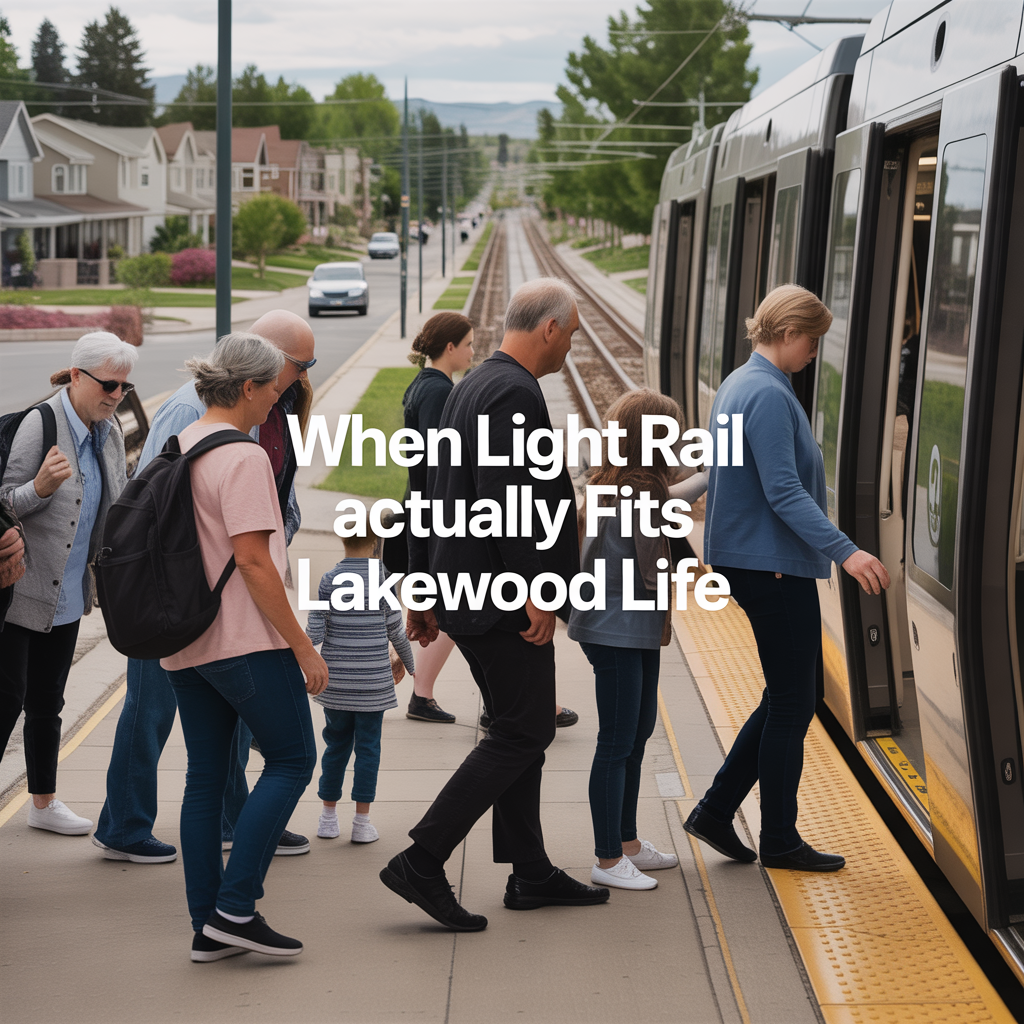
Light rail can be an excellent fit for Lakewood life, but only in specific situations. It works best when your home, your destination, and your daily rhythm all line up with the W Line and its station spacing—not just when there happens to be tracks nearby.
What Light Rail Actually Offers Lakewood
The W Line runs from Jefferson County Government Center–Golden through Red Rocks College, Federal Center, Lakewood–Wadsworth, Oak, Garrison, and on into Denver, ending downtown. In practical terms, that gives Lakewood direct rail access to:
- Downtown Denver (offices, courts, events).
- Union Station connections (commuter rail, airport train, regional buses).
- Jefferson County government and Golden‑area jobs/amenities at the west end.
Trains generally run every 15–30 minutes depending on time of day and day of week, with minor schedule adjustments around 2025–2026 as RTD tweaks the broader rail network. When things are running smoothly, Union Station–to–Lakewood runs in roughly 25 minutes on a direct W Line trip.
So the promise is clear: a predictable, car‑free way to move east–west between Golden, Lakewood, and downtown Denver.
When Light Rail Fits Lakewood Life Well
Light rail starts to make real sense for Lakewood residents when a few boxes are checked:
1. You Live Close to a Station
“Close” usually means:
- A comfortable walk or bike (typically 10–15 minutes or less), or
- A very short, low‑stress drive with reliable parking.
Neighborhoods near Lakewood–Wadsworth, Garrison, Oak, Federal Center, and Red Rocks College stations are the most obvious beneficiaries. If you can leave your driveway, be on a platform in 5–10 minutes, and not worry about hunting for parking or missing every other train, light rail starts to feel like a tool, not a hassle.
2. Your Destination Is Rail‑Friendly
You get the most value if:
- You work near a downtown station, or in walkable reach of a W Line stop in Denver or Golden.
- You’re frequently heading to Union Station for airport trips, events, or regional connections.
- Your regular outings (games, shows, museums, courts) are downtown, where parking is expensive or stressful.
If your job or main activities are in the Tech Center, far east Denver, or a business park not near rail, light rail becomes a partial solution at best; you’re likely to face a “last mile” problem at one end or the other.
3. You Can Work With the Schedule
Light rail works best when your schedule is:
- Somewhat flexible on arrival and departure times, or
- Aligned with standard office hours that match the service frequency.
If you’re constantly arriving at odd hours, leaving late, or juggling childcare pickups that require precise timing, light rail can still work—but you need to be realistic about how delays, missed trains, or service changes might ripple through your day.
When Driving Still Makes More Sense
Even as RTD restores more normal downtown patterns on the D, H, L, and W lines in early 2026, light rail doesn’t automatically beat driving for every Lakewood household.
Light rail often makes less sense when:
- You live far from a station, and every trip would require a 10–15 minute drive plus parking before you even get on the train.
- Your job is in a non‑rail corridor (Tech Center, warehouse/industrial areas, spread‑out suburban campuses).
- You frequently move between multiple stops in a single day (kids’ schools, clients spread across the metro, sports practices).
In those cases, the time and flexibility of a car—especially starting from Lakewood with quick access to 6th Avenue and C‑470—often outweigh pure transit benefits, even if you like the idea of rail on paper.
Light Rail as a Lifestyle Choice, Not Just Transportation
Where light rail shines for Lakewood is as part of a broader lifestyle pattern, not just a commute tool:
- Car‑light households. If you’re trying to get by with one car instead of two, being near a W Line station makes that dramatically more realistic. One partner can drive; the other can rely on rail plus walking/biking.
- Teens and young adults. For older kids, proximity to rail creates independence—getting downtown, to Golden, or to events without needing constant rides.
- Airport and big‑event travel. Being able to hop on the W Line, connect at Union Station, and ride the airport train (or walk to Coors Field, Ball Arena, etc.) can take a lot of stress out of occasional big trips and nights out.
City planning around the West Rail and West Colfax corridors has long assumed that light rail would support more transit‑oriented, mixed‑use neighborhoods where you can realistically walk to shops, housing, and stations. If that urban, rail‑adjacent lifestyle sounds like a fit, then being near the W Line becomes a core part of your neighborhood choice, not an afterthought.
How to Decide If Light Rail Should Shape Your Neighborhood Choice
A practical way to think about it:
- List your real destinations. Downtown? Golden? DTC? Tech Center? Kids’ schools? Airport?
- Mark which of those are rail‑served. If at least one or two big ones are directly on the W Line or easily reached from Union Station, that’s a strong point for light rail.
- Plot your most likely station(s). Lakewood–Wadsworth, Garrison, Oak, Federal Center, or Red Rocks College.
- Ask: could we comfortably walk or bike to that station most days? If the answer is yes, rail is a strong fit. If not, consider whether a short drive + park‑and‑ride really feels better than just driving all the way.
In short, light rail “fits” Lakewood life when it makes your regular week simpler, not more complicated. If it realistically replaces a chunk of your downtown or Golden driving—and you can get to a station without a headache—it’s worth centering in your housing decisions. If it would only serve rare outings, it’s a nice bonus rather than a deciding factor.
If you’d like to go granular on this—looking at specific Lakewood stations, your work locations, and how often you realistically go downtown or to the airport—I’m happy to help you map out whether light rail should be a must‑have, a nice‑to‑have, or just background context for your neighborhood search.
Get the full Denver Market Insights → [Market Insights]



Littleton’s Ken Caryl for Lockheed Relocations
This is part of Lockheed Martin Relocation → [Lockheed Martin Relocation Hub] & the larger Denver Relocation Hub → [Denver Relocation Hub] Written by: Chad Cabalka Ken Caryl is one of the best-kept “family first” relocation options for Lockheed Martin employees who want foothills scenery, strong neighborhood appeal, and a real suburban lifestyle that still feels connected…


Centennial & Parker for Lockheed Relocations
This is part of Lockheed Martin Relocation → [Lockheed Martin Relocation Hub] & the larger Denver Relocation Hub → [Denver Relocation Hub] Written by: Chad Cabalka Centennial and Parker are two of the smartest suburban choices for Lockheed Martin employees relocating with families because they give you a strong balance of commute flexibility, good neighborhood variety, and…

Highlands Ranch for Family-Friendly Lockheed Relocations
This is part of Lockheed Martin Relocation → [Lockheed Martin Relocation Hub] & the larger Denver Relocation Hub → [Denver Relocation Hub] Written by: Chad Cabalka Highlands Ranch is one of the strongest choices for Lockheed Martin employees relocating with families because it delivers exactly what most parents want after a big move: stable neighborhoods, strong community…