


Financing a Home in Denver → [Denver Home Financing Guide] & For more info on Buying in the Denver Metro Area → [Denver Metro Home Buying Process]
Written by: Chad Cabalka
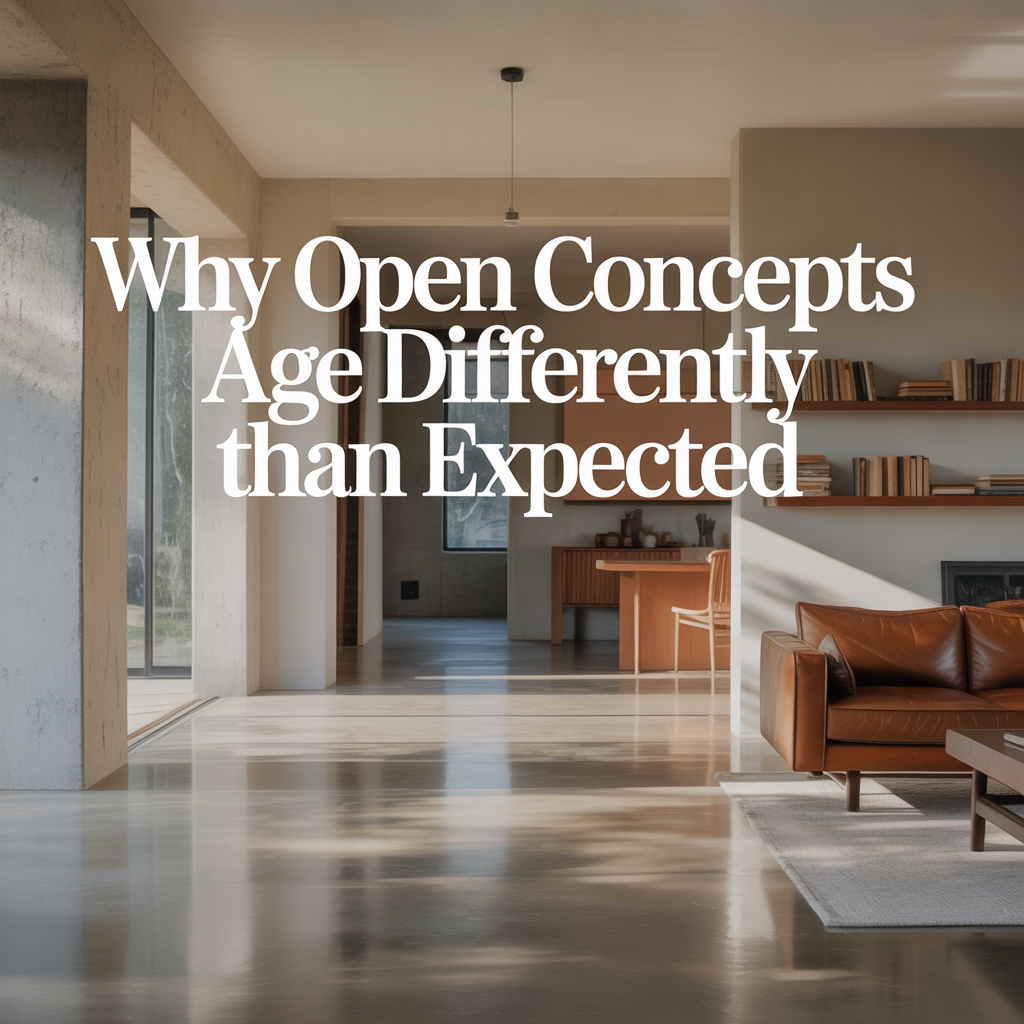
In Denver, open-concept living has been a driving force in home design for more than a decade, and for good reason: it fits the way many people socialize, cook, and entertain in this city. But what buyers and sellers often don’t anticipate is how differently open concepts age compared to the closed-off, room-by-room homes of past generations. Over time, what once felt spacious and modern can start to feel noisy, exposed, or strangely ill‑suited for the rhythms of real life, especially as families grow, work changes, and the desire for calm and privacy increases.
How Open Concepts Age for Families
When a family moves into a new open-concept home, it often feels like freedom — a large kitchen flows into the dining and living area, everyone can be together, and the home feels bigger and more connected. But as kids grow into teens, and schedules get busier, that openness starts to feel less like a party and more like a shared stage.
A teenager doing homework at the kitchen island while an adult is working from a nearby corner, a dog barking at the sliding door, or kids playing while someone is on an important work call can all feel exponentially louder and more interruptive in a wide-open space. There’s simply no place to “get away” from the main activity, which, over years, adds to mental fatigue and daily friction.
In neighborhoods like Stapleton (now Central Park), parts of Sunnyside, or newer builds in the south and west suburbs, this plays out in subtle but real ways. A layout that’s great for entertaining and family time at 25–35 years old can start to feel like it’s constantly demanding performance at 40–50, with less room for quiet, privacy, or separation between work and family life.
How the Value of Containers and Private Zones Grows Over Time
What changes most as an open-concept home ages is how much value people place on “containers” — distinct, well‑defined rooms or zones that can be closed off, even if they’re not full bedrooms.
A formal dining room, a den with doors, a tucked‑away home office, or a downstairs rec room that feels separate from the main kitchen‑living area becomes more valuable because it provides places where people can:
- Work from home without being in the main flow.
- Read, relax, or watch a show without the whole house hearing it.
- Keep holiday decor, toys, or hobbies contained, rather than spread across the main living area.
Homes that already had a mix of open and closed spaces tend to age better in Denver’s central neighborhoods, where many buyers want both the modern feel and a sense of retreat. A 1950s rambler, for example, often feels more flexible over time once some walls are opened judiciously, but not removed entirely, creating a kitchen that opens to the living area while still preserving a formal dining room or a den.
How Sound and Light Behave Differently Over the Years
Denver’s open-concept homes are prized for their light and views, and that’s a real strength. But over time, that same light and openness can contribute to stress if not balanced with some control.
A large, open kitchen‑living combo with big windows to the front or back yard can feel bright and inviting during the day, but at night, it can feel like a fishbowl, especially on busy blocks. The lack of separation also means that activities like cooking, cleaning, and TV time are all in the same sightline, which can make the home feel like it’s never “off,” even when everyone is just trying to decompress.
Over the years, small design choices make a bigger difference:
- A partial wall, a half‑wall, or a well‑placed island that defines zones without completely closing them off.
- Flooring transitions (hardwood to carpet, tile to wood) that help delineate different uses.
- Window treatments and lighting layered for task, mood, and privacy.
These details help an open home feel more like a series of purposeful spaces rather than one big, inescapable room, and they’re what many long‑term Denver residents value when they’re ready to move or renovate.
How Work-from-Home Life Changed the Equation
Before 2020, an open concept often meant a kitchen that visually connected to the living area, which was fine for a household where everyone left the house every day. After remote and hybrid work became common, that same openness started to feel like it lacked professional boundaries.
In a true open-plan home, there’s often no clear line between “work zone” and “family zone.” A desk in the corner of the kitchen‑living area may have worked for occasional emails, but it’s far less sustainable for daily video calls, focused work, and the need to “sign off” and switch gears at the end of the day.
Over time, buyers in Denver increasingly look for layouts that offer:
- A dedicated, closable space that can serve as a long‑term office.
- Rooms that can be converted later (guest bedroom, den, basement area) into a true work retreat.
- Floor plans where the main living area is open, but the private bedrooms and workspaces are tucked away, not on the main stage.
This is especially true in mixed‑generation homes or multigenerational setups, where the demand for separate but connected spaces is growing.
How Maintenance and Clutter Multiply in Open Spaces
A less obvious but very real way open concepts age is through clutter and maintenance. In a traditional floor plan, some mess can be hidden behind doors: kids’ toys, seasonal gear, mail, and work supplies can be tucked away in a formal dining room, den, or hallway closet.
In a wide-open plan, that same clutter is often on full display, and the home feels messy or chaotic even if it’s relatively clean. That constant visual exposure adds to stress, especially for people who are detail‑oriented or value a sense of order.
Over time, owners of open homes often invest more in organization (built‑ins, better storage, a large mudroom or garage conversion) not just for function, but to preserve that sense of calm. Homes that were designed with discreet storage and a clear separation between “lived‑in” and “public” areas tend to feel more livable as the decades pass.
How Denver Buyers Are Adjusting Their Expectations
In today’s market, many Denver buyers are still drawn to open layouts, but they’re also more thoughtful about how those spaces will feel in five, ten, or fifteen years.
They’re looking for:
- Open concepts that still include a few doors or partial walls to create zones, not one big sea of space.
- Homes with a balance of open and closed — a great kitchen‑living area plus a den, office, or flex space that can be closed off.
- Floor plans that support a mix of uses: entertaining, remote work, kids growing up, and, for some, aging parents or multigenerational living.
For sellers, this means that the best way to show an open concept isn’t just to push “openness,” but to demonstrate how the home can be used thoughtfully over time: a home office in the corner, a reading nook, a separate play area, or a quiet space that feels a bit removed from the main action.
A Practical Takeaway
When evaluating a home in Denver, it’s worth asking, not just “Do I like this open layout today?” but “How will this feel in ten years, when the kids are teens, when work is hybrid, and when I crave more calm and privacy?”
A floor plan that’s entirely open can age like a party that never ends — exciting at first, but tiring over time. A layout that’s open where it matters, but still offers some retreats, tends to age more like a home that can adapt to the long arc of life, not just the current chapter.
If it would be helpful, I’d be glad to talk through how specific floor plans in your neighborhood age in real life, and how small changes — in layout, furniture, or staging — can make the home feel more balanced and livable for the long term.
Get the full Denver Market Insights → [Market Insights]



Aurora Southlands Living For Aerospace And Defense Families
This is part of Lockheed Martin Relocation → [Lockheed Martin Relocation Hub] & the larger Denver Relocation Hub → [Denver Relocation Hub] Written by: Chad Cabalka Relocating to Denver for Lockheed Martin changes the home search fast, because Waterton Canyon is not the kind of campus you casually “figure out later.” The southwest metro drives the whole…


Best Neighborhoods For Buckley Space Force Base Commuters
This is part of Lockheed Martin Relocation → [Lockheed Martin Relocation Hub] & the larger Denver Relocation Hub → [Denver Relocation Hub] Written by: Chad Cabalka If Buckley Space Force Base is the anchor of your move, the best neighborhoods are usually in east and southeast Aurora, with the strongest practical options around Southlands, Murphy Creek, East…

C-470 Commuting Strategy For South Denver Aerospace Workers
This is part of Lockheed Martin Relocation → [Lockheed Martin Relocation Hub] & the larger Denver Relocation Hub → [Denver Relocation Hub] Written by: Chad Cabalka If you work at Waterton, split time between Waterton and the DTC, or live anywhere in the south metro with a Lockheed Martin paycheck attached to it, C-470 is the corridor…